


Contains Butter • Egg • Milk • Contains Gluten
2 loaves (16–20 slices)
Intermediate–Advanced
45 minutes
5–6 hours (or overnight)
HaMotzi or Mezonot*
*See Brachot section below — depends on quantity eaten and meal context.
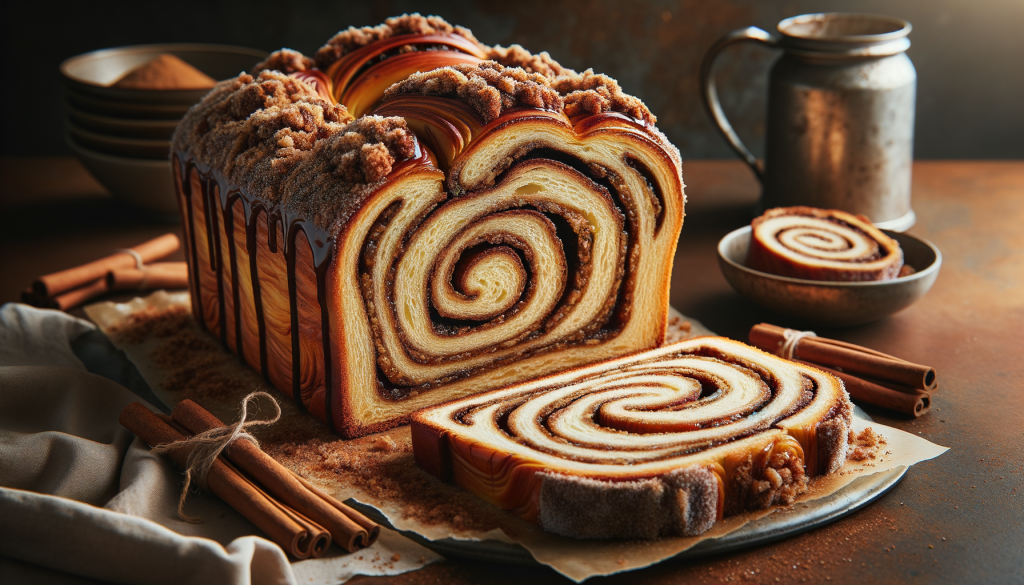
Cinnamon babka is the other babka — and for many, it is the better babka. While chocolate babka commands the spotlight in bakery windows from Brooklyn to Bnei Brak, the cinnamon version is the quieter triumph: a bread that trades drama for depth, where ribbons of cinnamon-brown sugar wind through a butter-rich dough so tender it tears like silk. Every slice reveals a new landscape of swirled layers, each one glistening with caramelized sugar and warm spice.
The great cinnamon-versus-chocolate debate has raged in Jewish bakeries for decades. Jerry Seinfeld famously declared cinnamon a lesser babka, but legions of bakers and grandmothers disagree. Chocolate impresses on first bite; cinnamon rewards on the fifth, the tenth, the last crumb scraped from the pan. Its sweetness is more subtle, more layered — brown sugar that darkens and deepens in the oven, cinnamon that blooms with heat, butter that caramelizes at the edges. This is a babka that tastes like the memory of every great kitchen you have ever walked into.
What elevates this recipe from good to extraordinary are three finishing touches: a crunchy streusel topping that shatters against the soft crumb, a simple syrup soak brushed on while the loaves are still hot (sealing in moisture and adding a delicate sheen), and an overnight cold rise that develops flavor no short-cut method can replicate. The result is a babka that stays moist for days — not that it will last that long.
If you have baked our Chocolate Babka, you already know this dough. The two share the same rich, brioche-like foundation — it is the filling that transforms each into something entirely different. Master one, and the other is yours.
What Makes This Cinnamon Babka Special
This is not a dry cinnamon loaf with a stripe of spice running through it. Every element is engineered for maximum flavor and texture:
- Rich brioche-like dough — butter, eggs, and milk create a tender, pillowy crumb with the structure to support heavy swirls of filling without collapsing. The dough is enriched enough to taste indulgent, but not so much that it feels like cake.
- Cinnamon-brown sugar swirl — a thick, paste-like filling of dark brown sugar, ground cinnamon, and softened butter spread edge-to-edge ensures cinnamon in every single bite. No dry pockets, no bare spots.
- Streusel topping — a butter-flour-sugar crumble baked on top adds a crispy, sandy contrast to the soft interior. It is the textural element most bakery babkas skip, and the one you will never want to go without.
- Simple syrup soak — brushed over the babka the moment it leaves the oven, the syrup seeps into every crevice of the swirl, keeping the bread impossibly moist and adding a subtle glossy finish.
- Overnight cold fermentation — an optional but recommended refrigerator rise develops complex flavor and makes the dough dramatically easier to roll and shape.
Babka in Eastern European Jewish Tradition
Babka was born in the Jewish communities of Eastern Europe — Poland, Ukraine, Belarus — where resourceful home bakers took leftover challah dough and enriched it further with butter and sugar, filled it with whatever was precious and available, and baked it in tall, fluted pans. The name babka comes from baba or bubbe — grandmother — and indeed this was grandmotherly baking at its finest: transforming humble ingredients into something that felt like a celebration.
Before chocolate became widely available in Eastern Europe, cinnamon was the classic filling. Ground cinnamon, a precious spice traded along routes from Ceylon and Sumatra, was the luxury of the Shabbat table — mixed with sugar and sometimes nuts or raisins, then layered into the twisted dough. Chocolate babka rose to prominence later, particularly among Ashkenazi communities in America, but cinnamon babka remained the original and, for purists, the definitive version.
Today babka has experienced a remarkable renaissance. From Breads Bakery on 16th Street in Manhattan to Lehamim Bakery in Tel Aviv, artisan bakers have elevated what was once a simple home bread into one of the most celebrated pastries in the Jewish baking canon. Our recipe draws on this tradition while adding the professional touches — streusel, syrup soak, precise temperatures — that separate an extraordinary babka from a merely good one.
For the chocolate version of this classic, see our Chocolate Babka Recipe — same dough, different filling, equally magnificent.
Kosher Observance & Halachic Notes
Kosher Classification: Dairy
This recipe contains butter in the dough, the filling, and the streusel, as well as milk in the dough. It is fully dairy (chalavi) and may not be served at a meat meal or within the waiting period after eating meat. Clearly label as dairy if serving on a buffet or gifting.
Hafrashat Challah (Separating Challah)
This recipe uses approximately 600 g of flour across both loaves combined. According to most Ashkenazi poskim, this amount requires separating challah with a bracha. Sephardi practice may differ — consult your community’s minhag.
How to perform Hafrashat Challah:
- After the dough is fully mixed, pinch off a small piece — at least a kezayit (roughly 28 g / 1 oz).
- Recite the bracha:
Hebrew:
בָּרוּךְ אַתָּה ה’ אֱלֹהֵינוּ מֶלֶךְ הָעוֹלָם אֲשֶׁר קִדְּשָׁנוּ בְּמִצְוֹתָיו וְצִוָּנוּ לְהַפְרִישׁ חַלָּהTransliteration:
Baruch Atah Adonai, Eloheinu Melech ha’olam, asher kid’shanu b’mitzvotav v’tzivanu l’hafrish challah.Translation:
“Blessed are You, Lord our God, King of the universe, Who has sanctified us with His commandments and commanded us to separate challah.”
- Say: “Harei zu challah” (“This is challah”).
- Wrap the separated piece in foil and burn it. It may not be eaten.
Checking Eggs for Blood Spots
Each egg should be cracked individually into a clear glass or small bowl and inspected before adding to the dough. If a blood spot is found, the egg must be discarded entirely.
Pas Yisroel
When a Jewish person turns on the oven or contributes to the baking in any way, the babka fulfills Pas Yisroel requirements. This is particularly relevant during the Aseret Yemei Teshuvah (Ten Days of Repentance between Rosh Hashanah and Yom Kippur).
Brachot (Blessings)
- If eaten as part of a bread meal (washing hands, eating a meal’s worth): HaMotzi Lechem Min Ha’Aretz before, Birkat HaMazon after.
- If eaten as a snack or dessert (a slice or two without a meal): Borei Minei Mezonot before, Al HaMichya after.
Because babka dough is heavily enriched with sugar, butter, and eggs, many poskim classify it as pas haba’ah b’kisnin (bread-like cake). If you eat enough to constitute a meal (typically the volume of 3–4 eggs of bread), you wash and make HaMotzi. For a casual slice, Mezonot applies. When in doubt, consult your rabbi.
Ingredients
Enriched Dough
| Ingredient | Grams | Volume | Baker’s % |
|---|---|---|---|
| All-purpose flour (unbleached) | 600 g | 4¾ cups | 100% |
| Granulated sugar | 100 g | ½ cup | 16.7% |
| Fine sea salt | 8 g | 1½ tsp | 1.3% |
| Instant (rapid-rise) yeast | 9 g | 2¼ tsp | 1.5% |
| Large eggs, room temperature (check for blood spots) | 150 g | 3 large eggs | 25% |
| Whole milk, warm (see DDT note below) | 120 g | ½ cup | 20% |
| Unsalted butter, softened and cubed | 115 g | ½ cup (1 stick) | 19.2% |
| Pure vanilla extract | 8 g | 2 tsp | 1.3% |
| Total Dough Weight | ~1,110 g | — | — |
Cinnamon-Brown Sugar Filling
| Ingredient | Grams | Volume |
|---|---|---|
| Dark brown sugar, packed | 200 g | 1 cup |
| Ground cinnamon (high quality, such as Vietnamese or Ceylon) | 15 g | 2 Tbsp |
| Unsalted butter, melted | 60 g | 4 Tbsp (¼ cup) |
| All-purpose flour | 15 g | 2 Tbsp |
| Pinch of fine sea salt | 1 g | ¼ tsp |
Mix the filling ingredients into a thick, spreadable paste. The flour helps the filling stay put during rolling and prevents it from leaking out during baking.
Streusel Topping
| Ingredient | Grams | Volume |
|---|---|---|
| All-purpose flour | 65 g | ½ cup |
| Dark brown sugar | 50 g | ¼ cup |
| Ground cinnamon | 3 g | 1 tsp |
| Unsalted butter, cold, cubed | 40 g | 3 Tbsp |
| Pinch of fine sea salt | 1 g | ¼ tsp |
Rub the cold butter into the dry ingredients with your fingertips until the mixture resembles coarse, sandy crumbs. Refrigerate until ready to use.
Simple Syrup
| Ingredient | Grams | Volume |
|---|---|---|
| Granulated sugar | 100 g | ½ cup |
| Water | 100 g | ½ cup |
Combine sugar and water in a small saucepan. Bring to a boil, stir until dissolved, then remove from heat and let cool slightly. The syrup should be warm — not boiling — when you brush it on.
Equipment
- Two 9 × 5 inch (23 × 13 cm) loaf pans
- Stand mixer with dough hook (or large bowl for hand kneading)
- Kitchen scale
- Rolling pin
- Offset spatula (for spreading filling)
- Parchment paper
- Pastry brush (for syrup)
- Clear glass or small bowl for egg checking
- Instant-read thermometer (optional, for checking internal temperature)
Desired Dough Temperature (DDT)
Target DDT: 24°C (75°F)
A slightly cool DDT keeps the butter from melting out of the enriched dough. To calculate your milk temperature:
Milk Temp = (DDT × 3) − Flour Temp − Room Temp
Example: If your kitchen is 22°C and your flour is 21°C:
Milk = (24 × 3) − 22 − 21 = 29°C (84°F)
The milk should feel barely warm. If it is too hot, the butter will melt prematurely and the dough will become greasy and slack. Never exceed 38°C (100°F).
Step-by-Step Instructions
Step 1: Make the Enriched Dough
Crack each egg individually into a clear glass and inspect for blood spots. If clear, add all 3 eggs to the bowl of a stand mixer along with the warm milk, sugar, and vanilla extract. Whisk briefly to combine.
Add the flour, salt, and instant yeast (keep salt and yeast on opposite sides). Mix on low speed (speed 1–2) for 2–3 minutes until a shaggy dough forms and no dry flour remains.
Increase to medium speed (speed 3–4) and knead for 5 minutes until the dough begins to come together and pull away from the sides.
With the mixer running on medium, add the softened butter one or two cubes at a time, waiting until each addition is mostly incorporated before adding the next. This will take 3–4 minutes. The dough will look shaggy and broken at first — this is normal.
Once all butter is added, increase to medium-high speed (speed 5–6) and knead for 6–8 minutes until the dough is:
- Smooth, glossy, and elastic — it should pull cleanly from the bowl sides and slap against the bottom.
- Soft and slightly tacky — but not sticky or wet. It should not cling to dry fingers.
- Passes a windowpane test — stretch a small piece thin enough to see light through it without tearing.
Hand kneading: This enriched dough is challenging by hand. Knead on a lightly floured surface for 15–18 minutes using the slap-and-fold technique. The dough will be very sticky at first but will smooth out as the gluten develops.
Step 2: First Rise (or Overnight Cold Rise)
Lightly oil a large bowl. Place the dough inside, turn to coat, and cover tightly with plastic wrap.
Option A — Same-day rise (faster): Let rise at room temperature for 1.5 to 2 hours until doubled in volume. Then refrigerate for at least 1 hour (up to 2 hours) to firm up the butter before rolling.
Option B — Overnight cold rise (recommended): Place the covered bowl directly in the refrigerator for 8–12 hours (overnight). The cold fermentation develops deeper, more complex flavor and produces a firm dough that is far easier to roll out and fill. Remove from the fridge 15–20 minutes before shaping to take the chill off slightly.
Step 3: Prepare the Filling, Streusel, and Pans
While the dough rises (or in the morning if using overnight method):
Filling: In a medium bowl, combine the dark brown sugar, cinnamon, melted butter, flour, and salt. Mix until a thick, spreadable paste forms. It should have the consistency of wet sand. Set aside.
Streusel: In a small bowl, whisk together the flour, brown sugar, cinnamon, and salt. Add the cold cubed butter and rub with your fingertips until coarse, sandy crumbs form. Some pea-sized pieces of butter are desirable. Refrigerate until needed.
Pans: Grease two 9 × 5 inch loaf pans generously with butter. Line the bottom and two long sides with a strip of parchment paper, leaving a 2-inch overhang on each side (these are your handles for lifting the babka out later).
Step 4: Roll Out and Spread the Filling
Divide the dough into 2 equal pieces (~555 g each). Work with one half at a time, keeping the other covered in the refrigerator.
On a lightly floured surface, roll one piece of dough into a large rectangle, approximately 40 × 30 cm (16 × 12 inches). The dough should be about 5 mm (¼ inch) thick. If it springs back, let it rest for 5 minutes and try again.
Using an offset spatula, spread half of the cinnamon filling evenly over the entire surface, right to the edges. Be thorough — every square centimeter should be covered. The filling should form a thin, even layer.
Step 5: Roll, Twist, and Shape
- Roll up tightly from the long edge (the 40 cm / 16-inch side), creating a tight log. Pinch the seam to seal.
- Using a sharp knife or bench scraper, slice the log in half lengthwise, from end to end, exposing all the layers of filling inside. You now have two long strands with the layers visible.
- With the cut sides facing up (so the layers are exposed), cross the two strands over each other to form an X in the middle.
- Twist the strands around each other 2–3 times, keeping the cut sides facing up as much as possible. This is what creates the dramatic swirl pattern in every slice.
- Carefully lift the twisted loaf and place it into the prepared pan, tucking the ends underneath if necessary.
Don’t worry about perfection. Babka is forgiving — even a messy twist will look beautiful once baked. The key is keeping the cut (layered) sides facing up so the swirls are visible.
Repeat with the second piece of dough and remaining filling.
Step 6: Second Rise (Proofing)
Cover both pans loosely with plastic wrap or a damp towel. Let rise in a warm place for 1 to 1.5 hours until the dough has risen noticeably and crests about 1 cm (½ inch) above the rim of the pans. The dough should look puffy and jiggle slightly when the pan is tapped.
Do not over-proof. Babka that rises too much will collapse in the oven and lose its defined swirl layers. The dough should be clearly risen but still have spring left in it.
During the last 20 minutes of proofing, preheat your oven to 175°C (350°F) with a rack in the lower third.
Step 7: Top with Streusel and Bake
Remove the plastic wrap. Distribute the streusel topping evenly over both loaves, pressing it gently so it adheres to the surface.
Place the pans in the oven on the lower-third rack. Bake for 35–40 minutes until:
- The streusel topping is deep golden brown and crisp.
- The exposed dough swirls are richly browned.
- An instant-read thermometer inserted into the center reads 88–92°C (190–198°F).
If the top browns too quickly (common after 20–25 minutes), tent loosely with aluminum foil for the remaining baking time. Do not reduce the oven temperature — the interior needs the full heat to bake through.
Step 8: Brush with Simple Syrup
While the babka bakes, prepare the simple syrup: combine 100 g sugar and 100 g water in a small saucepan. Bring to a boil, stir until dissolved, then remove from heat.
The moment the babkas come out of the oven, brush the warm syrup generously over the tops and into every visible crevice. Use all of the syrup, divided between both loaves. It may seem like a lot — trust the process. The hot bread will absorb it immediately, and this is what keeps the babka moist for days.
Let the babkas cool in their pans for 20 minutes, then use the parchment overhangs to lift them out onto a wire rack. Cool for at least 30 minutes more before slicing. (Patience is difficult here — the aroma is extraordinary — but slicing too early will compress the swirl layers.)
Storage & Make-Ahead
- Room temperature: Wrap tightly in plastic wrap or foil. Cinnamon babka stays moist and delicious for 3–4 days at room temperature thanks to the simple syrup soak and enriched dough.
- Reheating: Wrap individual slices in foil and warm in a 150°C (300°F) oven for 8–10 minutes, or toast slices lightly for a crispy exterior. Avoid the microwave — it makes the crumb gummy.
- Freezing: Wrap cooled babka tightly in plastic wrap, then foil, then place in a freezer bag. Freeze for up to 3 months. Thaw overnight at room temperature (still wrapped), then refresh in a warm oven for 10 minutes.
- Make-ahead: The overnight cold rise method (Step 2, Option B) is the best make-ahead strategy. Shape the babkas in the evening, cover the pans with plastic wrap, refrigerate overnight, then pull from the fridge in the morning, let proof for 1.5–2 hours, and bake fresh.
Troubleshooting Guide
| Problem | Likely Cause | Solution |
|---|---|---|
| Filling leaks out during baking | Filling spread too thick; dough not sealed properly; too much butter in filling | Spread filling in a thin, even layer. Pinch the seam tightly after rolling. The flour in the filling helps — do not skip it. |
| Babka is dry despite syrup soak | Over-baked; syrup applied too late (bread cooled); not enough syrup used | Check internal temp — pull at 90°C (194°F). Apply syrup immediately while bread is still hot. Use all the syrup. |
| Swirl layers are indistinct | Filling too thin; dough rolled too thick; not enough twist | Roll dough to 5 mm thickness. Spread filling generously. After slicing the log lengthwise, twist with cut sides up for maximum visual impact. |
| Dough too sticky to roll | Dough too warm; insufficient chilling; butter melting | Refrigerate dough for at least 1 hour (overnight is best). Lightly flour the surface. If dough warms during shaping, return to fridge for 15 minutes. |
| Top burns before interior is cooked | Oven too hot; rack too high; streusel browning fast | Bake on lower-third rack. Tent with foil after 20–25 minutes if browning too quickly. Verify oven temp with a thermometer. |
| Babka collapses or sinks in the middle | Over-proofed; oven temperature too low | Proof until just cresting the pan rim — do not let it rise much beyond. Ensure oven is fully preheated to 175°C (350°F). |
Frequently Asked Questions
What is the difference between cinnamon babka and chocolate babka?
Both start with the same rich, brioche-like dough. The difference is entirely in the filling: chocolate babka uses a bittersweet chocolate-cocoa filling (and sometimes a chocolate glaze), while cinnamon babka uses a cinnamon-brown sugar butter paste. Cinnamon babka tends to be slightly sweeter and more caramelized, with a warmer spice note. Chocolate babka is richer and more intense. Many bakers (ourselves included) consider them equals — make both and decide for yourself. See our Chocolate Babka Recipe for the other half of the debate.
Can I make cinnamon babka pareve?
Yes, but it requires substitutions. Replace the butter in the dough, filling, and streusel with high-quality margarine (stick, not tub). Replace the milk with non-dairy milk (oat or soy work well). The result will be very good, though dairy babka has a richness and tenderness that margarine cannot fully replicate. If you need a pareve version, we recommend increasing the margarine in the dough by 10–15 g to compensate for the lower fat content of non-dairy milk.
Why do I need to soak the babka in simple syrup?
The simple syrup serves two essential purposes. First, it seals in moisture — the hot bread absorbs the syrup into every crevice and layer, preventing the crumb from drying out over the next several days. Second, it adds a subtle gloss and sweetness that elevates the finished presentation. Without it, babka dries out within a day. With it, the bread stays soft and moist for 3–4 days. Do not skip this step — it is the secret to bakery-quality babka at home.
Can I bake cinnamon babka as a round (in a tube or bundt pan)?
Absolutely. The traditional Eastern European babka was often baked in a tall, fluted tube pan (which is where the “grandmother’s skirt” shape comes from). Use a well-greased 10-inch tube or bundt pan, combine all the dough (no need to divide), and twist it into the pan in a ring. Increase baking time to 40–50 minutes and tent with foil after 25 minutes. The internal temperature should still reach 88–92°C (190–198°F).
How far in advance can I make babka for Shabbat or Yom Tov?
Babka is an excellent make-ahead bake. For Shabbat, bake on Thursday and store tightly wrapped at room temperature — it will be perfect on Friday night and Shabbat morning. For longer planning, bake up to a month in advance and freeze. Thaw overnight and refresh in a warm oven before serving. You can also prepare the dough on Wednesday evening (overnight rise in the fridge), shape on Thursday morning, and bake Thursday afternoon for the freshest possible Shabbat babka.
The Other Babka Deserves Its Moment
Swirled with cinnamon, soaked in syrup, crowned with streusel. This is the babka that ends the chocolate-vs-cinnamon debate — by proving there is room for both.
Save This Recipe
Try Our Chocolate Babka Too →
Have questions? Tag us @kosherbreadpro on Instagram or leave a comment below. We answer every one.