


Dairy-Free • Egg • Contains Gluten
2 round challahs
Beginner–Intermediate
30 minutes
3½–4 hours
HaMotzi
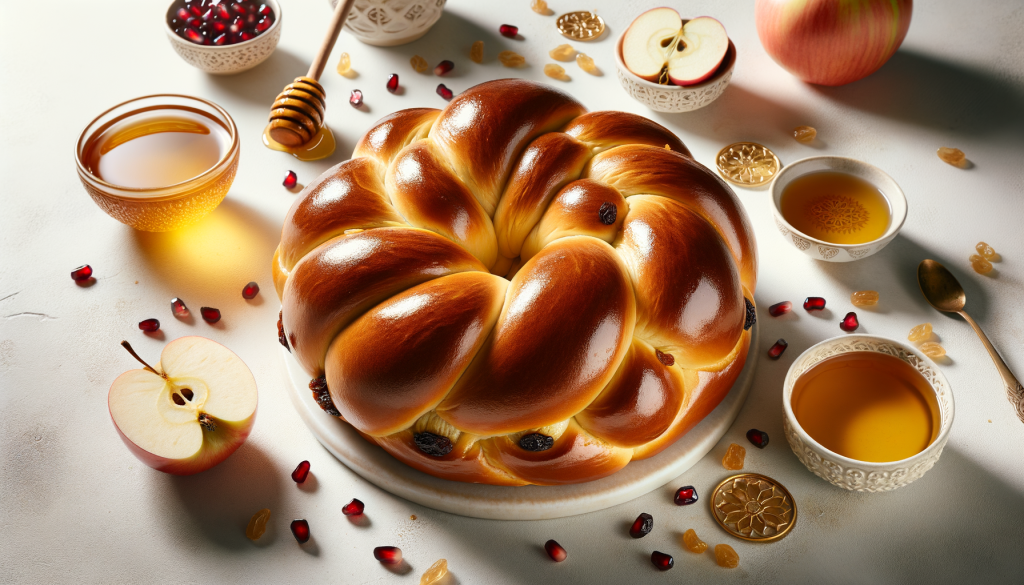
Round honey challah is THE bread of Rosh Hashanah. If there is one loaf that defines the Jewish New Year, this is it — golden, glistening with honey glaze, shaped into a tight spiral that speaks of cycles, continuity, and hope. From the first night of Rosh Hashanah through the final meal of Sukkot, this round, honey-sweetened challah replaces the traditional braided loaf on every observant Jewish table.
The symbolism is woven into every element. The round shape represents the cycle of the year — no beginning, no end, the eternal turning of seasons and festivals. Honey replaces sugar in the dough, because we ask God for a shanah tovah u’metukah — a good and sweet new year. And the spiral, rising upward from the center, is said to evoke a crown, a reminder of God’s sovereignty on the Day of Judgment.
If you have baked our Classic Kosher Challah, you already have the foundation. Honey challah uses the same core technique but swaps most of the sugar for rich, floral honey and reshapes the dough from a braid into a beautiful round coil. It is a small shift in method that carries enormous meaning.
On Rosh Hashanah night, the round challah is dipped in honey before eating — doubling the sweetness. Some families place a bowl of honey at the center of the table and let each person tear a piece and dip it themselves, making the wish for a sweet new year a communal, tactile act.
What Makes This Honey Challah Special
This is not simply a regular challah bent into a circle. Every choice in the recipe is deliberate:
- Honey replaces most of the sugar — real honey contributes moisture, a deeper golden color, a subtle floral complexity, and a softer crumb that stays fresh longer than sugar-only doughs. We use a generous amount for unmistakable honey flavor.
- Round spiral shape with authentic technique — we teach the traditional single-rope coil method, producing a tight, even spiral that rises beautifully and slices cleanly. No braiding required.
- Optional raisins — many families add raisins to their Rosh Hashanah challah for extra sweetness. We include them as an option, with guidance on how to incorporate them without disrupting the dough structure.
- Golden honey glaze — a warm honey wash applied immediately after baking gives the challah a gorgeous, lacquered sheen and a hint of sticky sweetness on the crust.
- Full baker’s percentages — every ingredient is scaled to flour weight so you can confidently adjust the batch size for your table.
The Round Challah: Rosh Hashanah Bread Traditions
The custom of baking round challah for Rosh Hashanah is observed across virtually all Jewish communities — Ashkenazi, Sephardi, Mizrachi, and Yemenite — though the specific shape and enrichments vary. The practice dates back centuries and is rooted in deep symbolism.
The round shape carries multiple layers of meaning. Most commonly, it represents the cycle of the year — as one year ends and another begins, the circle reminds us of the continuous, unbroken flow of time. The Kabbalistic tradition sees the spiral as a crown (keter), symbolizing God’s sovereignty, which we affirm on Rosh Hashanah when we declare God as King. Some commentators also note that the round shape, with no visible beginning or end, reflects our prayer that the coming year will be complete and whole.
Honey is central to Rosh Hashanah as one of the simanim — the symbolic foods eaten on the first night. The most well-known siman is apple dipped in honey, accompanied by the prayer: “Yehi ratzon… she’techadesh aleinu shanah tovah u’metukah” — “May it be Your will to renew for us a good and sweet year.” By sweetening the challah itself with honey, we extend that symbolism to the bread, the centerpiece of every Jewish meal.
The round, honey-sweetened challah is served from Rosh Hashanah through Hoshana Rabbah (the seventh day of Sukkot) — the entire period of the High Holidays and the festival season. After Sukkot, we return to the standard braided challah shape for the rest of the year. Some families also bake round challah for the meal before Yom Kippur (seudah hamafseket), sending the faster into the fast with sweetness and sustenance.
Kosher Observance & Halachic Notes
Kosher Classification: Pareve
This honey challah is fully pareve, made with vegetable oil rather than butter. It can be served alongside meat or dairy meals — making it appropriate for any Rosh Hashanah table, whether the main course is brisket, chicken, or a dairy meal.
Hafrashat Challah (Separating Challah)
This recipe calls for 600 g of bread flour, which produces two round challahs. According to most Ashkenazi poskim, this amount requires separating challah with a bracha. Sephardi practice may differ — consult your community’s minhag.
How to perform Hafrashat Challah:
- After the dough is fully mixed, pinch off a small piece — at least a kezayit (roughly 28 g / 1 oz).
- Recite the bracha:
Hebrew:
בָּרוּךְ אַתָּה ה’ אֱלֹהֵינוּ מֶלֶךְ הָעוֹלָם אֲשֶׁר קִדְּשָׁנוּ בְּמִצְוֹתָיו וְצִוָּנוּ לְהַפְרִישׁ חַלָּהTransliteration:
Baruch Atah Adonai, Eloheinu Melech ha’olam, asher kid’shanu b’mitzvotav v’tzivanu l’hafrish challah.Translation:
“Blessed are You, Lord our God, King of the universe, Who has sanctified us with His commandments and commanded us to separate challah.”
- Say: “Harei zu challah” (“This is challah”).
- Wrap the separated piece in foil and burn it. It may not be eaten.
Checking Eggs for Blood Spots
Each egg should be cracked individually into a clear glass or small bowl and inspected before adding to the dough. If a blood spot is found, the egg must be discarded entirely.
Pas Yisroel
When a Jewish person lights the oven or contributes to the baking in any way, the challah fulfills Pas Yisroel requirements. This is especially important during the Aseret Yemei Teshuvah (the Ten Days of Repentance between Rosh Hashanah and Yom Kippur), when many communities that are lenient about Pas Yisroel year-round are strict about it.
Simanim (Symbolic Foods) on Rosh Hashanah
The round honey challah itself serves as a siman for a sweet year. On the first night of Rosh Hashanah, it is customary to dip the challah in honey instead of the usual salt. Some continue dipping in honey through Sukkot. The challah is eaten after the traditional simanim (apple in honey, pomegranate, dates, etc.) and the associated yehi ratzon prayers.
Shehecheyanu on Rosh Hashanah
On the first night of Rosh Hashanah, the Shehecheyanu blessing is recited during Kiddush. On the second night, it is customary to place a new fruit (one not yet eaten this season) on the table to serve as the basis for the Shehecheyanu. The round challah, while central to the meal, does not require its own Shehecheyanu.
Brachot (Blessings)
- Before eating: HaMotzi Lechem Min Ha’Aretz — wash hands with the bracha for netilat yadayim, then recite HaMotzi. On Rosh Hashanah, dip the challah in honey.
- After eating: Birkat HaMazon (Grace After Meals), with the Rosh Hashanah insertions (Ya’aleh v’Yavo).
Ingredients
Dough
| Ingredient | Grams | Volume | Baker’s % |
|---|---|---|---|
| Bread flour | 600 g | 4¾ cups | 100% |
| Honey (preferably raw, mild-flavored) | 115 g | ⅓ cup | 19.2% |
| Granulated sugar | 25 g | 2 Tbsp | 4.2% |
| Instant (rapid-rise) yeast | 9 g | 2¼ tsp | 1.5% |
| Fine sea salt | 10 g | 1¾ tsp | 1.7% |
| Large eggs, room temperature (check for blood spots) | 150 g | 3 large eggs | 25% |
| Vegetable or canola oil | 80 g | ⅓ cup + 1 Tbsp | 13.3% |
| Warm water (see DDT note below) | 180 g | ¾ cup | 30% |
| Total Dough Weight | ~1,169 g | — | — |
Optional Raisins
| Ingredient | Amount | Notes |
|---|---|---|
| Golden or dark raisins | 120 g (¾ cup) | Soak in hot water for 10 minutes, drain and pat dry before adding |
Egg Wash
- 1 large egg + 1 Tbsp water, beaten (check egg for blood spots)
Honey Glaze
- 2 Tbsp honey + 1 Tbsp warm water, stirred until smooth
Desired Dough Temperature (DDT)
Target DDT: 26°C (78°F)
An enriched dough like challah benefits from a warm, active fermentation. To calculate your water temperature:
Water Temp = (DDT × 3) − Flour Temp − Room Temp
Example: If your kitchen is 22°C and your flour is 21°C:
Water = (26 × 3) − 22 − 21 = 35°C (95°F)
The water should feel comfortably warm — like bath water. Never exceed 43°C (110°F), which can kill yeast.
Step-by-Step Instructions
Step 1: Mix the Dough
Crack each egg individually into a clear glass and inspect for blood spots. If clear, add to the bowl of a stand mixer.
Add the warm water, honey, sugar, and oil to the eggs. Whisk briefly to combine.
Add the bread flour, salt, and instant yeast (keep salt and yeast on opposite sides of the bowl). Mix on low speed (speed 1–2) for 2–3 minutes until a shaggy, cohesive dough forms and no dry flour remains.
Increase to medium speed (speed 3–4) and knead for 8–10 minutes until the dough is:
- Smooth and elastic — it should pull away from the bowl sides cleanly.
- Soft and slightly tacky — but not sticky. It should not cling to dry fingers when poked.
- Passes a windowpane test — stretch a small piece gently; it should thin out without tearing immediately.
If adding raisins: Add the drained, dried raisins during the last 1–2 minutes of kneading on low speed. Mix just until evenly distributed. Do not over-knead after adding raisins or they will tear and bleed into the dough.
Hand kneading: Combine wet and dry ingredients in a large bowl, turn onto a lightly oiled surface, and knead 12–15 minutes. Enriched doughs take longer by hand — be patient. The dough should feel supple, smooth, and alive.
Step 2: First Rise
Lightly oil a large bowl. Place the dough inside, turn to coat, and cover tightly with plastic wrap or a damp towel.
Let rise at room temperature for 1.5 to 2 hours until doubled in volume. Honey-enriched doughs can be slightly slower to rise than sugar-only doughs — be patient and judge by size, not by time alone.
Step 3: Shape the Round Challahs
Line two baking sheets with parchment paper.
Turn the risen dough out onto a lightly oiled work surface. Gently deflate. Using a bench scraper and scale, divide the dough into 2 equal pieces (~585 g each).
The Round Spiral Shaping Technique:
Working with one piece at a time (keep the other covered):
- Roll into a long rope. Using both hands, roll the dough piece on the work surface into a rope approximately 60–70 cm (24–28 inches) long. Keep the rope slightly thicker at one end and gently tapered at the other. If the dough resists and springs back, let it rest under a towel for 5 minutes, then continue rolling.
- Begin the coil. Take the thicker end and curl it inward on itself to form a small, tight knot or rosette in the center — this is the heart of the spiral.
- Wind the rope around the center. Working outward, wrap the remaining rope around the center knot in a snug spiral, keeping the coil flat on the work surface. Each layer should sit snugly against the previous one.
- Tuck the tail. When you reach the thin tapered end, tuck it firmly underneath the coil so it does not unravel during proofing or baking.
- Gently flatten. With your palm, press the coil down very slightly to even its height. It should be about 8–10 cm (3–4 inches) in diameter at this stage — it will expand significantly.
Place each shaped round challah on a prepared baking sheet, leaving plenty of room for expansion. Cover loosely with plastic wrap or a damp towel.
Step 4: Second Rise (Proof)
Let the shaped challahs proof at room temperature for 45 minutes to 1 hour until they are puffy and have grown by about 50%. The dough should spring back slowly when pressed gently with a fingertip — if it springs back quickly, it needs more time; if the indent stays, it is slightly over-proofed.
During the last 20 minutes of proofing, preheat your oven to 180°C (350°F) with a rack in the center position.
Step 5: Egg Wash
Beat the egg wash (1 egg + 1 Tbsp water) and brush it gently and evenly over the entire surface of each challah. Be thorough — get into the crevices of the spiral — but use a light hand to avoid deflating the dough.
Optional: For an extra-deep golden color, apply a second coat of egg wash after 5 minutes.
Step 6: Bake
Place the challahs in the preheated oven. Bake for 28–35 minutes until:
- The crust is a deep golden brown — honey challah browns faster than sugar challah, so watch carefully in the last 10 minutes.
- The internal temperature reaches 88–93°C (190–200°F) on an instant-read thermometer inserted into the center.
- The bottom sounds hollow when tapped.
If the tops are browning too quickly: Tent loosely with aluminum foil after the first 20 minutes and continue baking.
Step 7: Honey Glaze
As soon as the challahs come out of the oven, stir together 2 Tbsp honey and 1 Tbsp warm water until smooth. Immediately brush this honey glaze generously over the hot challahs. The heat of the bread will set the glaze into a beautiful, slightly tacky, golden sheen.
Transfer to a wire rack and let cool for at least 30 minutes before slicing or tearing. The interior continues to set as it cools — cutting too early will result in a gummy crumb.
Storage & Make-Ahead Tips
- Room temperature: Wrap tightly in plastic wrap or store in a large zip-top bag. Honey challah stays soft and fresh for 2–3 days at room temperature — the honey acts as a natural humectant, retaining moisture longer than sugar-only challah.
- Freezing: Wrap cooled challah tightly in plastic wrap, then in aluminum foil. Freeze for up to 3 months. Thaw at room temperature for 2–3 hours (still wrapped to prevent condensation on the crust).
- Reheating: Wrap in foil and warm in a 165°C (325°F) oven for 10–15 minutes. For a crisp crust, unwrap for the final 3 minutes.
- Make ahead for Rosh Hashanah: Bake 1–2 days before Yom Tov and freeze immediately. Thaw the morning of erev Rosh Hashanah for a fresh-tasting challah at the holiday table.
Troubleshooting Guide
| Problem | Likely Cause | Solution |
|---|---|---|
| Spiral unravels during baking | Tail not tucked securely; coil wound too loosely; over-proofed | Tuck the tail firmly underneath. Wind the spiral snugly (but not so tight that it tears). Reduce proof time slightly. |
| Challah is too dark or burns on top | Honey browns faster than sugar; oven runs hot | Tent with foil after 20 minutes. Reduce oven to 170°C (340°F). Use an oven thermometer to verify temperature. |
| Dough is too sticky to shape | Honey adds moisture; insufficient kneading; too much water | Knead longer to develop gluten. Use a lightly oiled (not floured) surface. The dough should be tacky but manageable after full kneading. |
| Crumb is dense or gummy | Under-baked; cut while too hot; insufficient rising | Bake until internal temp reaches 90°C (194°F). Let cool at least 30 minutes. Ensure dough fully doubled in the first rise. |
| Raisins sink to the bottom | Raisins too wet; added too early in kneading | Pat raisins very dry after soaking. Toss in 1 Tbsp flour before adding. Fold in gently at the very end of kneading. |
| Challah is flat, did not rise well | Yeast is expired; water too hot; salt killed yeast | Test yeast freshness by proofing in warm water with a pinch of sugar. Never exceed 43°C (110°F). Keep salt away from yeast when adding to bowl. |
Frequently Asked Questions
Why is Rosh Hashanah challah round instead of braided?
The round shape carries deep symbolism for the Jewish New Year. It represents the cycle of the year — as one year ends and another begins, the circle reminds us of the continuous flow of time and seasons. The spiral is also said to resemble a crown, reflecting God’s sovereignty that we affirm on Rosh Hashanah. Additionally, the shape has no visible beginning or end, symbolizing our prayer for a year that is complete and whole. The custom of baking round challah extends from Rosh Hashanah through Sukkot, after which we return to the traditional braided shape.
Can I add raisins to the challah?
Absolutely — raisin challah is a beloved Rosh Hashanah tradition in many Ashkenazi communities. The raisins add pockets of sweetness that complement the honey beautifully. Use 120 g (¾ cup) of golden or dark raisins, soaked in hot water for 10 minutes and thoroughly drained and dried. Add them during the last 1–2 minutes of kneading on low speed. Some families also add a handful of raisins pressed into the surface of the shaped challah before the final proof.
Can I use this dough to make a braided challah instead?
Yes. This honey-enriched dough works beautifully for a traditional 4- or 6-strand braid. Simply divide each half into the appropriate number of strands and braid as you would for our Classic Kosher Challah. However, for Rosh Hashanah specifically, the round shape is the strong and nearly universal minhag. Save the braid for after Sukkot.
What type of honey should I use?
Use a mild, light-colored honey such as clover, acacia, or wildflower. These have a clean sweetness that enriches the dough without overpowering it. Avoid very dark, strongly flavored honeys (like buckwheat) for the dough itself — their intense flavor can be bitter when baked. For the glaze, any honey works well since it is applied in a thin layer. Raw or pasteurized honey both work; just ensure the honey is liquid enough to mix into the dough smoothly.
How far in advance can I bake honey challah for Rosh Hashanah?
Honey challah freezes exceptionally well. You can bake up to 3 months ahead, wrap tightly in plastic wrap and foil, and freeze. Thaw at room temperature (still wrapped) for 2–3 hours on the day of erev Rosh Hashanah. For the freshest possible result, bake 1–2 days before Yom Tov and freeze immediately after cooling. The honey in the dough acts as a humectant, helping the challah retain moisture better than sugar-only versions even after freezing.
Shanah Tovah U’Metukah — A Sweet New Year
This round honey challah belongs on your Rosh Hashanah table. Bake it with intention, tear it with joy, and dip it in honey with hope for the year ahead.
Save This Recipe
Bake Our Classic Challah Too →
Have questions? Tag us @kosherbreadpro on Instagram or leave a comment below. We answer every one.