


Contains Ground Lamb/Beef • No Dairy • Contains Gluten
12 flatbreads
Intermediate
45 minutes
2–2.5 hours
HaMotzi (as meal)
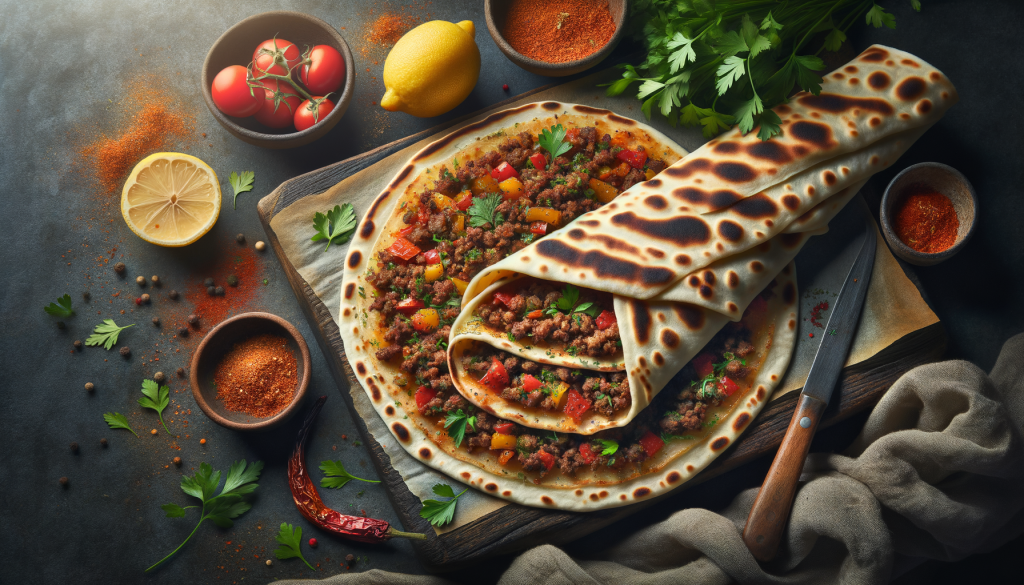
Lahmajoun is the paper-thin, crispy flatbread that proves the best pizza is the one you roll up and eat with your hands. Picture a round of dough stretched impossibly thin — almost translucent — spread with a vivid, spiced layer of ground lamb and tomato, then blasted in a scorching oven until the edges crackle and the meat sizzles. You pull it from the heat, squeeze a wedge of lemon across the surface, scatter fresh parsley and a few leaves of mint, roll the whole thing into a tight cylinder, and bite. The crunch gives way to spiced, tangy warmth. This is lahmajoun.
Known affectionately as “Jewish pizza” or “Armenian pizza,” lahmajoun (lahm bi ajeen, لحم بعجين — literally “meat with dough”) has been a cornerstone of Sephardi and Mizrachi cooking for centuries. From the bustling markets of Aleppo to the Jewish quarters of Istanbul, from the kitchens of Baghdad to modern-day Jerusalem, this flatbread has traveled with Jewish communities across the Ottoman world and beyond, adapting to local spices and traditions while keeping its essential character intact.
What sets lahmajoun apart from other flatbreads is its remarkable restraint. The dough is a vehicle — thin, crisp, and yielding — while the topping does the talking. A vibrant paste of finely ground meat, tomato, onion, and peppers, seasoned with cumin, paprika, and the gentle warmth of Aleppo pepper, spread so thinly that the dough beneath crisps in the oven’s fierce heat. There is no cheese, no heavy sauce, no excess. Just meat, dough, fire, and lemon.
Lahmajoun is always rolled, never sliced. Squeeze fresh lemon juice over the surface, add a handful of flat-leaf parsley and fresh mint, then roll it into a cylinder and eat it out of hand. Some add pickled turnips, sliced radishes, or a drizzle of tahini. This is street food at its most elegant.
What Makes This Lahmajoun Special
Every element of lahmajoun is calibrated for a specific result — maximum flavor from minimum ingredients, achieved through technique rather than complexity:
- Paper-thin, cracker-crisp dough — rolled to near-translucent thinness so it crisps completely in the oven’s blast of heat, creating the signature shatter when you bite through. The dough has no fat, keeping it lean and pliable.
- Finely processed meat topping — the lamb or beef is ground to a near-paste consistency with onion, tomato, and peppers, ensuring it cooks through in the brief, intense bake and adheres to the dough like a second skin.
- Aleppo pepper and warm spices — cumin, paprika, and the fruity, moderate heat of Aleppo pepper (pul biber) give the topping its distinctive character — complex, warm, and never aggressively hot.
- Lemon and fresh herbs at the finish — a squeeze of lemon juice and a scatter of parsley and mint added after baking provide brightness and contrast that elevate the entire experience.
- Rolled, not sliced — lahmajoun is eaten rolled into a cylinder, making it perfect hand food for gatherings, Melaveh Malka, or a weeknight meat meal.
The Story of Lahmajoun: From Aleppo to Jerusalem
Lahmajoun sits at one of the most fascinating crossroads in Jewish culinary history — the intersection of Turkish, Armenian, Arab, and Jewish food traditions. The dish itself predates clear national boundaries, originating in the region that spans modern-day southeastern Turkey, northern Syria, and Armenia. For the Jewish communities that thrived in these lands for millennia, lahmajoun was everyday food, market food, celebration food.
In Aleppo (Halab), the great center of Syrian Jewish life, lahmajoun was a staple of the Jewish market quarter. Aleppan Jewish bakers were renowned throughout the city, and their version — seasoned with cumin, allspice, and the local Aleppo pepper — became the benchmark. When the Aleppan Jewish community dispersed in the mid-twentieth century, they carried their lahmajoun recipes to Brooklyn, São Paulo, Mexico City, and Jerusalem.
In Istanbul, the Sephardi Jewish community — descendants of the Spanish expulsion of 1492 — adopted lahmajoun from their Armenian and Turkish neighbors, adding their own touches. The Istanbul Jewish version often features a slightly thicker dough and a topping enriched with pine nuts. In the Jewish quarters of Balat and Kuzguncuk, lahmajoun bakeries served the community for generations.
Today, lahmajoun is ubiquitous in Israel, found in bakeries, restaurants, and home kitchens from Haifa to Beer Sheva. It has become one of the essential expressions of Mizrachi and Sephardi Jewish cooking — a dish that tells the story of communities that moved, adapted, and preserved their culinary identity across continents and centuries.
Kosher Observance & Halachic Notes
Kosher Classification: Meat (Fleishig)
Lahmajoun is a meat (fleishig / basari) dish. The topping contains ground lamb or beef, making the entire flatbread meat. It cannot be served with dairy in any form — no cheese, no butter, no yogurt sauce. Despite the nickname “Jewish pizza,” adding cheese would violate the prohibition of basar b’chalav (mixing meat and milk). Use only kosher-certified meat with proper hechsher.
Basar B’Chalav (Meat and Milk)
Because lahmajoun is meat, all utensils, baking sheets, rolling pins, and surfaces used must be designated for meat or pareve use. Do not use dairy equipment. After eating lahmajoun, observe the standard waiting period before consuming dairy products (6 hours in most Sephardi and many Ashkenazi communities; consult your community’s minhag).
Hafrashat Challah (Separating Challah)
This recipe calls for 500 g of flour. According to most Ashkenazi poskim, this amount requires separating challah without a bracha. If you double the recipe (1,000 g flour), you should separate challah without a bracha (most authorities require a bracha at 1,200–1,666 g, depending on custom). Sephardi practice may differ — consult your community’s minhag.
How to perform Hafrashat Challah:
- After the dough is fully mixed, pinch off a small piece — at least a kezayit (roughly 28 g / 1 oz).
- If the total flour exceeds the bracha threshold for your community, recite the bracha:
Hebrew:
בָּרוּךְ אַתָּה ה’ אֱלֹהֵינוּ מֶלֶךְ הָעוֹלָם אֲשֶׁר קִדְּשָׁנוּ בְּמִצְוֹתָיו וְצִוָּנוּ לְהַפְרִישׁ חַלָּהTransliteration:
Baruch Atah Adonai, Eloheinu Melech ha’olam, asher kid’shanu b’mitzvotav v’tzivanu l’hafrish challah.Translation:
“Blessed are You, Lord our God, King of the universe, Who has sanctified us with His commandments and commanded us to separate challah.”
- Say: “Harei zu challah” (“This is challah”).
- Wrap the separated piece in foil and burn it. It may not be eaten.
No Eggs in This Recipe
This lahmajoun recipe does not contain eggs, so there is no need to check for blood spots. However, if you modify the dough to include egg for enrichment, each egg must be cracked individually into a clear glass and inspected before use.
Pas Yisroel
When a Jewish person sets the oven temperature or contributes to the baking in any way, the lahmajoun fulfills Pas Yisroel requirements. This is particularly relevant during the Aseret Yemei Teshuvah.
Brachot (Blessings)
- Before eating (as a meal): HaMotzi Lechem Min Ha’Aretz — when lahmajoun is eaten as the basis of a meal with bread-like intent, wash and make HaMotzi. If eating a single piece as a snack, some authorities hold Mezonot may apply — consult your rav.
- After eating (as a meal): Birkat HaMazon (Grace After Meals).
- After eating (as a snack): Al HaMichya (if Mezonot was recited).
Ingredients
Dough
| Ingredient | Grams | Volume | Baker’s % |
|---|---|---|---|
| All-purpose flour (unbleached) | 500 g | 4 cups | 100% |
| Fine sea salt | 8 g | 1½ tsp | 1.6% |
| Granulated sugar | 10 g | 2 tsp | 2% |
| Instant (rapid-rise) yeast | 5 g | 1½ tsp | 1% |
| Olive oil | 30 g | 2 Tbsp | 6% |
| Warm water (see DDT note below) | 300 g | 1¼ cups | 60% |
| Total Dough Weight | ~853 g | — | — |
Spiced Meat Topping
| Ingredient | Grams | Volume |
|---|---|---|
| Ground lamb or beef (kosher, with hechsher) | 400 g | 14 oz |
| Tomato paste | 70 g | 4 Tbsp |
| Yellow onion, finely grated or minced | 150 g | 1 medium onion |
| Red bell pepper, finely diced | 100 g | 1 small pepper |
| Fresh tomato, finely diced (or 100 g crushed canned) | 120 g | 1 medium tomato |
| Fresh flat-leaf parsley, finely chopped | 15 g | ¼ cup |
| Garlic cloves, minced or pressed | 10 g | 3 cloves |
| Ground cumin | 4 g | 1½ tsp |
| Sweet paprika | 4 g | 1½ tsp |
| Aleppo pepper (pul biber) or ½ tsp cayenne + ½ tsp paprika | 3 g | 1 tsp |
| Ground allspice | 1 g | ¼ tsp |
| Ground black pepper | 1 g | ¼ tsp |
| Fine sea salt | 5 g | 1 tsp |
| Lemon juice (for the topping mixture) | 15 g | 1 Tbsp |
For Serving
- Fresh lemons, cut into wedges — essential, not optional
- Fresh flat-leaf parsley, whole leaves
- Fresh mint leaves
- Sumac (optional) — a sprinkle adds tangy depth
- Pickled turnips or sliced radishes (optional)
- Sliced tomatoes and cucumber (optional)
Equipment
- Baking stone or heavy-duty baking sheet (inverted) — preheated in the oven for maximum heat transfer
- Rolling pin
- Kitchen scale
- Food processor (for the meat topping) or sharp knife for very fine mincing
- Parchment paper
- Large bowl for dough
- Bench scraper
- Oven capable of reaching at least 250°C (480°F) — the hotter, the better
Desired Dough Temperature (DDT)
Target DDT: 26°C (78°F)
A moderately warm dough ensures a controlled rise without over-proofing during the rest. To calculate your water temperature:
Water Temp = (DDT × 3) − Flour Temp − Room Temp
Example: If your kitchen is 22°C and your flour is 21°C:
Water = (26 × 3) − 22 − 21 = 35°C (95°F)
The water should feel comfortably warm — like bath water. Never exceed 43°C (110°F).
Step-by-Step Instructions
Step 1: Make the Dough
In a large bowl or the bowl of a stand mixer, combine the warm water, sugar, and olive oil. Stir briefly.
Add the flour, salt, and instant yeast (keep salt and yeast on opposite sides). Mix on low speed (speed 1–2) for 2–3 minutes until a shaggy dough forms.
Increase to medium speed (speed 3–4) and knead for 6–8 minutes until the dough is:
- Smooth and elastic — it should pull away from the bowl sides cleanly.
- Soft and slightly tacky — but not wet. Lahmajoun dough should be supple and easy to handle.
- Extensible — you should be able to stretch a small piece thin without it tearing. Extensibility is more important than elasticity here, as you need to roll the dough paper-thin.
Hand kneading: Combine in a large bowl, turn onto a lightly floured surface, and knead 8–10 minutes. The dough should feel smooth, soft, and alive.
Step 2: Rest the Dough
Lightly oil a large bowl. Place the dough inside, turn to coat, and cover tightly with plastic wrap or a damp towel.
Let rest at room temperature for 1 to 1.5 hours until doubled in volume. The dough should be puffy and soft when you press it gently. This rest develops flavor and makes the dough easier to roll thin.
Step 3: Prepare the Meat Topping
While the dough rests, make the topping. This step is crucial — the meat mixture must be processed finely enough to spread in a thin, even layer.
Food processor method (recommended):
- Add the onion, red bell pepper, garlic, fresh tomato, and parsley to a food processor. Pulse until very finely minced — almost a paste, but not completely pureed. Transfer to a large bowl.
- Add the ground lamb or beef, tomato paste, lemon juice, and all spices (cumin, paprika, Aleppo pepper, allspice, black pepper, salt).
- Mix thoroughly with your hands or a wooden spoon for 2–3 minutes until the mixture is homogeneous and paste-like. It should be spreadable, not chunky.
By hand: Grate the onion on a box grater. Mince the pepper, tomato, garlic, and parsley as finely as possible. Combine with the meat and spices and knead the mixture until smooth and spreadable.
Important: If the mixture seems too wet, do not drain it. The moisture helps the topping spread thin and keeps it from drying out in the oven’s intense heat. If it seems too thick, add a tablespoon of water.
Step 4: Preheat the Oven
Place a baking stone or inverted heavy baking sheet on the lowest oven rack. Preheat the oven to 250°C (480°F) — or as high as your oven will go. If your oven reaches 275°C (525°F) or has a “pizza” setting, use it. Allow at least 30 minutes for the stone to fully saturate with heat.
The intense heat is non-negotiable. Lahmajoun needs a blast of fierce, dry heat to crisp the thin dough while cooking the meat topping through in just 5–7 minutes.
Step 5: Divide and Shape the Dough
Turn the risen dough out onto a lightly floured work surface. Gently deflate.
Using a bench scraper and scale, divide the dough into 12 equal pieces (~71 g each). Shape each piece into a smooth ball by tucking the edges underneath and rolling gently on the surface.
Cover the balls loosely with a towel or plastic wrap and let them rest for 10–15 minutes. This relaxes the gluten and makes rolling much easier.
Step 6: Roll Paper-Thin
This is the critical step. Thin is everything.
Working with one ball at a time (keep the rest covered):
- Dust your surface lightly with flour. Place a dough ball on the surface and press it flat with your palm.
- Roll outward from the center in all directions, rotating the round a quarter turn every few strokes. Roll to a circle roughly 25–28 cm (10–11 inches) in diameter.
- The dough should be paper-thin — you should be able to see the surface beneath it. If it springs back, let it rest 2–3 minutes and try again.
- Transfer to a sheet of parchment paper for easy handling.
Tip: Roll 2–3 rounds ahead and keep them on parchment, stacked with flour between them. This creates an efficient assembly line for topping and baking.
Step 7: Spread the Topping
Take 2–3 tablespoons (~40 g) of the meat mixture and place it in the center of a rolled-out dough round.
Using the back of a spoon or your fingers, spread the topping in a very thin, even layer all the way to the edges. Do not leave a border — lahmajoun is topped edge to edge. The layer should be thin enough that you can see the dough through it in places. This is not a thick pizza — restraint is key.
Step 8: Bake at Maximum Heat
Carefully slide the topped lahmajoun (on its parchment) onto the preheated baking stone or inverted baking sheet.
Bake for 5–7 minutes at 250°C (480°F) until:
- The edges of the dough are golden-brown and crisp, with some charred spots (this is desirable).
- The meat topping is cooked through and no longer pink.
- The bottom is firm and lightly spotted — not pale or soft.
Watch carefully. At these temperatures, the difference between perfect and burned is 60–90 seconds. Your first batch may need adjustment.
Remove with a large spatula or pizza peel. Repeat with remaining dough and topping.
Step 9: Finish and Serve
This is where lahmajoun becomes transcendent. Immediately after baking:
- Squeeze fresh lemon juice generously over the hot surface. The acidity cuts through the richness and brings every flavor alive.
- Scatter fresh parsley leaves and torn mint across the top.
- Optionally, add a pinch of sumac for extra tang, or tuck in some pickled turnips or sliced radishes.
- Roll the lahmajoun into a tight cylinder and eat immediately, out of hand.
Roll, don’t slice. Lahmajoun is never cut into triangles like pizza. Rolling it concentrates the flavors, gives you a satisfying textural contrast of crisp exterior and soft interior, and makes it perfect hand food. This is how it has been eaten for centuries.
Storage & Reheating
- Same day: Lahmajoun is at its absolute best straight from the oven, rolled with lemon and herbs. The crispness is fleeting — serve immediately.
- Room temperature: Stack cooled lahmajoun between sheets of parchment paper and store in an airtight container at room temperature for up to 1 day. The crispness will soften but the flavor remains excellent.
- Reheating: Place on a baking sheet in a preheated 220°C (425°F) oven for 3–4 minutes to re-crisp. Alternatively, heat directly on a dry skillet over high heat for 1–2 minutes per side. Do not microwave — it will make the bread soft and chewy.
- Freezing (unbaked): Prepare through Step 7 (topped but unbaked). Stack on parchment, wrap tightly in plastic wrap, then foil. Freeze for up to 2 months. Bake directly from frozen — add 1–2 minutes to the baking time.
- Freezing (baked): Cool completely, stack between parchment, and freeze in airtight bags for up to 2 months. Reheat from frozen in a hot oven for 4–5 minutes.
- Dough only: The dough balls can be refrigerated for up to 24 hours. Bring to room temperature for 30 minutes before rolling.
Troubleshooting Guide
| Problem | Likely Cause | Solution |
|---|---|---|
| Dough is too thick and bready | Not rolled thin enough; dough springing back | Let dough rest longer (5 minutes) between rolling passes. Roll until you can see the surface through the dough. Lahmajoun should be almost translucent. |
| Topping is raw but edges are burning | Topping spread too thick; oven not hot enough from below | Spread the topping thinner — you should see dough through it. Ensure the baking stone is fully preheated (30+ minutes). Move the stone to a lower rack position. |
| Dough is soggy in the center | Topping too wet; baking surface not hot enough | If the meat mixture is very watery, let it sit in a fine strainer for 10 minutes. Ensure the baking stone is scorching hot before baking. |
| Dough tears when rolling | Gluten too tight; insufficient rest | Let the dough ball rest 5–10 more minutes before rolling again. Ensure the dough had a full 1–1.5 hour rise. Slightly increase hydration next time. |
| Meat topping is dry and crumbly | Not processed finely enough; too little moisture | Process the vegetables more finely in the food processor. The mixture should be paste-like, not chunky. Add a tablespoon of water if needed. |
| Lahmajoun sticks to the stone | No parchment; wet dough | Always use parchment paper beneath the lahmajoun. Dust the parchment lightly with flour or semolina. The parchment can be removed halfway through baking for extra crispness. |
Frequently Asked Questions
What is lahmajoun?
Lahmajoun (also spelled lahmacun, lahm bi ajeen) is a paper-thin flatbread topped with a seasoned mixture of finely ground meat, tomato, onion, peppers, and spices, baked at very high heat until crisp. It originates from the culinary traditions of Turkey, Armenia, and the Levant, and has been a beloved part of Sephardi and Mizrachi Jewish cooking for centuries. It is often called “Jewish pizza” or “Armenian pizza,” though it predates pizza by centuries and is always eaten rolled with lemon and fresh herbs, never sliced.
Can I use ground beef instead of lamb?
Absolutely. While lamb is traditional and gives the most authentic flavor — slightly gamey, rich, and perfectly complemented by the spices — ground beef works beautifully. Many Jewish communities, particularly in Turkey and parts of Syria, traditionally used beef. You can also use a 50/50 blend of lamb and beef for a balanced flavor. Choose ground meat that is not too lean — 15–20% fat content produces the best result, keeping the topping moist during the intense bake.
Why can’t I add cheese to lahmajoun?
Lahmajoun is a meat dish — the topping contains ground lamb or beef. Adding cheese or any dairy product would violate the Torah prohibition of basar b’chalav (cooking meat and milk together). This is one of the most fundamental principles of kashrut. Despite the “pizza” nickname, lahmajoun is not pizza and should never be topped with cheese. The dish is complete and perfect as it is — the lemon, herbs, and spices provide all the complexity you need.
How do I get lahmajoun paper-thin?
Three keys: rest, patience, and a good rolling pin. First, let the dough balls rest for at least 10–15 minutes after shaping — this relaxes the gluten and makes rolling dramatically easier. Second, roll from the center outward, rotating the dough a quarter turn every few strokes. Third, if the dough springs back stubbornly, walk away for 3 minutes and come back. Do not fight the gluten — just give it time. The finished round should be 25–28 cm (10–11 inches) across and thin enough to see through.
Can I make the dough and topping ahead of time?
Yes, both components hold well. The dough can be made, divided into balls, placed on a floured tray, covered with plastic wrap, and refrigerated for up to 24 hours. Bring to room temperature for 30 minutes before rolling. The meat topping can be made up to 24 hours in advance and refrigerated in an airtight container — the flavors actually deepen overnight. For large gatherings, you can assemble topped lahmajoun on parchment, stack them, and freeze unbaked for up to 2 months. Bake directly from frozen, adding 1–2 minutes to the time.
Bring the Flavors of Aleppo to Your Kitchen
Lahmajoun is the kind of recipe that makes your entire home smell extraordinary. Roll the dough thin, spread the spiced meat, and let a blazing oven do the rest. Squeeze, roll, bite — this is how it has been done for centuries.
Save This Recipe
Try Our Yemenite Kubaneh Next →
Have questions? Tag us @kosherbreadpro on Instagram or leave a comment below. We answer every one.