


Dough is Pareve • Dairy when served with butter • Contains Gluten
12–15 mufletas
Intermediate
45 minutes
2 hours
Mezonot
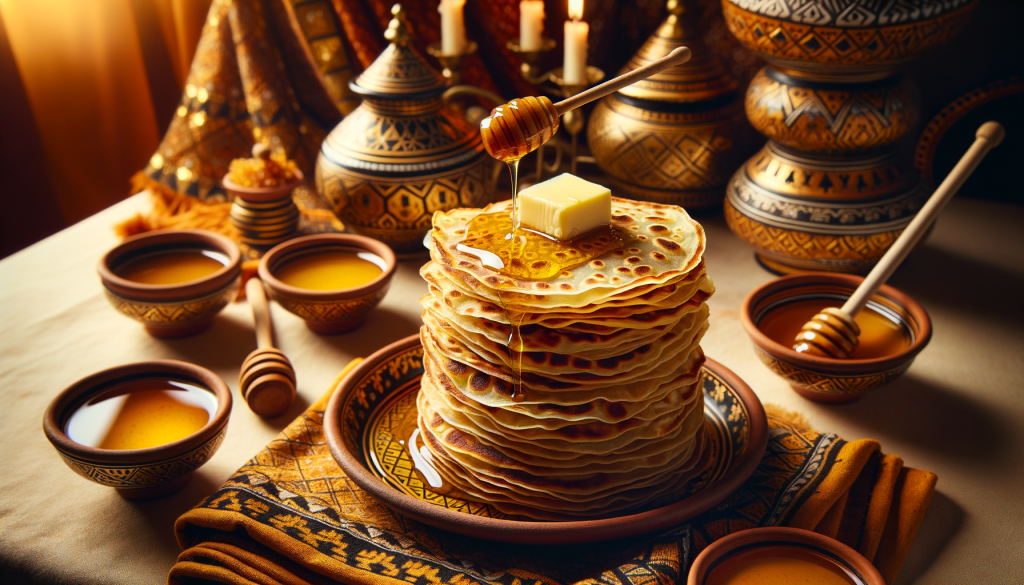
Mufleta is the first bread after Pesach — and it tastes like freedom all over again. For seven (or eight) days, Moroccan Jews have lived without chametz. No flour, no yeast, no risen dough. And then, the moment Pesach ends — sometimes literally minutes after havdalah — the flour comes out, the griddle heats up, and the kitchen fills with the scent of something extraordinary: paper-thin rounds of dough, stretched by hand until nearly translucent, sizzling on a hot surface, stacking up in a warm, glistening tower drizzled with honey and melted butter.
This is mufleta (mufleta, מופלטה), the iconic bread of Mimouna — the jubilant Moroccan Jewish celebration that marks the end of Pesach and the joyful return to chametz. It is not merely a recipe. It is a ritual, a homecoming, a communal act of sweetness and abundance. In Moroccan Jewish homes from Casablanca to Fez to Marrakech, and today across Israel and the diaspora, mufleta is the bread that announces: the holiday is over, and the good life continues.
The dough itself could not be simpler — flour, water, salt, a pinch of sugar, and oil. No yeast, no eggs, no dairy. But the technique is everything. Each ball of dough is oiled generously, rested until supple, then stretched by hand on an oiled surface until it becomes a gossamer-thin disc — so thin you can read a newspaper through it. Cooked on a blazing-hot griddle for just seconds per side, the mufletas are stacked one atop another, the residual heat steaming them into pliable, silky sheets. Drizzled with warm honey and a generous pat of butter, rolled or folded, eaten with the fingers — this is Mimouna.
Mufleta is traditionally prepared and served on the evening immediately after Pesach ends (Motzei Pesach). The timing is deliberate and deeply meaningful: this is the very first chametz touching your lips after a week of abstention. The sweetness of the honey, the richness of the butter, the tender warmth of fresh-cooked dough — it is a sensory celebration of abundance, gratitude, and renewal.
What Makes This Mufleta Special
Mufleta looks deceptively simple — it is, after all, just flatbread. But every element of the process is calibrated for a specific, remarkable result:
- Paper-thin hand-stretching technique — the dough is not rolled with a pin but stretched by hand on a generously oiled surface, producing a translucent disc far thinner than any rolling pin can achieve. This is the soul of mufleta and the skill that distinguishes a good one from a great one.
- Griddle-cooked at high heat — each mufleta cooks in under a minute on a blazing-hot ungreased surface. The result: blistered, lightly golden spots against a pale, supple background — cooked but not crisp.
- Stacked and steam-softened — as each mufleta comes off the griddle, it is placed on the growing stack, where residual heat and trapped steam soften every layer into a silky, pliable sheet. The stack is the secret: mufletas are not meant to be eaten alone but as part of this warm, layered tower.
- Mimouna tradition — mufleta is not an everyday bread. It is prepared specifically for the Mimouna celebration at the end of Pesach, giving it a ritual significance that elevates it far beyond ordinary flatbread. To make mufleta is to participate in a centuries-old Moroccan Jewish tradition of joy, hospitality, and renewal.
- Impossibly simple ingredients — flour, water, salt, sugar, oil. That is all. The beauty lies entirely in technique and tradition. No special equipment, no exotic ingredients — just skilled hands and a hot griddle.
Mimouna: The Moroccan Jewish Celebration of Sweetness and Freedom
To understand mufleta, you must understand Mimouna. The word likely derives from the Arabic maimoun (good fortune) or possibly from the Hebrew emunah (faith). Whatever its etymology, Mimouna is one of the most distinctive and beloved celebrations in the entire Jewish world — a festival unique to Moroccan Jewry and the communities influenced by them.
Mimouna begins on the evening that Pesach ends. Almost the instant havdalah is recited, Moroccan Jewish homes transform into open houses of extraordinary hospitality. Tables are laid with an elaborate spread: mufletas stacked high, bowls of honey and butter, platters of dried fruits and nuts, marzipan, nougat, fresh spring flowers, stalks of wheat, live fish (symbols of abundance and fertility), and always — always — an open door. Neighbors visit neighbors, friends visit friends, and the streets come alive with a sense of communal joy that is unlike any other night in the Jewish calendar.
The tradition has deep roots in the Jewish communities of Morocco — from the grand cities of Fez, Meknes, Casablanca, and Marrakech to the smaller communities of the Atlas Mountains and the Saharan south. When the vast majority of Moroccan Jews made aliyah to Israel in the 1950s and 1960s, they carried Mimouna with them. Today, Mimouna is celebrated across Israel as a national holiday of sorts, with massive public gatherings, political leaders visiting Moroccan Jewish families, and mufleta consumed by the thousands. It has become a bridge between communities — Ashkenazi, Sephardi, Mizrachi — all united around a griddle and a pot of honey.
For Moroccan Jews in the diaspora — in France, Canada, the United States, and beyond — Mimouna remains a powerful link to heritage. The act of making mufleta, of stretching that first piece of chametz dough after Pesach, connects generations across continents and centuries. It is, in its quiet way, one of the most emotionally resonant moments in the Jewish culinary year.
Kosher Observance & Halachic Notes
Kosher Classification: Pareve Dough (Dairy when served with butter)
The mufleta dough itself is entirely pareve — it contains no dairy or meat ingredients. However, mufleta is traditionally served with butter and honey, which renders the served dish dairy. If you wish to keep the meal pareve, substitute margarine or coconut oil for the butter drizzle. Clearly communicate the dairy status if butter is used at the table.
Hafrashat Challah (Separating Challah)
This recipe calls for 500 g of flour. According to most Ashkenazi poskim, this amount requires separating challah without a bracha. If you increase the recipe to 1,200 g flour or more, you should separate challah with a bracha. Sephardi practice may differ — consult your community’s minhag.
How to perform Hafrashat Challah:
- After the dough is fully mixed, pinch off a small piece — at least a kezayit (roughly 28 g / 1 oz).
- If the total flour exceeds the bracha threshold for your community, recite the bracha:
Hebrew:
בָּרוּךְ אַתָּה ה’ אֱלֹהֵינוּ מֶלֶךְ הָעוֹלָם אֲשֶׁר קִדְּשָׁנוּ בְּמִצְוֹתָיו וְצִוָּנוּ לְהַפְרִישׁ חַלָּהTransliteration:
Baruch Atah Adonai, Eloheinu Melech ha’olam, asher kid’shanu b’mitzvotav v’tzivanu l’hafrish challah.Translation:
“Blessed are You, Lord our God, King of the universe, Who has sanctified us with His commandments and commanded us to separate challah.”
- Say: “Harei zu challah” (“This is challah”).
- Wrap the separated piece in foil and burn it. It may not be eaten.
Timing: Motzei Pesach
Mufleta must not be prepared until Pesach has fully ended. This means waiting until after havdalah on the night following the last day of Pesach (the eighth day in the diaspora, the seventh day in Israel). All chametz ingredients — flour in particular — must be newly purchased or retrieved from wherever they were sold or stored for Pesach. Many families purchase fresh flour specifically for this occasion. Do not begin mixing the dough until Pesach is definitively over.
Pas Yisroel
When a Jewish person lights the griddle or contributes to the cooking in any way, the mufleta fulfills Pas Yisroel requirements. This is particularly relevant during the Aseret Yemei Teshuvah, though mufleta is almost always made in a Jewish home and thus inherently Pas Yisroel.
Brachot (Blessings)
- Before eating: Borei Minei Mezonot — mufleta is a flat, unleavened bread that is not typically consumed as a meal-bread (pas ha’ba’ah b’kisnin). If you eat a quantity that constitutes a meal (roughly the equivalent of 3–4 mufletas), wash and make HaMotzi instead.
- After eating: Al HaMichya (if Mezonot was recited). Birkat HaMazon if HaMotzi was recited.
Ingredients
Dough
| Ingredient | Grams | Volume | Baker’s % |
|---|---|---|---|
| All-purpose flour (unbleached) | 500 g | 4 cups | 100% |
| Warm water (see DDT note below) | 300 g | 1¼ cups | 60% |
| Fine sea salt | 8 g | 1½ tsp | 1.6% |
| Granulated sugar | 15 g | 1 Tbsp | 3% |
| Vegetable or sunflower oil (for dough) | 30 g | 2 Tbsp | 6% |
| Total Dough Weight | ~853 g | — | — |
For Stretching & Oiling
| Ingredient | Amount | Purpose |
|---|---|---|
| Vegetable or sunflower oil | 120–150 g (½–⅔ cup) | For coating dough balls and oiling the work surface during stretching |
Traditional Toppings (for serving)
- Honey — warm, pourable; the classic Mimouna drizzle
- Butter — unsalted, at room temperature or melted (makes the dish dairy)
- Nut butter or almond paste — a traditional Moroccan variation
- Powdered sugar — optional, for an extra touch of sweetness
- Fresh fruit and nuts — dates, walnuts, almonds are all traditional on the Mimouna table
Equipment
- Large flat griddle or heavy skillet — 28–30 cm (11–12 inch). Cast iron, carbon steel, or a heavy non-stick pan all work. The surface should be very hot and ungreased.
- Large smooth work surface — a countertop, large cutting board, or marble slab for stretching
- Kitchen scale
- Large mixing bowl
- Small bowl for oil (for coating hands and surface)
- Clean kitchen towel or foil (for keeping the stack warm)
- Spatula or tongs (for flipping)
Desired Dough Temperature (DDT)
Target DDT: 28°C (82°F)
A warm, pliable dough is essential for mufleta — it must stretch without tearing. Because there is no yeast, the DDT calculation is simpler. Use warm water to achieve a soft, extensible dough.
Water Temp = (DDT × 2) − Room Temp
Example: If your kitchen is 22°C:
Water = (28 × 2) − 22 = 34°C (93°F)
The water should feel comfortably warm — like bath water. Warmer water produces more extensible dough, which is exactly what you want for stretching paper-thin.
Step-by-Step Instructions
Step 1: Mix the Dough
In a large bowl, combine the warm water, salt, sugar, and oil. Stir until the salt and sugar dissolve.
Add the flour gradually, mixing with your hand or a wooden spoon until a shaggy mass forms. Turn the dough out onto a clean, unfloured surface and knead by hand for 5–7 minutes until the dough is:
- Smooth and soft — it should feel like earlobe-soft playdough.
- Slightly tacky but not sticky — if it clings to the surface, oil your hands lightly rather than adding flour.
- Very elastic — when you pull a piece, it should stretch easily without snapping back aggressively. This extensibility is critical for the stretching step.
Do not add extra flour. A slightly soft, slightly tacky dough is exactly right. A stiff dough will not stretch thin enough.
Step 2: Divide and Oil the Dough Balls
Using a scale and bench scraper, divide the dough into 12–15 equal pieces (~57–71 g each). Roll each piece into a smooth ball.
Pour a generous pool of oil into a shallow bowl or onto a tray. Coat each dough ball thoroughly in oil — they should be glistening. Arrange the oiled balls on a tray or plate, leaving a little space between them. The oil prevents sticking and conditions the dough for stretching.
Cover the oiled balls with plastic wrap or a damp towel and let them rest at room temperature for at least 30 minutes, and up to 1 hour. This rest is non-negotiable — it relaxes the gluten and makes the dough dramatically easier to stretch thin.
Pro tip: Longer rest = easier stretching. If you have time, rest for the full hour. The dough balls will spread slightly under their own weight — this is a good sign that the gluten is relaxed and ready.
Step 3: Prepare Your Station
Set up an efficient workspace — you will be stretching and cooking in a rhythm, one mufleta at a time.
- Oiled surface: Generously oil a smooth, clean countertop or large cutting board with vegetable oil. The surface should be slick — not just lightly coated but genuinely slippery.
- Hot griddle: Heat your griddle or skillet over medium-high heat — approximately 200–220°C (400–425°F). The surface should be hot enough that a drop of water sizzles and evaporates instantly. Do not oil the griddle.
- Warm plate: Set a large plate or platter nearby, covered with a clean towel or foil, for stacking the finished mufletas.
Step 4: Stretch Paper-Thin
This is the heart of mufleta — the moment where simple dough becomes something extraordinary.
Working with one oiled ball at a time:
- Place the ball on the oiled surface. Oil your palms and fingertips generously.
- Press down with your palms to flatten the ball into a thick disc, roughly 10 cm (4 inches) across.
- Begin stretching from the center outward using the backs of your hands and your fingertips. Work in a circular motion, gently pulling the dough outward and letting gravity help. Lift the edges and let the weight of the dough stretch itself.
- Continue stretching until the disc is paper-thin and nearly translucent — you should be able to see the surface beneath it. The final diameter should be roughly 30–35 cm (12–14 inches). Occasional small holes are fine; do not try to patch them.
The key: Work gently and patiently. If the dough resists or springs back, let it rest on the surface for 1–2 minutes and return to it. Force tears the dough; patience stretches it.
Oil is your ally. Re-oil your hands and the surface as needed. The dough should glide, never stick.
Step 5: Cook on the Hot Griddle
Once stretched, immediately transfer the mufleta to the hot griddle. Drape it over your forearms or gather it gently and lay it flat on the hot surface.
Cook for 30–45 seconds per side until you see:
- Light golden-brown blisters and spots on the underside
- The surface begins to look dry and set rather than raw and translucent
- Small bubbles forming across the surface
Flip carefully with a spatula or your fingers and cook the second side for another 20–30 seconds. The mufleta should be cooked but still pliable — not crispy, not browned all over. Think crepe, not tortilla chip.
Step 6: Stack and Steam
Immediately transfer each cooked mufleta to the warm plate and cover with the towel or foil. This is essential. As the mufletas stack, the residual heat steams the layers below, softening them into silky, supple sheets.
Continue stretching and cooking the remaining dough balls, adding each mufleta to the top of the stack and re-covering immediately. You will develop a rhythm: stretch one, cook one, stack one, reach for the next ball.
By the time you finish, you will have a tall, warm, fragrant stack of 12–15 paper-thin flatbreads — the tower of Mimouna.
Step 7: Serve with Honey and Butter
Serve immediately while warm. Mufleta waits for no one.
Bring the entire stack to the table. Each person peels off a mufleta from the stack, drizzles it with warm honey, adds a generous pat of butter (which melts on contact), and folds or rolls it up. Eat with the hands.
Some families spread the mufleta with almond paste or nut butter before the honey. Others add a dusting of powdered sugar. All variations are traditional and all are magnificent.
The Mimouna greeting: As you serve, say “Terbhu u-tsa’adu” — “May you prosper and be happy.” Your guests reply “Terbhu u-tsa’adu” in return. This is the blessing of Mimouna.
Storage & Make-Ahead
- Same evening: Mufleta is at its absolute best fresh off the griddle, served immediately during Mimouna. The warmth, the pliability, the way butter melts into the folds — this cannot be replicated after cooling.
- Room temperature: Stack leftover mufletas with a small piece of parchment or wax paper between each, wrap the stack tightly in foil. Consume within 1 day.
- Reheating: Warm a skillet or griddle over medium heat. Place a mufleta on the dry surface for 15–20 seconds per side until warmed through and pliable again. Alternatively, wrap the stack in foil and warm in a 150°C (300°F) oven for 5–8 minutes.
- Freezing: Separate cooled mufletas with parchment paper, stack, and wrap tightly in plastic wrap, then foil. Freeze for up to 1 month. Thaw at room temperature, then reheat on a dry skillet.
- Make-ahead note: The dough balls can be oiled and refrigerated for up to 4 hours before stretching and cooking. Bring them to room temperature for 20 minutes before stretching. However, the stretching and cooking should ideally happen just before serving.
Troubleshooting Guide
| Problem | Likely Cause | Solution |
|---|---|---|
| Dough tears when stretching | Dough not rested long enough; too stiff; not enough oil on surface and hands | Rest dough balls for the full hour. Add more oil to hands and surface. If dough resists, set it aside for 2–3 minutes and work on the next ball. |
| Mufleta is too thick / won’t stretch thin | Dough too stiff (too much flour); insufficient rest; not enough oil | The dough should be soft and slightly tacky after mixing. Never add extra flour. Ensure generous oiling and a full 30–60 minute rest. |
| Mufleta is crispy or stiff after cooking | Griddle too hot; cooked too long; not stacked and covered immediately | Reduce heat slightly. Cook only until light golden spots appear — 30–45 seconds per side maximum. Stack and cover immediately to trap steam. |
| Mufleta sticks to the griddle | Residual oil from stretching is pooling; griddle not hot enough | Ensure griddle is fully preheated. Shake off excess oil before placing on griddle. The dry, hot surface should cook the mufleta cleanly. |
| Dough balls stick together during rest | Insufficient oil coating | Each ball must be generously coated in oil on all sides. Leave space between balls on the tray. |
| Mufletas are unevenly cooked | Uneven thickness; griddle has hot spots | Stretch more evenly. Rotate the mufleta on the griddle if your pan has hot spots. A heavy cast iron pan provides the most even heat. |
Frequently Asked Questions
What is Mimouna?
Mimouna is a traditional Moroccan Jewish celebration held on the evening and day immediately following the end of Pesach (Passover). It marks the joyful return to chametz (leavened bread) after a week of abstention. Families open their homes to guests, set elaborate tables with symbols of abundance — honey, butter, flour, fresh fruit, live fish, wheat, and flowers — and prepare mufletas as the centerpiece. The celebration has its roots in centuries of Moroccan Jewish culture and is today observed widely across Israel and the Moroccan Jewish diaspora. Mimouna is a festival of sweetness, hospitality, faith, and communal joy.
What is the difference between mufleta and a crepe or tortilla?
While mufleta may look similar to a crepe or flour tortilla, the technique and result are quite different. Mufleta is made from a kneaded, rested, oil-saturated dough that is stretched by hand (not rolled) to paper-thin translucency, then cooked on a dry griddle. A crepe is a poured batter; a tortilla is typically rolled with a pin and uses fat differently. Mufleta’s texture is uniquely silky and supple — softer than a tortilla, sturdier than a crepe — especially when stacked and steamed. The oil-based stretching technique and the stacking method give mufleta a character entirely its own.
Can I make mufleta with a rolling pin instead of stretching by hand?
You can, but the results will not be the same. A rolling pin tends to produce a thicker, more uniform disc, while hand-stretching on an oiled surface yields the characteristic paper-thin translucency that defines great mufleta. The oil on the surface and hands acts as a lubricant that allows the dough to stretch far thinner than a pin can achieve. If you are new to the technique, start with a rolling pin to flatten the dough to about 20 cm (8 inches), then switch to hand-stretching for the final thinning. With practice, you will find yourself reaching for the rolling pin less and less.
Is mufleta only made at Mimouna, or can I make it anytime?
Traditionally, mufleta is strongly associated with Mimouna and the end of Pesach. Its emotional and spiritual power comes partly from this timing — it is the first chametz after a week without, and that context makes it transcendent. However, there is no halachic prohibition against making mufleta at other times of the year, and many Moroccan Jewish families do enjoy it occasionally as a special treat. Some serve it at other celebrations or on Shabbat. That said, if you have never experienced mufleta at Mimouna — fresh off the griddle, at a table overflowing with honey and guests — make that your first time. The context is half the recipe.
Why is the bracha Mezonot and not HaMotzi?
Mufleta is classified as pas ha’ba’ah b’kisnin — a baked (or cooked) product made from dough that is typically eaten as a snack rather than as the basis of a meal. Because each mufleta is thin, sweet-topped, and eaten in a casual, celebratory setting (not as a formal bread meal), the bracha is Mezonot. However, if you eat a substantial quantity — enough that it constitutes a full meal — you should wash, recite HaMotzi, and bench (recite Birkat HaMazon) afterward. When in doubt, consult your rabbi for guidance based on your community’s practice.
Celebrate Mimouna with the Bread That Starts It All
Mufleta is more than a recipe — it is the taste of freedom renewed, sweetness shared, and doors thrown open. Make it this year. Make it every year.
Save This Recipe
Bake Our Classic Challah Next →
Have questions? Tag us @kosherbreadpro on Instagram or leave a comment below. We answer every one.