Search 150+ Kosher Recipes
Dairy-Free • Egg-Free • Contains Gluten
8 flatbreads
Easy–Intermediate
30 minutes
2–3 hours
HaMotzi
This bread tastes like the Judean Hills. That is not poetry — it is terroir. The wild hyssop clinging to limestone terraces south of Jerusalem. The ancient olive groves whose roots grip the chalky soil of the Shfela foothills. The dry, warm wind that concentrates the essential oils in every leaf and berry. When you spread hand-blended Judean za’atar over soft, oil-enriched dough and slide it into a blazing oven, you are not just baking flatbread — you are bringing an entire landscape to your table.
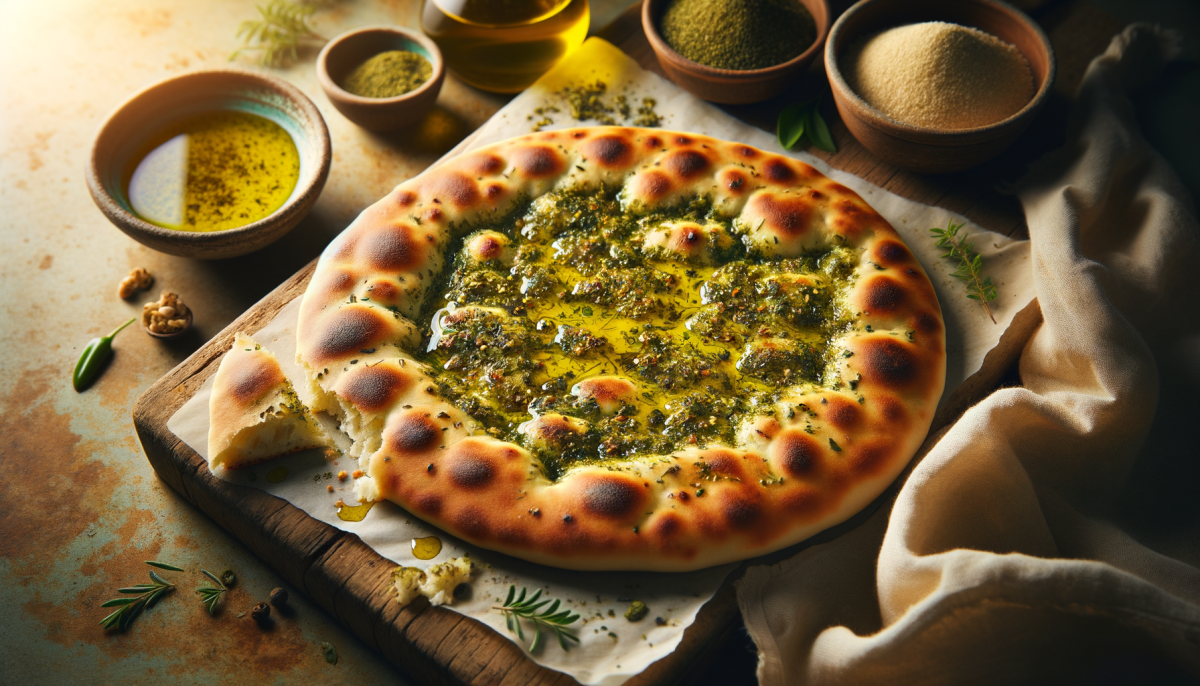
Za’atar bread — known as manakish (singular: man’oushe) throughout the Levant — is perhaps the most ancient of daily breads. Long before braided challahs graced the Shabbat table, flatbreads dressed with wild herbs and local olive oil were the everyday sustenance of the region. Baked in communal ovens at dawn, eaten warm with labaneh and fresh vegetables, manakish is comfort in its simplest, most elemental form. For another essential Israeli flatbread, see our Kosher Pita Bread — the puffy pocket bread that’s perfect for scooping the same za’atar and olive oil.
What sets this recipe apart is not technique — the dough is deliberately simple, just six ingredients, no eggs, minimal kneading. What sets it apart is where the ingredients come from. We have sought out artisan producers in the Judean Hills who grow, harvest, and blend these ingredients by hand. The za’atar is wild-harvested from the hillsides of Bat Ayin. The olive oil is cold-pressed from groves that have stood for generations. The honey comes from apiaries surrounded by wildflowers. This is a recipe that asks you to taste the difference that sourcing makes.
This is our first terroir recipe — a bread defined not just by technique, but by the land itself. Three of the Seven Species with which Eretz Yisrael was blessed — wheat, olive, and honey — come together in a single, fragrant flatbread.
What Makes This Za’atar Bread Special
This is not the za’atar bread you make with supermarket spice blends and generic olive oil. Every element has been chosen for a reason:
- Judean Hills terroir sourcing — every key ingredient (za’atar, olive oil, honey, optionally flour) traced to artisan producers in the Judea region of Israel. You will taste the difference.
- Hand-blended wild za’atar — not commercial oregano-heavy blends, but a small-batch mix of wild-harvested Judean hyssop (ezov), sumac, and sesame from the hillsides of Bat Ayin.
- Cold-pressed Judean olive oil — boutique EVOO from Judean groves, used generously in both the dough and the topping paste. The oil is the second hero ingredient.
- Simple, fast, egg-free dough — just six ingredients, no stand mixer required, under 10 minutes of kneading. The quality of the za’atar and olive oil does the work.
- Versatile format — make 8 individual flatbreads for a weeknight dinner or 4 large ones for Shabbat. Freezer-friendly at every stage.
- Three of the Seven Species — wheat, olive, and honey from the Judean Hills, three of the shiv’at haminim with which Eretz Yisrael was blessed (Devarim 8:8).
Featured Producers from the Judean Hills
This recipe celebrates the artisans of the Judean Hills — the farmers, blenders, and producers whose work transforms raw ingredients into something extraordinary. We encourage you to seek out their products and taste the terroir for yourself.
Judean Spices
Yehuda Miller • Bat Ayin, Judean Hills
Hand-blended za’atar and spice mixes from wild-harvested herbs growing on the Judean hillsides. Yehuda Miller has spent years studying the plants of this region, and each blend reflects his encyclopaedic knowledge of the local flora. 100% natural, kosher, and kosher for Passover.
Kosher • Kosher for Passover
Shop at IsraelCart.com →
Meshek Achiya & Har Va’Emek
Boutique Olive Oil • Judean Hills Groves
Cold-pressed extra virgin olive oil from groves rooted in the chalky, mineral-rich soil of the Judean foothills. These boutique producers craft EVOO with a peppery intensity and grassy freshness that mass-produced oils simply cannot match. Har Va’Emek carries Badatz Birkas Eliyahu certification.
Badatz Certified
Shop at IsraelCart.com →
BlessedBuyIsrael
Organic Flour • Wildflower Honey
Organic Israeli flour and raw wildflower honey sourced directly from small producers in Judea and Samaria. Free US shipping.
Lin’s Farm
Wildflower Honey • Judean Hills Apiaries
Pure wildflower honey from apiaries surrounded by the native flora of the Judean Hills. No preservatives, no additives — just terroir in a jar.
Tekoa Farms
Specialty Produce • Judean Desert
Israel’s leading producer of specialty mushrooms, fresh ginger, and exotic vegetables since 1986. Serve their produce alongside this bread for a complete Judean table.
Psagot Winery & Heart of Israel Wines
Judean Hills Kosher Wines
Award-winning kosher wines from the Judean Hills — the ideal pairing for a Shabbat meal featuring this bread. The region has over 25 wineries.
These are independent producers we admire. KosherBreadPro has no commercial affiliation with any of these businesses. Always verify kosher certification meets your community’s standards before purchasing.
Kosher Observance & Halachic Notes
Kosher Classification: Pareve
This recipe uses extra virgin olive oil (not butter) and contains no dairy or eggs, making it fully pareve. It may be served alongside both meat and dairy meals — perfect with a meat Shabbat dinner or a dairy brunch spread with labaneh and cheeses.
Hafrashat Challah (Separating Challah) — Without a Bracha
This recipe calls for 500 g of flour, which falls within the range requiring challah separation without a bracha according to most Ashkenazi poskim. If you double the recipe to 1,000 g or more, separate challah with a bracha.
How to perform Hafrashat Challah:
- After the dough has been fully mixed, pinch off a small piece — at least the size of a kezayit (roughly 28 g / 1 oz).
- Hold the piece and declare: “Harei zu challah” (— “This is challah”).
- When separating with a bracha (1,000 g+ flour), first recite:
Hebrew:
בָּרוּךְ אַתָּה ה’ אֱלֹהֵינוּ מֶלֶךְ הָעוֹלָם אֲשֶׁר קִדְּשָׁנוּ בְּמִצְוֹתָיו וְצִוָּנוּ לְהַפְרִישׁ חַלָּהTransliteration:
Baruch Atah Adonai, Eloheinu Melech ha’olam, asher kid’shanu b’mitzvotav v’tzivanu l’hafrish challah.Translation:
“Blessed are You, Lord our God, King of the universe, Who has sanctified us with His commandments and commanded us to separate challah.”
- The separated piece should be wrapped in foil and burned. It may not be eaten.
No Egg Checking Required
Unlike most other recipes on this site, this dough contains no eggs. There is no need to check for blood spots.
Pas Yisroel
When a Jewish person lights the oven or contributes to the baking in any way, the bread fulfils the requirements of Pas Yisroel (bread baked with Jewish involvement), which is preferred or required by many communities, especially during the Aseret Yemei Teshuvah (Ten Days of Repentance).
Terumot and Ma’asrot (Agricultural Tithes)
When using flour and produce grown in Eretz Yisrael, the obligations of terumot and ma’asrot (agricultural tithes) apply. Commercially sold Israeli flour with reliable kosher certification has already had tithes separated. If you source flour directly from an Israeli farm or mill, verify this with your supplier or consult your rabbi.
Brachot (Blessings)
- Before eating: HaMotzi Lechem Min Ha’Aretz — the standard blessing over bread. These flatbreads are made from one of the five grains, baked in an oven, and eaten as bread — HaMotzi applies.
- After eating: Birkat HaMazon (Grace After Meals) — the full bentching, as is required after eating bread to satisfaction.
Shabbat & Yom Tov Timing
Za’atar bread bakes in just 8–12 minutes, making it ideal to bake fresh on Friday afternoon close to Shabbat. For best results, prepare the dough earlier in the day (or even Thursday night with a cold retard), shape and top the flatbreads, and bake them as the last item before candle lighting. They are best eaten within hours of baking.
Ingredients
Dough
| Ingredient | Grams | Volume | Baker’s % |
|---|---|---|---|
| Bread flour (unbleached; or organic Israeli flour from BlessedBuyIsrael) | 500 g | 3¾ cups + 2 Tbsp | 100% |
| Fine sea salt | 9 g | 1½ tsp | 1.8% |
| Instant (rapid-rise) yeast | 7 g | 2 tsp | 1.4% |
| Judean Hills wildflower honey (or any raw honey) | 15 g | 1 Tbsp | 3% |
| Judean Hills extra virgin olive oil (Meshek Achiya or Har Va’Emek) | 30 g | 2 Tbsp | 6% |
| Warm water (see DDT note below) | 300 g | 1¼ cups | 60% |
| Total Dough Weight | ~861 g | — | — |
Total hydration: 60% — a moderately soft, extensible dough ideal for rolling into thin flatbreads.
Za’atar Topping Paste
| Ingredient | Grams | Volume |
|---|---|---|
| Judean Hills za’atar blend (Judean Spices or quality hand-blended) | 60 g | 6 Tbsp |
| Judean Hills extra virgin olive oil (Meshek Achiya or Har Va’Emek) | 80 g | ⅓ cup + 1 Tbsp |
| Fine sea salt | pinch | pinch |
Optional Additions
- Sumac — 1 tsp extra, for added tartness
- Sesame seeds — 1 Tbsp extra, for texture
- Nigella seeds (black cumin) — 1 tsp, for a peppery, oniony note
- Cherry tomatoes, halved — pressed into the paste before baking
- Crumbled feta or labaneh — dolloped on after baking (makes the bread dairy)
Equipment
- Large mixing bowl (stand mixer optional but not required)
- Kitchen scale (critical for consistency)
- Rolling pin
- 2 large sheet pans lined with parchment paper
- Baking stone or baking steel (recommended, not required)
- Bench scraper
- Instant-read thermometer
- Plastic wrap or reusable bowl covers
Desired Dough Temperature (DDT)
Target DDT: 26°C (78°F)
This lean dough is more forgiving than enriched doughs, but consistent temperature still produces the best results. To calculate your water temperature:
Water Temp = (DDT × 3) − Flour Temp − Room Temp
Example: If your kitchen is 22°C and your flour is 21°C:
Water = (26 × 3) − 22 − 21 = 35°C (95°F)
The water should feel comfortably warm to the inside of your wrist. Never exceed 43°C (110°F) or you risk killing the yeast.
Step-by-Step Instructions
Step 1: Mix the Dough
In a large mixing bowl, whisk together the flour, salt, and instant yeast. Keep the salt and yeast on opposite sides when adding them — direct contact can inhibit yeast activity before mixing begins.
Make a well in the centre. Pour in the warm water, honey, and olive oil. Stir with a wooden spoon or dough whisk until a shaggy mass forms and no dry flour remains.
Turn the dough onto a clean, lightly floured surface and knead for 6–8 minutes until the dough is smooth, supple, and slightly tacky but not sticky. Alternatively, use a stand mixer with a dough hook on medium speed for 5–6 minutes.
How to tell the dough is ready:
- The surface looks smooth and slightly glossy.
- When you poke it, it springs back slowly.
- It stretches into a thin, translucent membrane (windowpane test) without tearing.
This is a lean dough with no eggs or heavy enrichment — gluten develops faster than in challah. Do not over-knead.
Step 2: Hafrashat Challah (Separate Challah)
Before the first rise, perform the mitzvah of Hafrashat Challah as described in the Halachic Notes above. At 500 g of flour, separate a kezayit-sized piece without a bracha. Declare “Harei zu challah” and set the piece aside to be burned.
If you have doubled the recipe (1,000 g flour), separate with a bracha.
Step 3: First Rise (Bulk Fermentation)
Lightly oil a large, clean bowl with olive oil. Place the dough inside, turning once to coat. Cover tightly with plastic wrap or a damp towel.
Let rise at room temperature (24–27°C / 75–80°F) for 1 to 1.5 hours, or until the dough has doubled in volume.
How to tell it has doubled: Press two floured fingers about 1 cm into the surface. If the indentations hold their shape and fill back very slowly, bulk fermentation is complete. If the dough springs right back, give it 15–20 more minutes.
❄️ Make-Ahead: Cold Retard Option (Pause Here)
After the dough has doubled, punch it down gently, fold it onto itself, return it to the oiled bowl, cover tightly, and refrigerate for 12 to 24 hours.
When ready, remove from the refrigerator and let it sit at room temperature for 20–30 minutes before dividing. Cold-retarded dough develops a more complex, slightly tangy flavour.
Step 4: Prepare the Za’atar Paste
While the dough rises, combine the za’atar, olive oil, and a pinch of salt in a small bowl. Stir until you have a loose, spreadable paste — thicker than a vinaigrette but thinner than pesto. The paste should glisten with oil. Taste it: the za’atar should be fragrant and herbaceous, the olive oil peppery and fruity, with a gentle saltiness tying them together.
This is where sourcing matters most.
The topping is just three ingredients. There is nowhere for mediocre za’atar or bland olive oil to hide. Wild-harvested Judean za’atar has an earthy, resinous complexity that commercial blends — often padded with dried oregano and food colouring — simply cannot replicate. And cold-pressed Judean EVOO brings a grassy, peppery intensity that carries the herbs beautifully.
Step 5: Divide and Shape
Turn the risen dough onto a clean, unfloured work surface. Gently deflate by pressing with your palms.
Using a bench scraper and a kitchen scale, divide the dough into 8 equal portions (~107 g each) for individual flatbreads, or 4 portions (~215 g each) for large ones.
Shape each portion into a smooth ball by tucking the edges underneath. Cover loosely with a towel and let rest for 10 minutes — this relaxes the gluten and makes rolling easier.
On a lightly floured surface, roll each ball into a round disc: approximately 15 cm (6 inches) for individual flatbreads, or 25 cm (10 inches) for large ones. The dough should be about 5 mm (⅛ inch) thick — thin enough to bake quickly, thick enough to stay soft in the centre.
Step 6: Top with Za’atar
Transfer the rolled discs to parchment-lined sheet pans, leaving 3–4 cm between them.
Spoon 1–2 tablespoons of za’atar paste onto each flatbread. Using the back of the spoon or your fingers, spread the paste evenly across the entire surface, leaving only a tiny border (about 1 cm) at the edges. Press the paste gently into the dough — this helps it adhere during baking.
Optional: Before spreading, dimple the dough with your fingertips (focaccia-style) to create small wells that catch pools of olive oil.
Step 7: Brief Rest
You have two options:
- For a softer, puffier flatbread: Cover the topped flatbreads loosely and let them rest for 10–15 minutes. The dough will puff slightly.
- For a thinner, crispier flatbread: Skip the rest and bake immediately. Both approaches are traditional.
While the flatbreads rest (or immediately if skipping), preheat your oven to 230°C (450°F). If using a baking stone or steel, place it on the middle rack and preheat for at least 30 minutes.
Step 8: Bake
Slide the flatbreads into the oven — directly onto the baking stone if using one, or on the parchment-lined sheet pans on the middle rack.
Bake for 8–12 minutes until the edges are golden, the za’atar paste is fragrant and lightly set, and the bottom is spotted with light brown patches. Individual flatbreads on a baking stone may be ready in as little as 6–7 minutes — watch closely.
Transfer immediately to a wire rack. The flatbreads will firm up slightly as they cool but are best eaten within 30 minutes of baking, while the za’atar is still warm and aromatic and the interior is pillowy soft.
Serving suggestion:
Arrange the warm flatbreads on a board with labaneh, sliced cucumbers and tomatoes, olives, and a drizzle of extra Judean olive oil. For Shabbat, pair with a Judean Hills wine from Psagot or one of the region’s other 25+ wineries. This is the Israeli table at its most elemental and generous.
Storage & Make-Ahead Notes
- Room temperature: Wrap in a clean towel and eat the same day for best results. Za’atar bread is at its peak within a few hours of baking. It will keep up to 1 day but loses its crisp edges.
- Reheating: Place directly on an oven rack at 200°C (400°F) for 2–3 minutes. The za’atar will re-bloom with fragrance.
- Freezing (baked): Let cool completely, wrap each flatbread individually in plastic wrap, then place in a freezer bag. Freeze for up to 2 months. Reheat from frozen at 200°C (400°F) for 5–6 minutes.
- Freezing (dough): After dividing and shaping into balls (before rolling), freeze on a parchment-lined tray until solid, then transfer to a freezer bag. Up to 1 month. Thaw at room temperature for 30–45 minutes, then roll, top, and bake.
- Make-ahead za’atar paste: The paste keeps for up to 1 week in a sealed jar in the refrigerator. Stir well before using, as the oil will separate.
Troubleshooting Guide
| Problem | Likely Cause | Solution |
|---|---|---|
| Za’atar paste slides off during baking | Dough surface too smooth; paste too oily | Dimple the dough before spreading. Reduce oil in the paste slightly. Press paste firmly into the surface. |
| Flatbread is tough or chewy | Under-risen dough; over-kneaded; oven not hot enough | Allow full doubling during bulk fermentation. Do not exceed 8 minutes of kneading. Preheat oven to 230°C (450°F) with a baking stone for at least 30 minutes. |
| Za’atar tastes bitter or harsh | Low-quality za’atar; burnt during baking | Use a quality hand-blended za’atar (see Featured Producers above). If browning too fast, move to a lower oven rack or reduce temperature to 220°C (425°F). |
| Flatbread is pale and doughy | Oven temperature too low; bake time too short | Verify temperature with an oven thermometer. Bake until edges are distinctly golden. A baking stone dramatically improves bottom browning. |
| Bread puffs up like a balloon | Dough rolled too thin; very hot oven (pita effect) | This is not a defect — enjoy it, or press down gently. For flatter results, dock the dough with a fork before topping. |
| Centre is soggy | Too much olive oil in paste; paste pooled in centre | Spread paste evenly to the edges. Reduce oil in the paste by 1 tablespoon. Dimpling helps distribute the paste. |
Frequently Asked Questions
What is za’atar bread?
Za’atar bread — known as manakish (Arabic: مناقيش) throughout the Levant — is a flatbread topped with a paste of za’atar spice blend and olive oil, then baked in a very hot oven. It is one of the oldest and most beloved daily breads in the region, traditionally baked fresh each morning and eaten for breakfast with labaneh, fresh vegetables, and olives. In Israel, manakish has become a staple of the national food culture, available in bakeries and markets across the country.
What is za’atar made of?
Za’atar is both a specific plant (wild hyssop, Origanum syriacum, known as ezov in Hebrew) and a spice blend built around that plant. A traditional Judean Hills za’atar blend contains dried wild hyssop leaves, ground sumac (which adds a tart, citrusy note), toasted sesame seeds, and salt. Commercial blends often substitute dried oregano or thyme for the hyssop — the flavour is recognisable but lacks the earthy, resinous depth of the wild plant. For this recipe, we strongly recommend seeking out a hand-blended za’atar made with real hyssop, such as the blends from Judean Spices.
Can I use store-bought za’atar?
Yes — the recipe will work with any za’atar blend. However, the flavour difference between a commercial supermarket blend and a hand-blended Judean Hills za’atar is significant. Commercial blends are often padded with dried oregano, food colouring, and excess salt. A quality artisan blend lets you taste the individual components: the warm, slightly mentholated hyssop, the bright tang of sumac, the nuttiness of freshly toasted sesame. If this recipe is about anything, it is about tasting that difference.
Is za’atar bread the same as pita?
No, though they are related. Pita is typically a pocket bread baked at extremely high heat so it puffs into a hollow dome. Za’atar bread uses a similar lean dough but is rolled thinner, topped with za’atar paste (which weighs down the surface and prevents full puffing), and baked at a slightly lower temperature. The result is a flatbread that is soft and pliant in the centre with slightly crisp edges — not a pocket. Think of it as pita’s more flavourful, herb-dressed cousin.
Can I make this bread for Shabbat?
Absolutely — and it makes a wonderful addition to the Shabbat table. Bake the flatbreads on Friday afternoon, as close to candle lighting as practical. They reheat beautifully in a warm oven before serving. You cannot bake on Shabbat itself (baking is melacha), but the make-ahead cold retard option lets you prepare the dough on Thursday night and bake fresh on Friday. Za’atar bread alongside challah creates a beautiful, varied bread offering for lechem mishneh.
🍞 Get a New Kosher Recipe Every Week
Join our baking community. One recipe, one tip, one story — delivered every Friday before Shabbat.
No spam. Just bread. Unsubscribe anytime.
Bring the Judean Hills to Your Table
Three of the Seven Species. One simple dough. A bread that tastes like the land itself. Bake it this Friday and taste the difference terroir makes.
Save This Recipe
Try Our Kubaneh Next →
Have questions? Tag us @kosherbreadpro on Instagram or leave a comment below. We answer every one.
You Might Also Enjoy
- Za’atar Manoushe — Traditional za’atar flatbread
- Za’atar Challah — Za’atar braided bread
- Taboon Bread — Palestinian clay-oven bread
- Pita Bread — Classic Middle Eastern bread
- Laffa — Soft Iraqi flatbread
Leave a Reply
You must be logged in to post a comment.