Search 150+ Kosher Recipes
Water challah—challah made without eggs—has a long and respected history in Jewish baking, though it’s often overshadowed by its egg-enriched cousin. In many European Jewish communities, this was simply the challah: a lean, slightly sweet bread with a satisfying chew and a crust that shatters beautifully. Before eggs became affordable and abundant, water challah was the Friday night standard in homes across Poland, Lithuania, and Russia.
Today, water challah serves multiple purposes: it’s ideal for those with egg allergies, welcoming for vegan guests, and indispensable when you simply don’t have eggs on hand. But beyond accommodation, water challah is genuinely delicious in its own right. Without eggs softening and enriching the crumb, the wheat flavor comes through more clearly, the crust develops a more pronounced crackle, and the bread has a satisfying, slightly chewy texture that many bakers actually prefer.
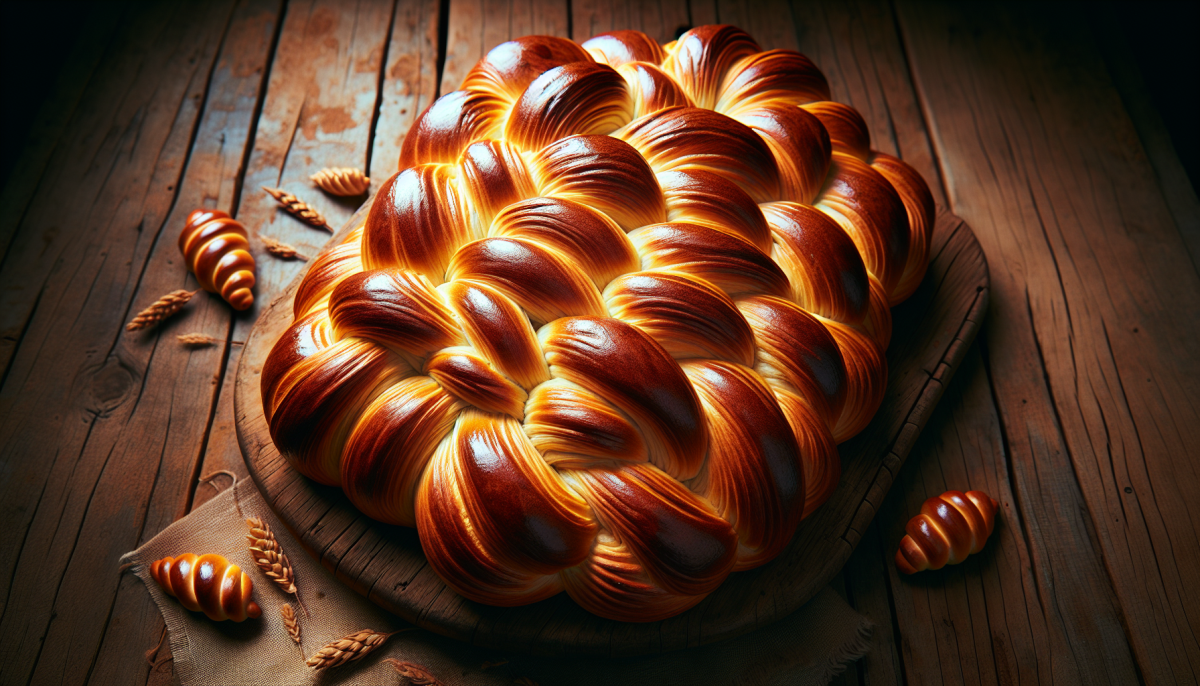
The key to a great water challah is hydration and fat. Without eggs providing moisture and richness, the dough relies on water and oil to create tenderness. A slightly higher hydration level and a generous pour of oil produce a challah that is soft, braids beautifully, and develops a gorgeous golden crust when brushed with an oil-and-turmeric wash (the clever egg-free alternative to egg wash that gives the same warm color).
What Makes This Recipe Special
- 100% egg-free — No eggs in the dough or the wash; suitable for vegan and egg-allergic guests
- Turmeric oil wash — Creates a golden, glossy crust that rivals traditional egg wash
- Historical authenticity — Follows the tradition of pre-modern European Jewish challah
- Clean wheat flavor — Without eggs, the bread and honey flavors shine through more clearly
- Braids beautifully — The dough is slightly firmer than egg challah, making it easier to braid with clean, defined strands
Halachic Notes
- Kosher Classification: Pareve — contains no dairy, meat, or egg ingredients.
- Hafrashat Challah: This recipe uses 600g of flour, which is below the standard shiur. If making multiple loaves totaling over 1.2 kg flour, separate challah without a bracha. With the bracha "ברוך אתה ה׳ אלקינו מלך העולם אשר קדשנו במצותיו וצונו להפריש חלה" at 2.25 kg.
- Egg-Free Benefit: Water challah eliminates the need to check eggs for blood spots, simplifying preparation.
- Pas Yisroel: When a Jewish person lights the oven or contributes to the baking process, this bread fulfills the Pas Yisroel requirement.
- Brachot: Hamotzi lechem min ha’aretz before; Birkat Hamazon after.
Ingredients
| Ingredient | Grams | Volume | Baker’s % |
|---|---|---|---|
| Bread flour | 600g | 4¾ cups | 100% |
| Warm water (38°C / 100°F) | 270g | 1 cup + 2 Tbsp | 45% |
| Neutral oil | 80g | ⅓ cup | 13.3% |
| Honey | 70g | 3 Tbsp | 11.7% |
| Fine sea salt | 10g | 1¾ tsp | 1.7% |
| Instant yeast | 8g | 2½ tsp | 1.3% |
Golden Oil Wash
| Ingredient | Amount |
|---|---|
| Neutral oil | 2 Tbsp |
| Maple syrup or agave | 1 Tbsp |
| Ground turmeric | ¼ tsp |
| Sesame seeds (optional) | For sprinkling |
Instructions
Step 1: Mix the Dough
In a large bowl, combine the warm water, oil, and honey. Add the flour, salt, and yeast. Mix until a shaggy dough forms. Turn onto a lightly floured surface and knead for 10–12 minutes until smooth and elastic. The dough should be slightly firmer than egg challah dough but still pliable and smooth. It should pass the windowpane test.
Step 2: First Rise
Place in a lightly oiled bowl, cover, and let rise at room temperature until doubled, about 1½–2 hours.
Step 3: Shape the Challah
Gently deflate the dough and divide into 4 or 6 pieces for braiding. Roll each piece into a strand about 40 cm (16 in) long. Braid using your preferred method (4-strand or 6-strand), pinching and tucking the ends underneath. Transfer to a parchment-lined baking sheet.
Step 4: Second Rise
Cover loosely and let rise for 30–40 minutes until puffy and nearly doubled. Preheat the oven to 175°C (350°F).
Step 5: Apply the Golden Wash and Bake
Whisk together the oil, maple syrup, and turmeric. Brush generously over the entire challah. Sprinkle with sesame seeds if desired. Bake for 30–35 minutes until deeply golden and the internal temperature reads 88°C (190°F). The crust will be slightly crisper than egg challah. Cool on a wire rack for at least 20 minutes before slicing.
Storage & Make-Ahead
- Room temperature: Store in an airtight bag for 2–3 days. Water challah firms up faster than egg challah but makes exceptional toast.
- Freezing: Wrap tightly in plastic and foil. Freeze up to 3 months. Thaw at room temperature and refresh at 175°C (350°F) for 8 minutes.
- Make-ahead: Shape and refrigerate overnight. Remove 45 minutes before baking to finish rising.
Troubleshooting
| Problem | Cause | Solution |
|---|---|---|
| Challah too dry or crumbly | Not enough water or oil | Measure by weight; ensure full 270g water and 80g oil |
| Pale crust without egg wash | Oil wash too thin or no turmeric | Apply generously; turmeric provides the golden color |
| Stales quickly | Natural for lean breads | Wrap immediately after cooling; freezes excellently |
| Braid losing definition | Over-proofed during second rise | Keep second rise to 30–40 minutes; bake when still slightly firm to touch |
| Dense texture | Under-kneaded or insufficient rise | Knead full 10–12 minutes; allow complete doubling during first rise |
Frequently Asked Questions
Is water challah as good as egg challah?
It’s different, not lesser. Water challah has a cleaner wheat flavor, a slightly chewier crumb, and a crispier crust. Many experienced bakers prefer it for certain applications—it makes better toast, absorbs dips more effectively, and pairs beautifully with savory toppings. For Shabbat, both types are equally valid for hamotzi and lechem mishneh.
Can I use sugar instead of honey?
Yes, substitute with 60g (⅓ cup) granulated sugar. Honey contributes extra moisture and a more complex sweetness, so the challah may be slightly less moist with sugar. Add 1 tablespoon extra water to compensate.
What gives the golden color without eggs?
The turmeric-oil wash is the secret. A tiny amount of turmeric (¼ teaspoon) mixed with oil and maple syrup creates a warm golden color remarkably similar to egg wash. The maple syrup adds browning through its sugars. Together, they produce a challah that looks beautifully golden without any egg.
Is water challah vegan?
If you use maple syrup or agave instead of honey in both the dough and the wash, this challah is fully vegan. Some vegans consider honey acceptable; others do not. Adjust according to your guests’ preferences.
Was challah originally made without eggs?
Yes. The earliest challahs in Eastern Europe were water-based, as eggs were expensive and often reserved for other uses. Egg-enriched challah became standard only as eggs became more affordable and accessible. Many traditional recipes from the shtetl era are egg-free. Water challah is not a modern adaptation—it’s a return to roots.
Enjoy Your Water Challah!
A beautiful, egg-free challah that honors the oldest traditions of Jewish bread baking.
🍞 Get a New Kosher Recipe Every Week
Join our baking community. One recipe, one tip, one story — delivered every Friday before Shabbat.
No spam. Just bread. Unsubscribe anytime.
You Might Also Enjoy
- Classic Kosher Challah — The egg-rich traditional version
- Olive Oil Challah — Another egg-free option with rich flavor
- Overnight No-Knead Challah — Effortless challah ready by morning
- Whole Wheat Challah — Wholesome and nutty
Leave a Reply
You must be logged in to post a comment.