Search 150+ Kosher Recipes
Dairy-Free • Contains Eggs • Contains Gluten
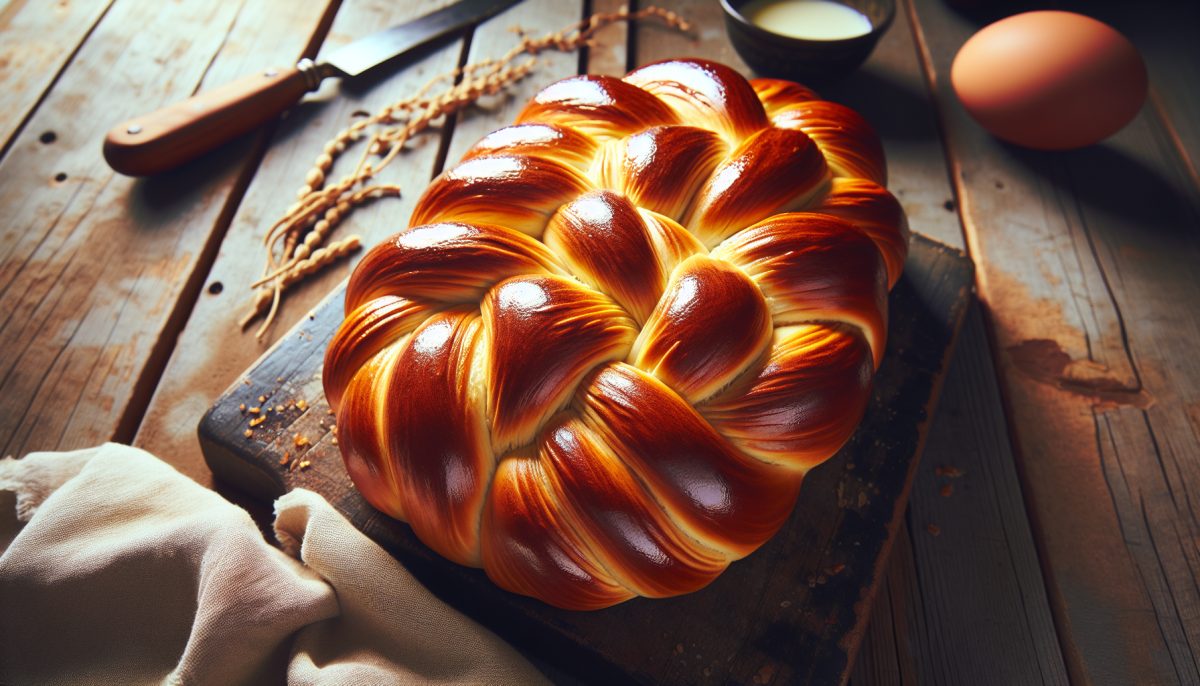
Olive oil challah is the bread that Italian Jews have been baking for centuries. While Ashkenazi challah relies on neutral oil or schmaltz, the Jewish communities of Rome, Livorno, and Venice have always reached for the olive press. The result is a challah with a golden, almost amber hue, a delicate fruity fragrance, and a crumb so tender it practically dissolves on the tongue.
This is a simpler, more rustic challah than its heavily enriched cousins. With fewer eggs and the olive oil taking center stage, the flavor is cleaner, more Mediterranean — bread that tastes of sun-warmed hillsides and ancient groves. It is the challah you want with a bowl of good soup, torn into pieces and shared around a table.
The Italian-Jewish tradition of olive oil challah reminds us that Jewish bread is as diverse as the Jewish people. From the olive groves of Puglia to the Shabbat tables of the Roman Ghetto, this bread has its own beautiful story to tell.
Use the best extra-virgin olive oil you can find. The bread’s flavor depends on it.
What Makes This Special
- Premium olive oil — extra-virgin olive oil as the primary fat, giving fruity depth and golden color.
- Simpler formula — fewer eggs, no honey, letting the olive oil and wheat flavors shine.
- Italian-Jewish heritage — from the oldest continuous Jewish community in Europe.
- Versatile — equally at home at Shabbat dinner or a weeknight supper with soup.
Kosher Observance & Halachic Notes
Kosher Classification: Pareve
Uses olive oil, no dairy. Fully pareve.
Hafrashat Challah
This recipe uses approximately 1000 g of flour, which is below the minimum shiur for hafrashat challah. No separation is required. If you combine multiple batches that together exceed 1,200 g of flour, separation would then apply.
Checking Eggs for Blood Spots
Each egg should be cracked individually into a clear glass and inspected before adding to the dough. If a blood spot is found, discard that egg entirely.
Pas Yisroel
When a Jewish person lights the oven or contributes to the baking, this fulfills Pas Yisroel requirements, preferred or required by many communities.
Brachot (Blessings)
- Before eating: HaMotzi Lechem Min Ha’Aretz
- After eating: Birkat HaMazon
Lechem Mishneh
Yields two loaves for lechem mishneh on Shabbat.
Ingredients
Dough
| Ingredient | Grams | Volume | Baker’s % |
|---|---|---|---|
| Bread flour | 1,000 g | 7½ cups | 100% |
| Fine sea salt | 18 g | 1 Tbsp | 1.8% |
| Instant yeast | 10 g | 1 Tbsp | 1% |
| Granulated sugar | 50 g | ¼ cup | 5% |
| Extra-virgin olive oil | 150 g | ⅔ cup | 15% |
| Large eggs | 150 g | 3 large | 15% |
| Warm water | 280 g | 1 cup + 3 Tbsp | 28% |
| Total Dough Weight | ~1,658 g | — | — |
Egg Wash
- 1 egg + 1 Tbsp water + pinch of salt
Topping
- Flaky sea salt
- Sesame seeds or fresh rosemary (optional)
Target DDT: 26°C (78°F)
To calculate your water temperature:
Water Temp = (DDT × 3) − Flour Temp − Room Temp
The water should feel comfortably warm — never exceed 43°C (110°F) or you risk killing the yeast.
Step-by-Step Instructions
Step 1: Mix the Dough
Combine flour, salt, sugar, and yeast in a stand mixer. Add eggs, olive oil, and warm water. Mix on low 3 minutes until shaggy, then medium 8 minutes until smooth. The dough will be slightly softer than classic challah due to the olive oil’s viscosity.
Step 2: Hafrashat Challah
Separate challah with a bracha (see Halachic Notes).
Step 3: First Rise
Place in a lightly oiled bowl, cover, and rise 1.5 hours until doubled.
Step 4: Shape
Divide into 2 portions, then each into 3 strands. Roll into ropes 40 cm long. Braid into 3-strand loaves. Place on parchment-lined pans.
Step 5: Second Rise
Cover and proof 45–60 minutes until puffy.
Step 6: Bake
Preheat oven to 180°C (355°F). Brush with egg wash, sprinkle with salt and optional toppings. Bake 25–30 minutes until golden. Internal temp: 88°C (190°F). Cool 20 minutes before serving.
Storage & Make-Ahead
- Room temperature: 2–3 days. The olive oil keeps it moist longer than standard challah.
- Freezing: Wrap and freeze up to 3 months.
Troubleshooting
| Problem | Likely Cause | Solution |
|---|---|---|
| Dough feels greasy | Normal with olive oil enrichment | The oil absorbs during kneading and fermentation. Do not add flour. |
| Olive oil flavor too strong | Oil is too peppery or bitter | Use a mild, buttery EVOO. Arbequina or Ligurian varieties work well. |
| Crust too hard | Overbaked or oven too hot | Reduce bake time by 3–5 minutes. Brush with olive oil immediately after baking for a softer crust. |
Frequently Asked Questions
What olive oil should I use?
A mild, fruity extra-virgin olive oil works best. Avoid very peppery or bitter varieties, which can overwhelm the bread. Israeli, Italian, or Spanish Arbequina oils are excellent choices.
How is this different from regular challah?
It uses olive oil instead of neutral oil, fewer eggs, and sugar instead of honey. The result is a cleaner, more Mediterranean flavor with a slightly firmer crumb and beautiful golden color.
Can I make a round loaf?
Yes. Shape into a single long rope and coil for Rosh Hashanah, or free-form into a round boule for everyday baking.
Is olive oil challah traditional?
Very much so. Italian Jews have used olive oil in their challah (called pane del sabato) for over 500 years. It predates the use of neutral vegetable oils in Ashkenazi challah.
🍞 Get a New Kosher Recipe Every Week
Join our baking community. One recipe, one tip, one story — delivered every Friday before Shabbat.
No spam. Just bread. Unsubscribe anytime.
You Might Also Enjoy
- Classic Kosher Challah — The traditional egg-rich version
- Water Challah — Simple egg-free vegan challah
- Za’atar Challah — Mediterranean spiced challah
- Olive Challah — Studded with briny olives
Ready to Bake?
Bookmark this recipe and make it yours this Shabbat.
Save This Recipe
Try our Water Challah Next →
Tag us @kosherbreadpro on Instagram. We answer every comment.
Leave a Reply
You must be logged in to post a comment.