Search 150+ Kosher Recipes
Kosher for Passover
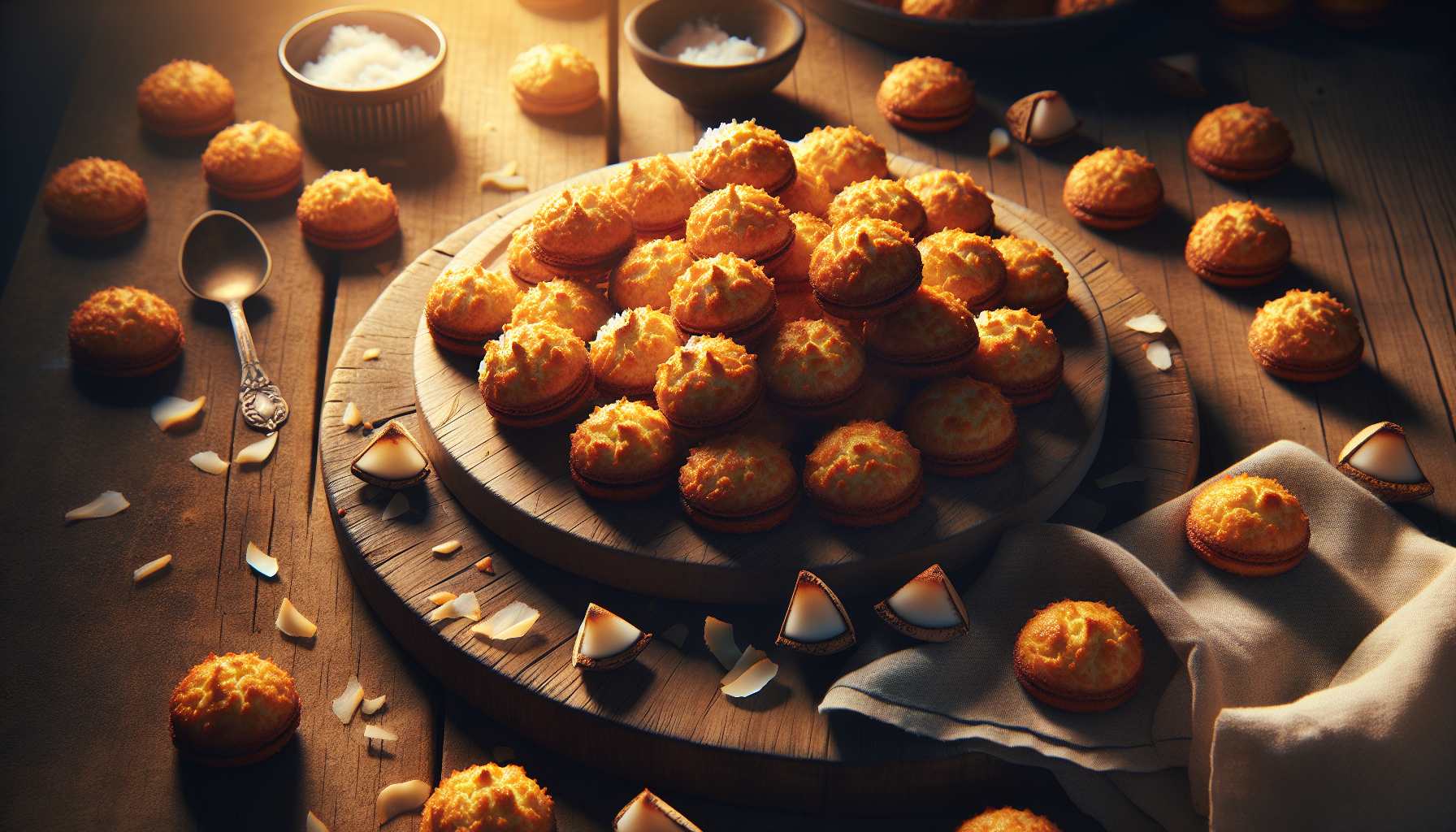
If there is one cookie that defines Passover baking in the American Jewish kitchen, it is the coconut macaroon. Not the French macaron with its fussy meringue shells and ganache filling—the humble, two-bite dome of shredded coconut bound by egg whites, golden and crackled on the outside, impossibly chewy and moist within. Every Jewish bakery in America sets out trays of them in the weeks before Pesach, and every family has an opinion about whether they should be tall or flat, soft or crisp, plain or dipped in chocolate.
The beauty of the coconut macaroon is its radical simplicity. Four ingredients—coconut, sugar, egg whites, vanilla—and you have something that is naturally chametz-free, naturally gluten-free, naturally pareve, and naturally delicious. There is no flour to substitute, no leavening to worry about, no dairy to navigate around a meat meal. The macaroon does not apologize for being a Passover cookie; it is a Passover cookie that happens to be one of the best cookies, period.
The secret to a truly great macaroon—the kind that makes people close their eyes and say “this is the one”—is the ratio of wet to dry and the baking temperature. Too much sugar and the interior turns gummy. Too little egg white and the cookies crumble. Too hot an oven and you get a burned shell with a raw center. Get the balance right, and you achieve that magical contrast: a thin, golden, almost caramelized crust giving way to a tender, coconutty interior that is somehow both chewy and light.
This recipe gives you the classic bakery macaroon plus a chocolate-dipped variation that elevates each cookie into something worthy of any Yom Tov dessert table. They come together in fifteen minutes of active work, require no mixer, no special equipment, and no advanced technique. They are, quite simply, Passover perfection.
What Makes This Recipe Special
- Four-ingredient simplicity — Shredded coconut, sugar, egg whites, and vanilla. No fillers, no condensed milk, no flour of any kind. The coconut is the star, not a supporting player
- Bakery-perfect texture — A precise coconut-to-egg-white ratio produces macaroons with a crisp golden shell and a chewy, moist interior that stays tender for days
- Naturally Passover-friendly — No chametz, no kitniyot, no grain flour. Coconut is permitted by all communities for Pesach, making these universally inclusive
- Chocolate-dipped variation — A quick dip in melted KFP chocolate transforms these from everyday treats into elegant Yom Tov confections
- Pareve by nature — Serve after any meal—meat or dairy—without a moment’s hesitation. Perfect for the Seder table
Halachic Notes
- Kosher Classification: Pareve. All ingredients are naturally pareve. If dipping in chocolate, ensure the chocolate is pareve and certified Kosher for Passover.
- Chametz & Kitniyot: This recipe contains no chametz and no kitniyot. Coconut is not classified as kitniyot and is permitted by all communities—Ashkenazi, Sephardi, and Mizrachi—during Pesach.
- KFP Certification: Verify that shredded coconut carries a reliable Kosher for Passover hechsher. Some brands process coconut on shared equipment with chametz products or add dextrose (potentially chametz-derived). Unsweetened, unflavored shredded coconut with a KFP symbol is ideal.
- Vanilla Extract: Must be certified Kosher for Passover. Standard vanilla extract contains alcohol that may be grain-derived (chametz). Use KFP-certified vanilla extract or substitute pure vanilla sugar with a KFP hechsher.
- Checking Eggs: Each egg must be cracked individually into a clear glass and checked for blood spots before use.
- Hafrashat Challah: Not required—this recipe contains no grain flour.
- Brachot: The bracha before eating is Shehakol, as coconut macaroons contain no grain flour. Some poskim discuss whether coconut warrants Ha’adamah since it grows on a tree (and some argue Ha’eitz), but the consensus for macaroons where the coconut is shredded, mixed, and baked into a new form is Shehakol. After eating, say Borei Nefashot. Follow your family’s minhag if it differs.
Ingredients
Coconut Macaroons
| Ingredient | Grams | Volume | Baker’s % |
|---|---|---|---|
| Sweetened shredded coconut (KFP certified) | 200g | 2⅔ cups | 100% |
| Granulated sugar | 100g | ½ cup | 50% |
| Large egg whites | 100g (about 3 large) | 3 egg whites | 50% |
| Pure vanilla extract (KFP certified) | 5g | 1 tsp | 2.5% |
| Fine sea salt | 2g | ¼ tsp | 1% |
Chocolate Dip (Optional)
| Ingredient | Grams | Volume |
|---|---|---|
| Semisweet or bittersweet chocolate (KFP certified) | 170g | 6 oz |
| Coconut oil (optional, for thinning) | 7g | 1½ tsp |
Instructions
Step 1: Preheat and Prepare
Preheat oven to 165°C (325°F) with a rack in the center position. Line a large baking sheet with parchment paper. The moderate temperature is essential—coconut burns easily, and a gentler heat allows the interior to set before the exterior over-browns.
Step 2: Combine Dry Ingredients
In a large bowl, toss together the shredded coconut, sugar, and salt until evenly distributed. Break up any clumps of coconut with your fingers. This dry mixture should look like fluffy, sugar-coated coconut snow.
Step 3: Add Egg Whites and Vanilla
Add the egg whites and vanilla extract to the coconut mixture. Remember: each egg must be cracked into a clear glass and checked for blood spots before separating. Stir with a sturdy spatula or wooden spoon until every strand of coconut is coated and the mixture holds together when squeezed. It should be moist and cohesive but not runny. If the mixture seems too dry, add one additional egg white (about 33g). If too wet, add a tablespoon of shredded coconut.
Step 4: Shape the Macaroons
Using a small ice cream scoop (about 3 tablespoons / 40–45g each) or two spoons, portion the mixture into mounds on the prepared baking sheet. Space them about 4 cm (1½ inches) apart—they will not spread much. Pack each scoop firmly so the macaroons hold their dome shape. You should get about 24 macaroons. For a bakery-style look, shape each mound into a tall dome or pyramid rather than a flat disc.
Step 5: Bake
Bake for 22–28 minutes at 165°C (325°F) until the macaroons are golden brown on the edges and tops, with the peaks turning a deep amber. The centers should still feel slightly soft when gently pressed—they will firm up as they cool. Rotate the pan halfway through baking for even browning. Do not underbake (pale, soft macaroons lack the signature crust) or overbake (dark brown all over means dry interiors).
Step 6: Cool Completely
Let the macaroons cool on the baking sheet for 10 minutes—they are very fragile when hot. Transfer to a wire rack and cool completely before handling or dipping in chocolate. The exterior will crisp further as they cool, developing that satisfying crackle.
Step 7: Chocolate Dip (Optional)
Melt the chocolate in a heatproof bowl set over barely simmering water (double boiler) or in the microwave in 30-second bursts, stirring between each. If the chocolate is too thick for dipping, stir in the coconut oil until smooth. Dip the bottom of each macaroon into the melted chocolate, letting excess drip off, then place on a parchment-lined sheet. For a more dramatic presentation, dip each macaroon halfway up the sides. Alternatively, drizzle melted chocolate over the tops with a fork for an elegant finish. Refrigerate for 15 minutes until the chocolate is fully set.
Storage & Make-Ahead
- Room temperature: Up to 5 days in an airtight container. The exterior stays crisp for the first 2 days, then softens to a uniformly chewy texture—delicious either way.
- Refrigerated: Up to 10 days in an airtight container. Bring to room temperature for 10 minutes before serving, or enjoy them chilled for a denser, fudgier bite.
- Frozen: Up to 3 months. Freeze in a single layer on a sheet pan until solid, then transfer to a freezer bag or container with parchment between layers. Thaw at room temperature for 20 minutes. Chocolate-dipped macaroons freeze especially well.
- Make-ahead for Pesach: Bake up to 2 weeks before Pesach and freeze. Thaw the day before the Seder. Dip in chocolate after thawing for the freshest chocolate coating, or dip before freezing—both methods work beautifully.
Troubleshooting
| Problem | Cause | Solution |
|---|---|---|
| Macaroons too dry and crumbly | Not enough egg white, or overbaked | Add an extra egg white next time; pull from oven when edges are golden but centers are still slightly soft |
| Macaroons flat and spreading | Too much egg white, or not packed firmly enough | Use exactly 3 egg whites for 200g coconut; pack each scoop tightly into a compact dome |
| Burnt outside, raw inside | Oven temperature too high | Bake at 165°C (325°F), not higher. Use an oven thermometer to verify. Move to a lower rack if tops brown too fast |
| Macaroons sticking to pan | No parchment paper, or removed too soon | Always use parchment; let cool 10 minutes on the pan before transferring |
| Chocolate not setting on dipped macaroons | Chocolate overheated or room too warm | Melt chocolate gently (never above 50°C / 120°F); refrigerate dipped macaroons for 15 minutes |
| Interior gummy or overly dense | Too much sugar or underbaked | Follow the sugar ratio precisely; ensure full bake time of 22–28 minutes until golden |
| Pale color, no golden crust | Underbaked or oven too cool | Bake until edges and peaks are distinctly golden-amber; verify oven temperature with a thermometer |
Frequently Asked Questions
Can I use unsweetened coconut instead of sweetened?
Yes, but you must increase the sugar to 150g (¾ cup) to compensate. Unsweetened coconut also tends to be drier, so you may need a fourth egg white to achieve the right moisture level. The texture will be slightly less chewy and more nutty in flavor. Many bakers prefer sweetened shredded coconut because its added moisture produces the classic soft, moist interior.
Why are my macaroons nothing like the ones from the bakery?
Most commercial bakeries use condensed milk, which creates an extremely moist, candy-like texture. This recipe uses only egg whites for binding, producing a more traditional, lighter macaroon with better textural contrast between the crisp shell and chewy center. If you want a denser, more confection-style macaroon, you can replace the egg whites with 120g (about ⅓ cup) of sweetened condensed milk—but ensure it is certified Kosher for Passover and note that it will make the cookies dairy.
Is coconut considered kitniyot?
No. Coconut is universally permitted during Pesach by all Jewish communities. It is not a legume, grain, or seed in the halachic sense. It grows on a palm tree and was never included in any list of kitniyot by any major posek. You will find coconut products with Kosher for Passover certification from all major hechsherim. The only concern is ensuring the specific product was not processed with chametz-containing additives or on chametz equipment.
How do I get tall, domed macaroons instead of flat ones?
The key is packing the mixture firmly. Use a small ice cream scoop and press the coconut mixture tightly into it before releasing onto the baking sheet. You can also shape by hand: take a portion, squeeze it firmly in your palm, then set it down without pressing flat. The mixture should be cohesive but not wet—if it slumps and spreads, you have too much egg white.
Can I add other flavors or mix-ins?
Absolutely. For almond macaroons, add ½ teaspoon of almond extract alongside the vanilla. For a tropical twist, fold in 40g (3 tablespoons) of finely chopped dried pineapple or mango (KFP certified). A pinch of ground cinnamon or cardamom adds warmth. You can also press a whole almond or pecan into the top of each macaroon before baking. Just ensure every addition carries a Kosher for Passover hechsher.
Chag Pesach Sameach!
Four ingredients, zero chametz, infinite satisfaction. These macaroons prove that the simplest Passover baking is often the most beloved.
Leave a Reply
You must be logged in to post a comment.