Search 150+ Kosher Recipes
Butter • Milk • Eggs • Contains Gluten
16 sufganiyot
Intermediate
1½ hours
4–5 hours
Mezonot
Two great traditions walk into a kitchen. One is 2,000 years old. The other is from a Boston hotel in the 1850s. What comes out of the fryer is nothing short of magnificent.
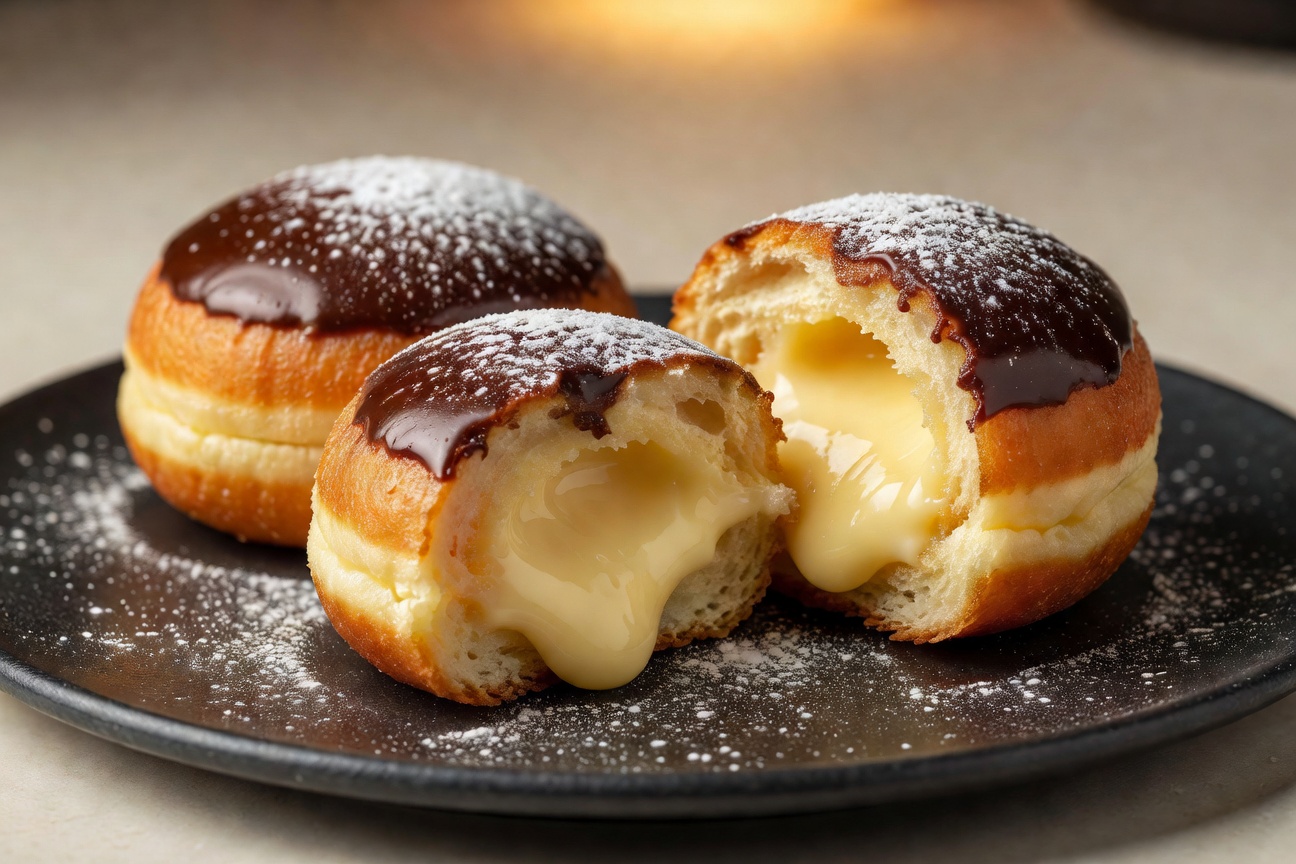
Picture this: a golden sufganiya, still warm from the oil, impossibly light and tender. You lift it and feel the weight of the custard inside — a silky vanilla pastry cream, made with real butter and whole milk, rich enough to make a Parisian pâtissier nod in approval. And on top, a glossy dome of dark chocolate ganache, cracked at the edges where it meets the powdered sugar, pooling slightly like a beret tilted to one side.
The Boston cream pie was invented at the Parker House Hotel in 1856 — a sponge cake filled with custard and glazed with chocolate. It became the official dessert of Massachusetts. Now imagine that flavour profile, that perfect trinity of vanilla custard, tender crumb, and dark chocolate, translated into the language of Israeli sufganiyot. Fried in oil. Filled to bursting. Eaten standing up in the kitchen with powdered sugar on your shirt.
This is not a gimmick. This is a recipe that honours both traditions — the miracle of oil and the genius of a 19th-century Boston pastry chef — and produces something genuinely extraordinary.
Hanukkah meets New England. The miracle of oil meets the miracle of custard. Your kitchen will never be the same.
What Makes These Boston Cream Sufganiyot Special
This recipe combines classical French pastry technique with Israeli frying tradition. Every component is made from scratch, every decision is deliberate, and the result is a sufganiya that could stand beside any Boston cream pie and hold its own.
- Enriched dairy dough with butter and milk — Unlike pareve sufganiyot made with oil and water, this dough uses butter and whole milk for a richer crumb, a more golden crust, and that distinctly tender, brioche-like texture that Boston cream pie demands.
- Real vanilla pastry cream (crème pâtissière) — Made the French way: whole milk, egg yolks, sugar, cornstarch, butter, and pure vanilla. No shortcuts, no instant pudding. The custard sets perfectly for piping and holds its shape inside the warm donut.
- Dark chocolate ganache glaze — A 2:1 ratio of semisweet chocolate to heavy cream, applied warm so it pools into a glossy cap that sets with a gentle snap. This is the signature of every great Boston cream.
- Precision frying at 170°C (340°F) — The exact temperature that gives you a golden exterior in 90 seconds per side without burning or absorbing excess oil.
- Baker’s percentages for scaling — Whether you’re making 16 for the family or 160 for the shul Hanukkah party, the math is built in.
Kosher Observance & Halachic Notes
Kosher Classification: Dairy (Milchig)
This recipe uses butter, whole milk, and heavy cream, making it milchig (dairy). It may not be served with or after a meat meal. A minimum of six hours must pass after eating meat before consuming these sufganiyot (Ashkenazi custom; consult your rav for your community’s practice). If you need a pareve version, see the notes in the FAQ below.
Bracha: Mezonot
The bracha for sufganiyot is Mezonot. Because they are deep-fried rather than baked, and the dough is enriched with a significant proportion of sugar, eggs, and fat, they are classified as pas haba’ah b’kisnin (snack-type bread products). The after-bracha is Al HaMichya.
Hafrashat Challah
This recipe uses 500 g of flour, which is below the threshold requiring separation of challah with a bracha in most Ashkenazi communities (approximately 1,200–1,667 g depending on the posek). If you double or triple the recipe for a large batch, separate challah with the bracha. Consult your rabbi for your community’s specific practice.
Checking Eggs
Each egg must be cracked individually into a clear glass and inspected for blood spots before adding to the dough or the pastry cream. If a blood spot is found, discard the entire egg.
Frying Oil
The oil used for deep frying must bear a reliable hechsher (kosher certification). Since this is a dairy recipe, the frying oil must be designated for dairy use and should not be reused for pareve or meat frying.
Dairy Ingredients
All dairy ingredients — butter, milk, and cream — must carry a reliable chalav Yisrael certification if your community observes this standard. For those who follow the leniency of Rav Moshe Feinstein (chalav stam), standard certified kosher dairy products are acceptable.
Pas Yisroel
Because sufganiyot are deep-fried rather than baked, many poskim hold that they are not in the category of pas (bread) and thus Pas Yisroel does not apply. However, some are stringent. To satisfy all opinions, a Jewish person should turn on the fryer or contribute to the cooking process.
Ingredients
Sufganiyot Dough — Dairy Version
| Ingredient | Grams | Volume | Baker’s % |
|---|---|---|---|
| Bread flour (unbleached, 12–13% protein) | 500 g | 3¾ cups | 100% |
| Granulated sugar | 65 g | ⅓ cup | 13% |
| Fine sea salt | 8 g | 1½ tsp | 1.6% |
| Instant (rapid-rise) yeast | 10 g | 1 Tbsp | 2% |
| Large eggs, room temperature (checked for blood spots) | 100 g | 2 large eggs | 20% |
| Large egg yolks, room temperature | 36 g | 2 yolks | 7.2% |
| Unsalted butter, softened (with hechsher) | 55 g | 4 Tbsp | 11% |
| Whole milk, warm (38°C / 100°F) | 160 g | ⅔ cup | 32% |
| Pure vanilla extract | 6 g | 1½ tsp | 1.2% |
| Lemon zest (1 lemon) | 4 g | 2 tsp | 0.8% |
Total hydration: ~59% (milk + eggs + yolks + vanilla). For frying: 1.5–2 litres of neutral vegetable oil (canola or sunflower with hechsher).
Vanilla Pastry Cream (Crème Pâtissière)
| Ingredient | Grams | Volume |
|---|---|---|
| Whole milk | 360 g | 1½ cups |
| Granulated sugar | 75 g | ⅓ cup + 1 Tbsp |
| Large egg yolks (checked for blood spots) | 72 g | 4 yolks |
| Cornstarch | 32 g | 3 Tbsp + 1 tsp |
| Fine sea salt | 2 g | ¼ tsp |
| Unsalted butter, cold and cubed | 28 g | 2 Tbsp |
| Pure vanilla extract (or 1 vanilla bean, scraped) | 8 g | 2 tsp |
Dark Chocolate Ganache Glaze
| Ingredient | Grams | Volume |
|---|---|---|
| Semisweet or dark chocolate (55–60% cocoa, with hechsher), finely chopped | 170 g | 6 oz |
| Heavy cream (36% fat) | 85 g | ⅓ cup + 1 Tbsp |
| Light corn syrup (for gloss, optional) | 15 g | 1 Tbsp |
Calculate your milk temperature:
Milk Temp = (DDT × 3) − Flour Temp − Room TempExample: if your kitchen is 22°C and flour is 22°C, warm milk to 34°C (93°F).
Step-by-Step Instructions
Step 1: Make the Pastry Cream (Do This First — It Needs to Chill)
In a medium saucepan, bring the milk to a gentle simmer over medium heat. While it heats, whisk the egg yolks, sugar, cornstarch, and salt together in a bowl until smooth and pale — about 1 minute of vigorous whisking.
When the milk begins to steam and tiny bubbles appear at the edges, pour about one-third of the hot milk into the yolk mixture while whisking constantly. This is tempering — it raises the temperature of the yolks gradually so they don’t scramble. Pour the tempered yolk mixture back into the saucepan and cook over medium heat, whisking constantly and vigorously. The custard will thicken suddenly after 2–3 minutes. Continue whisking for 1 full minute after it thickens to cook out the cornstarch taste. Remove from heat, add the cold butter and vanilla, and stir until the butter is fully melted and incorporated.
Transfer to a shallow bowl, press plastic wrap directly onto the surface (this prevents a skin from forming), and refrigerate for at least 2 hours. The pastry cream must be fully cold before filling.
Step 2: Mix the Dough
In the bowl of a stand mixer fitted with the dough hook, combine the flour, sugar, salt, and yeast. Stir briefly to distribute. Add the eggs, egg yolks, warm milk, vanilla, and lemon zest. Mix on low speed (speed 2) for 3 minutes until the dough comes together into a shaggy mass.
Increase to medium speed (speed 4) and knead for 6–8 minutes. The dough should become smooth and begin to pull away from the sides of the bowl. Now add the softened butter, one tablespoon at a time, mixing on medium speed. After each addition, wait until the butter is fully absorbed before adding the next. This takes about 4–5 minutes total. The finished dough should be smooth, supple, and slightly tacky — it should pass the window pane test (stretch a small piece thin enough to see light through without tearing).
Step 3: Bulk Fermentation
Shape the dough into a ball and place it in a lightly oiled bowl. Cover tightly with plastic wrap and let rise at room temperature (24–26°C / 75–78°F) for 1½ to 2 hours, until doubled in size. The dough should feel puffy and airy when you press it gently with a floured finger.
Step 4: Shape the Sufganiyot
Turn the dough out onto a lightly floured work surface. Roll it to an even thickness of 1.5 cm (⅝ inch). Use a 7 cm (2¾ inch) round cutter to stamp out circles, cutting as close together as possible. You should get 14–16 rounds. Gently re-roll scraps once to get additional rounds (these will be slightly less uniform but still delicious).
Place the rounds on parchment-lined baking sheets, spacing them 5 cm (2 inches) apart. Cover loosely with a lightly oiled sheet of plastic wrap and let proof for 30–40 minutes. The rounds should be visibly puffy and spring back slowly when pressed.
Step 5: Fry the Sufganiyot
Fill a heavy-bottomed pot or Dutch oven with oil to a depth of at least 8 cm (3 inches). Heat the oil to 170°C (340°F). Use a thermometer — do not guess. This temperature is critical.
Carefully lower 3–4 sufganiyot at a time into the oil using a slotted spoon or spider. Do not crowd the pot — the oil temperature will drop too much. Fry for 90 seconds per side, until deep golden brown. The sufganiyot will puff dramatically during frying, developing a pale ring around the equator — this is the sign of a properly proofed and fried sufganiya.
Remove to a wire rack set over a sheet pan. Do not drain on paper towels — the steam gets trapped underneath and makes the bottoms soggy. Monitor the oil temperature between batches, letting it return to 170°C before adding the next round. Let the sufganiyot cool completely before filling — at least 30 minutes.
Step 6: Fill with Pastry Cream
Transfer the chilled pastry cream to a piping bag fitted with a long, narrow filling tip (a Bismarck tip or any round tip about 5 mm wide). Push the tip into the side of each sufganiya, aiming for the centre, and gently squeeze while slowly pulling back. You should feel the sufganiya grow heavier in your hand. Fill each one with approximately 25–30 g of custard. Wipe any overflow from the entry point.
Step 7: Make the Chocolate Ganache
Place the chopped chocolate in a heatproof bowl. Heat the cream in a small saucepan until it just begins to simmer — small bubbles at the edges, not a full boil. Pour the hot cream over the chocolate, add the corn syrup if using, and let sit undisturbed for 2 minutes. Then stir gently from the centre outward in concentric circles until the ganache is perfectly smooth and glossy. If any chocolate pieces remain, microwave in 10-second bursts, stirring between each.
Let the ganache cool for 5–8 minutes until it thickens slightly but is still pourable — it should coat the back of a spoon. If it gets too thick, rewarm gently over a water bath.
Step 8: Glaze and Serve
Dip the top of each filled sufganiya into the warm ganache, submerging about one-third of the way down. Lift, let the excess drip off for a few seconds, then twist gently and place right-side up on the wire rack. The ganache will set into a glossy, dark chocolate cap within 10–15 minutes at room temperature.
Serve as-is for a clean, elegant look, or dust the unglazed portion lightly with powdered sugar for the classic sufganiyot finish.
Storage & Make-Ahead Tips
Room Temperature
Best eaten within 6–8 hours of frying. The dough stays tender, the custard stays cool, and the ganache stays glossy. After that, the pastry cream must be refrigerated for food safety.
Refrigerator
Store filled sufganiyot in an airtight container in the fridge for up to 24 hours. Bring to room temperature for 20 minutes before serving, or enjoy cold — the chilled custard has its own appeal.
Make-Ahead Strategy
- Pastry cream: Make up to 2 days ahead. Keep refrigerated with plastic wrap pressed on the surface. Whisk smooth before piping.
- Dough: Mix the dough, let it rise for 30 minutes, then refrigerate overnight (cold retard). The next day, bring to room temperature for 1 hour, then shape, proof, and fry.
- Ganache: Make up to 3 days ahead. Reheat gently in a water bath or microwave in 10-second bursts until pourable.
- Fry, fill, and glaze on serving day for the best texture.
Freezing
Fried but unfilled sufganiyot freeze well for up to 1 month. Cool completely, wrap individually in plastic, and place in a freezer bag. Thaw at room temperature, refresh in a 175°C (350°F) oven for 3–4 minutes, then fill and glaze.
Shabbat & Hanukkah Timing
Since these are dairy, they pair perfectly with a dairy Shabbat lunch or a Hanukkah party menu. For Friday serving: make pastry cream Wednesday, make dough Thursday night (cold retard), fry and assemble Friday morning.
Troubleshooting
| Problem | Likely Cause | Solution |
|---|---|---|
| Sufganiyot are greasy | Oil temperature too low | Maintain 170°C (340°F). Use a thermometer. Let oil recover between batches. |
| Dark outside, raw inside | Oil temperature too high | Lower to 170°C. Fry fewer at a time. Roll dough no thicker than 1.5 cm. |
| Pastry cream is lumpy | Eggs scrambled during tempering | Add hot milk to eggs slowly while whisking vigorously. Strain through a sieve if lumps form. |
| Pastry cream is too thin | Not cooked long enough after thickening | After the custard thickens, keep whisking over heat for 1 full minute to fully activate cornstarch. |
| Ganache is grainy or split | Cream was too hot, or stirred too early | Heat cream to just below boiling. Let sit on chocolate 2 minutes before stirring. If split, add 1 Tbsp warm cream and whisk vigorously. |
| Sufganiyot deflated after frying | Overproofed before frying | Proof only until visibly puffy (30–40 min). The poke test: dough should spring back slowly. |
| Custard leaks out the filling hole | Entry hole too large, or overfilled | Use a narrow tip (5 mm). Fill to 25–30 g per donut. Pipe slowly and stop before the cream pushes back out. |
Frequently Asked Questions
Can I make a pareve version?
Yes. Replace the butter in the dough with 45 g neutral vegetable oil, and the milk with warm water. For the pastry cream, use full-fat coconut milk in place of whole milk, coconut oil in place of butter, and ensure your chocolate and cream replacements are certified pareve. The texture will be slightly different — coconut milk custard sets a bit firmer — but it works beautifully. For the ganache, use coconut cream or a pareve whipping cream substitute.
What kind of chocolate works best for the ganache?
Use a good-quality semisweet or bittersweet chocolate in the 55–60% cocoa range. Avoid chocolate chips — they contain stabilizers that prevent smooth melting. Bars or couverture chocolate (such as Callebaut, Valrhona, or any bar with a hechsher) will give you the glossiest, smoothest ganache.
Can I use a different filling in addition to the pastry cream?
Absolutely. The Boston cream concept is specifically vanilla custard + chocolate, but you could experiment: mocha pastry cream (add 2 tsp instant espresso to the hot milk), white chocolate ganache on top with vanilla cream inside, or add a thin layer of raspberry jam at the bottom of the filling before piping in the custard for a “Boston berry” variation.
How do I know when the oil is at the right temperature without a thermometer?
Drop a small cube of bread into the oil. At 170°C, it should sizzle immediately and turn golden in about 60 seconds. If it browns in 20 seconds, the oil is too hot. If it just sits there sadly, the oil is too cool. That said — buy a thermometer. They cost less than a bag of flour and they eliminate the single biggest variable in frying.
Why butter in the dough instead of oil?
Butter contributes flavour, richness, and a more tender, cake-like crumb that is closer to the Boston cream pie experience. Oil makes a slightly chewier, more “bready” sufganiya (which is wonderful for the classic version). This recipe intentionally leans into the dairy richness to honour both traditions. The butter also helps the crust fry to a deeper golden colour.
Loved This Recipe?
Save it to your collection and explore more Jewish baking traditions.
Leave a Reply
You must be logged in to post a comment.