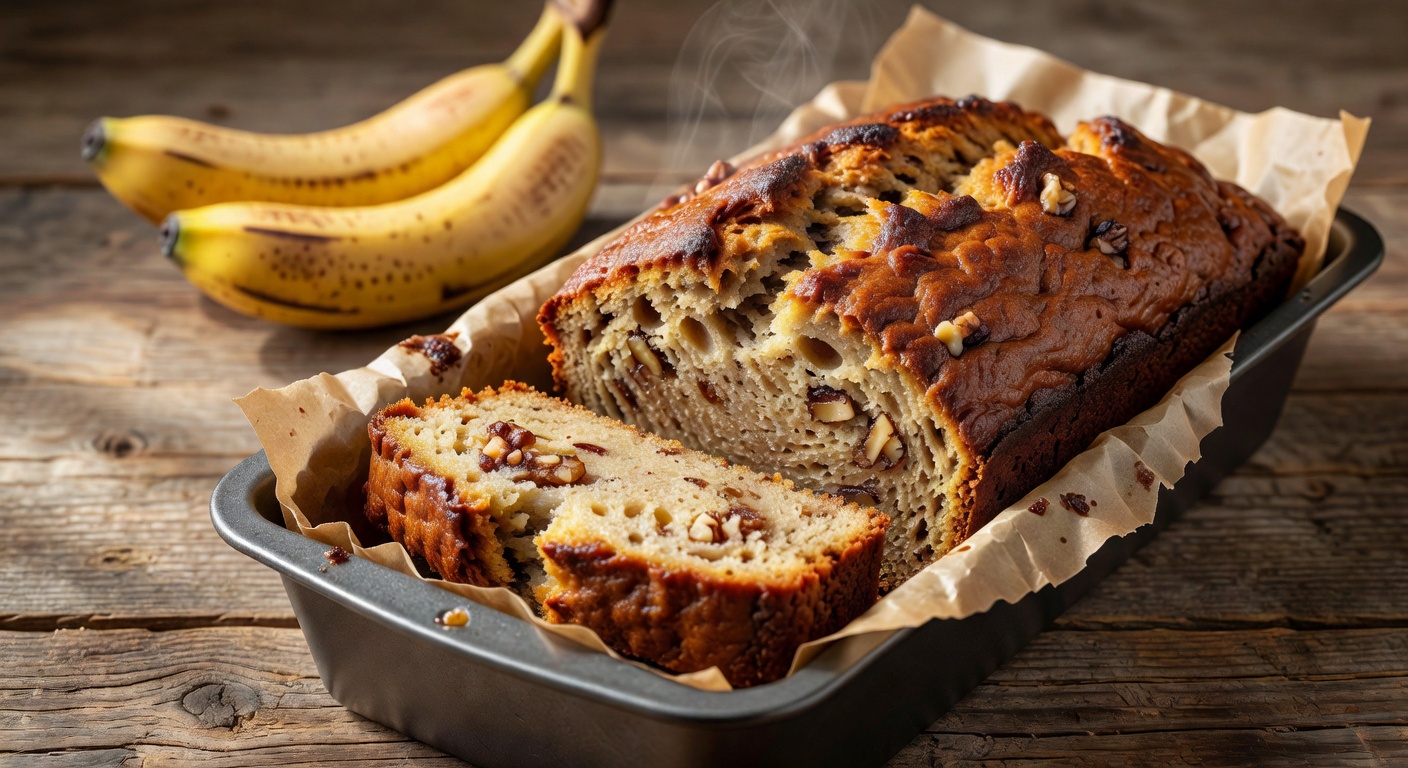
Banana bread has no ancient heritage, no holiday association, no liturgical significance. It does not appear in the Talmud. No grandmother carried the recipe from the Old Country. And yet it has become one of the most baked items in Jewish kitchens across America—because it solves a problem that every Jewish household faces: what to do with overripe bananas on a Friday morning when you need something for Shabbat dessert.
Most banana bread recipes call for butter. This one does not. Oil replaces butter, making the bread pareve—suitable after meat or dairy meals. This is not a compromise; it is an upgrade. Oil produces a banana bread that is more moist, more tender, and stays fresh longer than any butter version. The bananas provide so much flavour and moisture that butter is genuinely unnecessary. You will not miss it. No one will know. They will only know that this is the best banana bread they have ever tasted.
The method is nearly effortless: mash bananas, whisk in oil and eggs, fold in flour and leavening, pour into a loaf pan, bake. One bowl. One whisk. One pan. Fifteen minutes of active work for a loaf that fills the kitchen with the most intoxicating smell in baking—that caramelized banana sweetness that makes everyone wander into the kitchen asking “what’s in the oven?”
This recipe uses the ripest, blackest, most embarrassing bananas you can find. The ones you hid behind the cereal box. The ones with fruit flies circling. Those are the ones that make extraordinary banana bread, because overripeness converts starch to sugar, producing deeper flavour, more moisture, and a natural sweetness that means you can use less added sugar. Do not waste beautiful yellow bananas on this recipe. They will produce a bland, starchy loaf. Ugly bananas make beautiful bread.
What Makes This Recipe Special
- Pareve and proud — Oil-based with no dairy. Serve after Friday night chicken, Saturday dairy lunch, or Wednesday dinner. No waiting, no worrying
- One bowl, fifteen minutes — Mash, whisk, fold, pour, bake. No creaming butter, no separating eggs, no multiple bowls. The simplest recipe on this entire site
- Overripe bananas = better bread — Black, spotted bananas have more sugar, more moisture, and deeper flavour than yellow ones. This recipe converts fruit-bowl failures into kitchen triumphs
- Extra banana for moisture — Most recipes use 3 bananas. This one uses 4. The extra banana means more flavour, more moisture, and a loaf that stays soft for days
- Brown sugar depth — A mix of brown and white sugar creates a deeper, more caramelized flavour than white sugar alone. The molasses in brown sugar complements the banana beautifully
- Freezer-to-lunchbox ready — Slice and freeze individually. Pull a slice in the morning and it’s thawed by lunch. The ultimate pareve snack
Halachic Notes
- Kosher Classification: Pareve — contains no dairy or meat ingredients. Eggs must be checked for blood spots.
- Hafrashat Challah: This recipe uses 240g of flour, well below the shiur. No separation required.
- Brachot: Borei minei mezonot before; Al hamichya after. Banana bread is a baked good from the five grains and is classified as mezonot, not ha’adamah (which would apply to plain bananas).
- Pas Yisroel: While banana bread is mezonot, some authorities extend Pas Yisroel to all baked goods from the five grains. A Jewish person should light the oven or be involved in the baking.
- Shabbat Timing: Bake before Shabbat. Banana bread is excellent at room temperature and needs no reheating. It can also be wrapped in foil and placed on a hot plate or blech for a warm Shabbat dessert.
- Chocolate Chips (Optional): If adding chocolate chips, verify they are pareve. Many chocolate chips carry dairy or DE designations. Check the label carefully.
Ingredients
| Ingredient | Grams | Volume | Baker’s % |
|---|---|---|---|
| All-purpose flour | 240g | 2 cups | 100% |
| Overripe bananas (peeled weight) | 400g (4 large) | ~1¾ cups mashed | 167% |
| Light brown sugar, packed | 100g | ½ cup packed | 42% |
| Granulated sugar | 50g | ¼ cup | 21% |
| Neutral oil (canola or sunflower) | 80g | ⅓ cup | 33% |
| Large eggs, room temperature | 100g (2 large) | 2 eggs | 42% |
| Pure vanilla extract | 5g | 1 tsp | 2% |
| Baking soda | 5g | 1 tsp | 2% |
| Fine salt | 3g | ½ tsp | 1.3% |
| Ground cinnamon (optional) | 2g | ¾ tsp | 0.8% |
| Walnuts, roughly chopped (optional) | 60g | ½ cup | 25% |
Step-by-Step Instructions
Step 1: Prepare the Pan
Preheat the oven to 175°C (350°F). Grease a 23×13cm (9×5 inch) loaf pan with oil and line the bottom and two long sides with a strip of parchment paper, leaving a 5cm (2-inch) overhang on each side. This parchment sling makes unmolding effortless.
Step 2: Mash the Bananas
In a large bowl, mash the bananas with a fork until mostly smooth. A few small lumps are fine—they create pockets of concentrated banana flavour in the finished bread. Do not use a blender or food processor; puréed bananas produce a dense, gummy texture rather than the tender, rustic crumb you want.
Step 3: Mix the Wet Ingredients
Add the oil, brown sugar, white sugar, eggs, and vanilla to the mashed bananas. Whisk until well combined and the sugars are mostly dissolved. The mixture will be thick, fragrant, and slightly foamy.
Step 4: Add the Dry Ingredients
Sprinkle the flour, baking soda, salt, and cinnamon (if using) over the wet mixture. Fold gently with a spatula or wooden spoon until just combined. You should see no dry pockets of flour, but do not mix beyond that point. Overmixing develops gluten and turns the bread tough and chewy. A few streaks of flour are better than an overmixed batter. If adding walnuts, fold them in now with 2–3 final strokes.
Step 5: Pour and Bake
Pour the batter into the prepared loaf pan and smooth the top. For a classic split down the center, run a lightly oiled knife or spatula down the length of the batter, about 1cm (½ inch) deep. Bake at 175°C (350°F) for 55–65 minutes. The bread is done when the top is deeply golden, the crack down the center looks set (not wet), and a wooden skewer inserted into the center comes out clean or with a few moist crumbs. If the top browns too quickly, tent loosely with foil after 40 minutes.
Step 6: Cool
Let the bread cool in the pan for 10 minutes. Use the parchment overhang to lift the loaf out of the pan and transfer to a wire rack. Cool for at least 30 minutes before slicing. Banana bread slices best when slightly warm, not hot—the crumb needs time to set. Use a serrated knife for clean slices.
Storage & Make-Ahead
- Room temperature: Wrap tightly in plastic wrap or store in an airtight container. Stays moist for 3–4 days. The banana continues to flavour the bread as it sits.
- Refrigerator: Wrapped in plastic, up to 7 days. Bring to room temperature before serving, or toast slices lightly.
- Freezer: Wrap the entire loaf or individual slices in plastic wrap, then foil. Freezes for up to 3 months. Thaw at room temperature or toast directly from frozen for a warm, crispy-edged slice.
- Overripe banana storage: Freeze whole bananas (in their peels) whenever they get too ripe. Collect 4 and you’re ready to bake. Thaw at room temperature for 30 minutes before using—they will be mushy and perfect.
- Shabbat Prep: Bake Thursday or Friday morning. Excellent at room temperature. Can also be sliced and served alongside challah French toast for a Shabbat brunch.
Troubleshooting
| Problem | Cause | Solution |
|---|---|---|
| Bland banana flavour | Bananas not ripe enough | Use only heavily spotted, black-peeled bananas. Yellow bananas are starchy and flavourless when baked. Oven-ripen if needed (150°C / 300°F, 15–20 min) |
| Dense, gummy texture | Batter overmixed, bananas puréed too smooth, or too much flour | Mash with a fork (not a blender). Fold flour in gently. Weigh flour (240g) rather than scooping |
| Raw center, dark crust | Oven too hot or loaf too thick | Use an oven thermometer. Tent with foil if top browns before center sets. Ensure pan is standard 9×5 inch—a smaller pan creates a taller loaf that bakes unevenly |
| Flat, spread loaf | Baking soda expired or too little used | Baking soda loses potency after 6 months. Test by adding a drop of vinegar—it should fizz vigorously. Use the full 5g (1 tsp) |
| Sticks to the pan | Pan not lined or greased properly | Always use the parchment sling method. Oil the pan before placing parchment. The sugar in the bread caramelizes and sticks aggressively without a liner |
| Soggy bottom | Bread cooled in the pan too long, trapping steam | Remove from pan after 10 minutes and cool on a wire rack. Air circulation under the loaf prevents condensation |
Frequently Asked Questions
Can I add chocolate chips?
Yes, and it’s wonderful. Fold in 100g (⅔ cup) of pareve chocolate chips with the nuts (or instead of them). Verify the chips are pareve—many brands are dairy or dairy equipment. Pareve options include certain Enjoy Life and Trader Joe’s varieties. Check every time you buy, as certifications can change. The combination of banana and dark chocolate is magnificent, and the chips melt into gooey pockets throughout the bread.
Why oil instead of butter?
Three reasons: kashrut (oil is pareve, butter is dairy), moisture (oil stays liquid at room temperature, keeping the crumb soft for days), and simplicity (no need to cream softened butter—just whisk and go). Banana bread made with oil is actually superior in texture to butter versions, which begin to dry and stiffen within a day as the butter solidifies. This is one of those rare cases where the kosher-friendly option is genuinely the better option.
How ripe is too ripe?
There is no such thing as too ripe for banana bread. Bananas with completely black peels, bananas that have been in the freezer for three months, bananas so soft that the peel splits—all of these are perfect. The only bananas that are truly unusable are those with mould (discard) or fermentation (if they smell alcoholic, they have gone past the point of usefulness). Short of that, the uglier the banana, the better the bread.
Can I make muffins instead of a loaf?
Absolutely. Fill standard muffin cups (greased or lined) about three-quarters full. Bake at 175°C (350°F) for 20–25 minutes. The recipe yields 12 muffins. Reduce baking time and check early—muffins bake faster than a loaf because of the increased surface area. Banana muffins are ideal for lunchboxes and on-the-go snacking.
Is banana bread actually bread?
Not in the halachic sense and not in the baking sense. Banana bread is a quick bread—leavened with baking soda rather than yeast, with a batter-like consistency rather than a dough. It is closer to cake than to bread. Halachically, the bracha is mezonot (as for cake), not hamotzi (as for bread). The name “bread” is a historical convention from American baking, not a technical description. Call it what you like; it tastes the same either way.
More Pareve Baking
Try our classic marble cake or explore the Shavuot dairy collection.