
Can You Freeze Challah? (And Reheat It Perfectly)
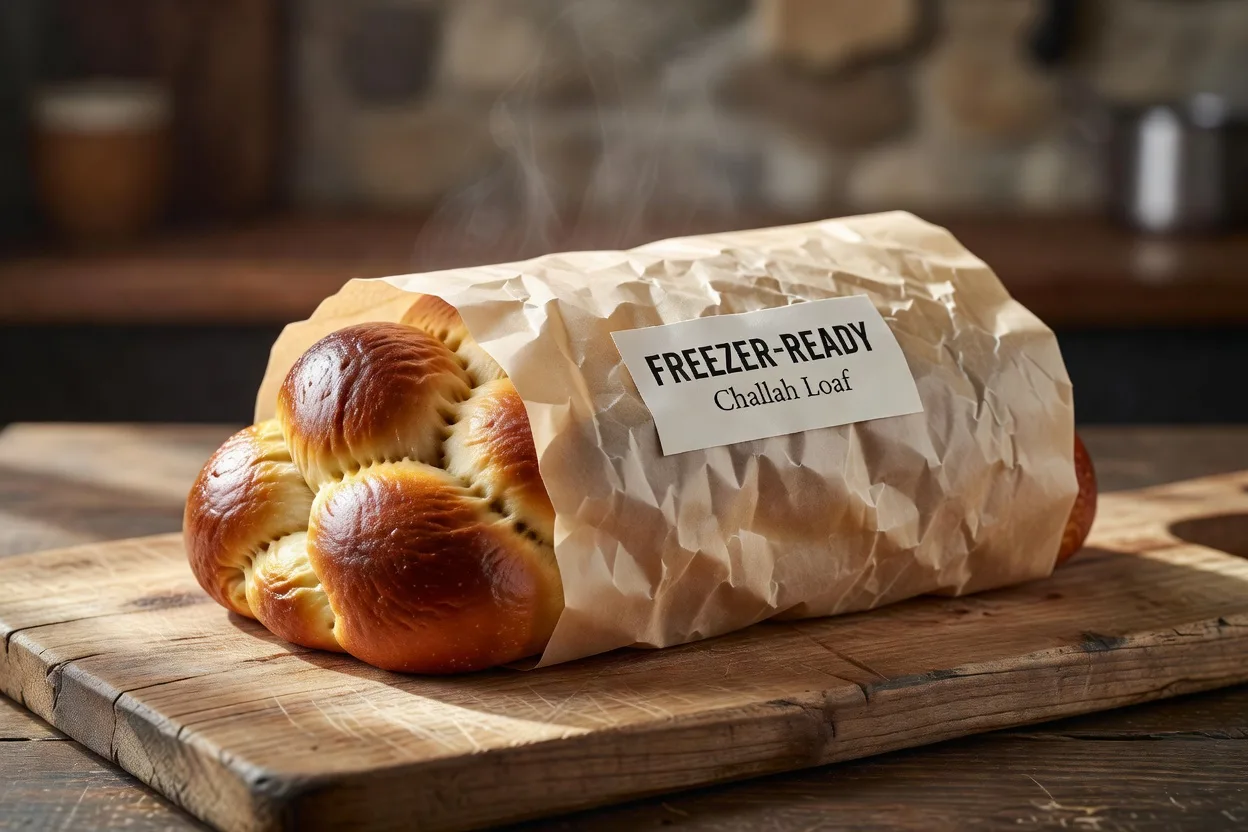
Quick answer: Yes. Challah freezes exceptionally well — better than most breads — because of its oil-enriched crumb structure. Freeze it fully baked and cooled, wrapped in two layers. It keeps for up to three months with no perceptible quality loss. Reheat at 175°C (350°F) for 12–15 minutes, still wrapped, then unwrap for 3 minutes to refresh the crust.
Before or After Baking? Which Is Better?
You have two freezing windows: freezing the shaped, unbaked dough before the final proof, or freezing the finished loaf after it has fully cooled. Both work. The right choice depends on your workflow.
| Method | Best for | Freezer life | Drawback |
|---|---|---|---|
| Freeze shaped dough (before final proof) |
Baking a fresh loaf on demand; Shabbat prep | 4–6 weeks | Requires thawing overnight + 1–2 hrs proofing before baking; yeast loses strength over time |
| Freeze baked loaf (fully cooled) |
Batch baking; stocking up; leftover management | Up to 3 months | Requires proper reheating to restore crust; can go slightly dry if not wrapped well |
For most home bakers, freezing the baked loaf is the more reliable method. The results are consistent, there is no risk of under-proofing when you thaw, and a three-month shelf life is long enough to bake in large batches and pull from the freezer each week.
How to Freeze Baked Challah
Step 1 — Cool completely
Never freeze a warm loaf. Steam from a warm challah will condense inside the wrapping and form ice crystals that turn to sogginess on thawing. Cool the loaf on a wire rack until it is fully at room temperature — at least 2 hours after it comes out of the oven. For a large loaf, allow 3 hours.
Step 2 — Wrap tightly in two layers
The enemy of frozen challah is freezer burn: dehydration from exposure to the dry, circulated air of the freezer compartment. Two layers prevent this:
- First layer: Cling film (plastic wrap), stretched tightly over the entire surface with no air pockets. Go around the loaf at least twice.
- Second layer: A zip-lock freezer bag (press out all air before sealing), or a second layer of heavy-duty foil. The foil adds puncture protection and an extra moisture barrier.
If you are freezing individual slices for weekday use, wrap each slice separately in cling film, then place all slices in a single freezer bag. This lets you pull one slice at a time without thawing the whole loaf.
Step 3 — Label with the date
Write the date on the outer layer. Challah frozen for more than three months is safe to eat but will have lost some of its character — the crumb may be slightly drier and the crust less crisp on reheating.
How to Reheat Frozen Challah
| Method | Temperature & time | Result |
|---|---|---|
| Oven (whole loaf) Best method |
175°C / 350°F for 15 min still wrapped, then 3 min unwrapped | Crisp crust, warm and moist crumb — indistinguishable from fresh |
| Oven (slices) | 175°C / 350°F for 8 min on a baking sheet, unwrapped | Slight crust, soft interior — good for slices eaten at a meal |
| Toaster oven | 160°C / 325°F for 6–8 min (unwrapped slice) | Good for a single slice; crust may be slightly dry at the edges |
| Microwave | 20–25 seconds per slice at 70% power | Soft and warm immediately; crust softens and becomes chewy. Fine for French toast or immediate eating — not ideal for the table |
| Room temperature thaw (no heat) | 2–3 hours, still wrapped | Safe but crust will be soft. Better than microwave for texture; no crunch. |
Freezing Shaped Dough (Before Baking)
If you want the experience of baking a fresh loaf from frozen, shape the challah after the first proof, before the final proof. Place the braided loaf on a parchment-lined tray and freeze it uncovered for 1 hour until firm (this prevents the braid from deforming under the weight of the wrap). Then wrap in two layers and return to the freezer.
To use: Transfer to the fridge the night before. In the morning, leave at room temperature for 1–2 hours. It should be puffy but not over-proofed. Glaze with egg wash and bake as usual — add 5 minutes to the normal baking time. Results are excellent for up to 4 weeks; beyond that, the yeast weakens and the rise may be uneven.
What Not to Do
- Do not freeze challah with toppings already applied. Sesame and poppy seeds can fall off and become soggy. If you seed after freezing, brush with egg wash just before baking and add seeds then.
- Do not refreeze a thawed challah. A second freeze-thaw cycle degrades the crumb structure noticeably.
- Do not freeze challah with icing or sugar glaze. Wet toppings crystallize and weep on thawing. Add any glaze after reheating.
- Do not skip the full cool-down. Even slightly warm challah will develop ice crystals in the crumb during freezing, which turn to wet patches on thawing.
How Long Does Unfrozen Challah Keep?
At room temperature in a bread bag or wrapped: 2–3 days before the crumb starts to dry and the crust toughens. Challah stales faster than sourdough or lean breads because of its oil-and-egg content — the fat that makes it so tender also accelerates moisture migration. If you are not eating it within two days, freeze it.
In the fridge: counterintuitively, refrigerating bread accelerates staling — the cold temperature speeds up starch retrogradation. Do not refrigerate challah unless you are slicing it for French toast within 24 hours. Freeze instead.
Bake a double batch this Friday
Our tested recipe scales perfectly — bake two loaves, eat one on Shabbat, freeze the other for the week after.
FAQ
Can I freeze challah rolls?
Yes — and rolls freeze even better than whole loaves because they thaw faster and reheat more evenly. Freeze fully baked and cooled rolls in a single layer, then transfer to a freezer bag once solid. Reheat at 175°C (350°F) for 8–10 minutes directly from frozen, unwrapped on a baking sheet.
Can I freeze sourdough challah?
Yes. Sourdough challah freezes the same way as commercial-yeast challah. Its slightly denser crumb and lower sugar content mean it holds its structure marginally better through a freeze-thaw cycle. The reheating method is identical.
How do I know if my frozen challah has gone bad?
Challah that has been properly wrapped and frozen will not go bad in the microbiological sense within three months. What you will notice past that point is freezer burn: greyish-white patches on the crust, a slightly cardboard smell, and a dry crumb that does not fully revive on reheating. It is safe to eat but noticeably diminished. Toss and bake fresh.
Can I freeze challah French toast?
Yes — but freeze the challah first, then make the French toast fresh. Frozen French toast (already cooked) can be reheated in a toaster or oven, but the eggy custard layer makes for a slightly rubbery texture compared to fresh. It is still good for a weekday breakfast. Let the challah thaw slightly, slice, soak in custard, and cook as usual.
Does honey challah freeze differently?
No. Honey challah freezes and reheats identically to standard challah. The honey actually helps retain moisture slightly, making honey challah one of the better varieties to freeze. The glaze (if applied before freezing) may become slightly sticky on thawing — a brief stint in the oven uncovered will re-crisp it.
