
Dairy-Free • Egg-Free • Contains Gluten
12 bialys
Intermediate
45 minutes
3–4 hours
HaMotzi
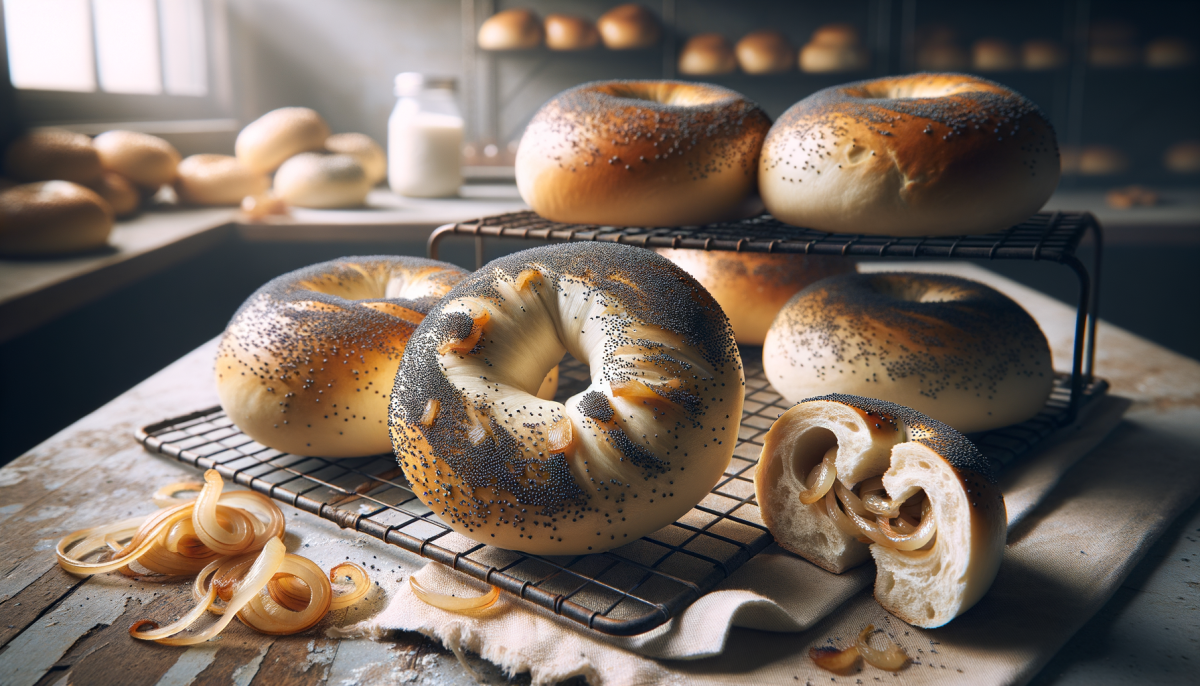
The bialy is the bagel’s forgotten cousin — and in many ways, the more interesting one. Where the bagel has conquered the world, the bialy has remained a quiet, stubborn treasure, beloved by those who know it and almost unknown to everyone else. It is not boiled. It is not shiny. It has no hole. What it has is a shallow crater filled with caramelized onions and poppy seeds, a chewy-tender crumb, a flour-dusted crust that crackles softly under your fingers, and a flavor so deeply savory and aromatic that one bite can rearrange your entire understanding of what a roll can be.
The bialy — properly called bialystoker kuchen, the “cake from Białystok” — was born in the Jewish community of Białystok, a city in northeastern Poland near the Lithuanian border. For centuries, Jewish bakers there shaped these small, flat rolls with their distinctive onion-filled depression, baking them in blisteringly hot ovens until the bottoms charred slightly and the onion filling turned sweet and golden. They were the everyday bread of a thriving Yiddish-speaking world.
Unlike bagels, bialys are never boiled, never glazed, and never meant to be toasted. They are best eaten fresh from the oven, still warm, when the contrast between the crisp exterior and the soft, almost custardy center is at its most dramatic. Split one open, spread it with cream cheese or butter if you like, but a truly great bialy needs nothing at all — the caramelized onion filling is its own condiment.
In New York, the bialy survived thanks to a handful of bakeries on the Lower East Side — most famously Kossar’s Bialys, which has been baking them since 1936. If the bagel is New York’s most famous Jewish bread, the bialy is its most soulful. If you love our New York Bagel Recipe, the bialy is the essential next step in your Jewish bread education.