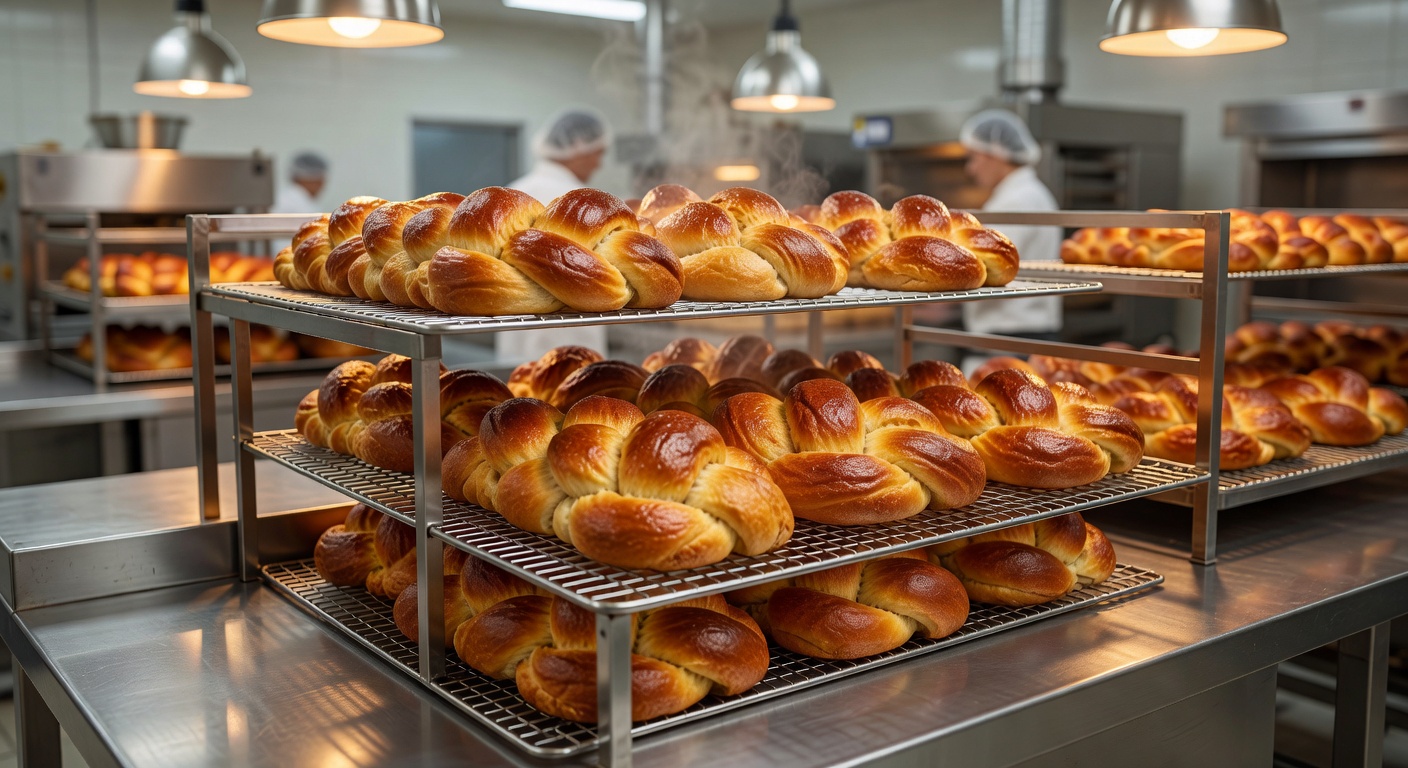
The kosher bakery market is shifting. Customers are reading labels. Synagogue purchasing committees are asking questions. And the days of hiding behind a wall of chemical-sounding ingredients are ending fast. The challenge for production bakers is real: how do you maintain the dough performance, shelf life, and consistency that your business depends on—while cleaning up your ingredient list?
Novo Ingredients, a US-based clean label ingredient company, offers a two-product system—a dough conditioner and a freshness extender—designed specifically for yeast-raised breads. Both products are kosher pareve certified, making them fully compatible with challah and other pareve bread production. We evaluated them against the demands of high-volume kosher baking, and three claims stood out.
1. One Ounce Per Hundred Pounds of Flour
The first number that stops you cold: Levartos AA CL, Novo’s dough conditioner, works at 0.0625% flour weight. That is one ounce of conditioner for every hundred pounds of flour. For a typical challah batch using 50 pounds of flour, you need just half an ounce—about 14 grams, barely enough to fill a tablespoon.
Why does this matter? Three reasons.
Cost. Novo claims a greater than 30% bowl cost reduction compared to standard clean-label conditioners. Standard dough conditioners typically run at 0.5–2.0% flour weight—eight to thirty-two times the inclusion rate of Levartos. Even if the per-pound price is higher, you’re using so much less that the total cost per batch drops significantly. For a bakery producing 500 challahs a week, that math adds up fast.
Simplicity. Lower inclusion means less product to order, ship, receive, store, and measure. One case of Levartos lasts far longer than a case of standard conditioner. For small to mid-size kosher bakeries where the owner is also the buyer, the inventory manager, and often the baker, this is a genuine operational benefit.
One caveat on scaling precision. Ultra-concentrated products demand accurate measurement. With a diluted conditioner like S500 Green dosed at 1–2% flour weight, a 5% scaling error is absorbed across a larger mass and barely registers in the finished bread. With Levartos at 0.0625%, that same 5% error is concentrated into a tiny quantity—the difference between 14 grams and 13.3 grams in a 50 lb batch. A reliable digital scale (0.1g resolution) is essential. This is a trade-off worth understanding: you save on cost and inventory, but you need tighter process control at the scale.
2. Twenty-Eight Days of Softness Without the Gummy Phase
Every baker who has tried enzyme-based anti-staling systems knows the trade-off: you get a softer bread on day seven, but on day one the crumb feels gummy, wet, almost underbaked. Customers bite into a “fresh” challah and think something went wrong. The enzyme did its job too well too early, breaking down starch before the bread had a chance to set properly.
Novo’s freshness system, Novosoft LS, makes a specific claim that addresses this directly: no early gumminess. The enzyme system is designed to activate gradually, preventing starch retrogradation (the molecular process behind staling) without disrupting the initial crumb structure. The result, according to Novo, is a bread that feels clean and properly baked on day one and remains soft through day twenty-eight for enriched breads like challah.
For kosher bakeries, this claim is particularly relevant because of the Shabbat cycle. Challah is typically baked Thursday night or Friday morning and must be excellent for Friday night dinner and Saturday lunch—a 24 to 36-hour window where staling is already noticeable in untreated bread. With Novosoft, the bread should sail through that window and remain sellable for days beyond.
The commercial implications are significant:
- Reduced waste. Bread that stays soft longer means fewer returns, fewer markdowns, fewer challahs going to the day-old rack on Monday
- Wider distribution. A 28-day shelf life opens doors to grocery chains, online shipping, and wholesale accounts that require minimum shelf life guarantees
- Subscription models. Shabbat challah subscription services (an increasingly popular business model in Jewish communities) need bread that can ship on Wednesday and arrive perfect for Friday
3. An Ingredient List Your Customers Can Actually Read
Here is the full ingredient declaration for both products combined:
That’s it. Three ingredients. Compare that to a typical commercial dough conditioner label: wheat flour, diacetyl tartaric acid esters of mono- and diglycerides (DATEM), sodium stearoyl lactylate, calcium peroxide, azodicarbonamide, L-cysteine hydrochloride, ammonium sulfate, potassium iodate…
The clean label movement is no longer a niche trend. It is the market. According to industry research, over 60% of consumers actively check ingredient labels, and “clean label” is now the second most important purchasing driver for bakery products after taste. In the kosher market, where customers are already accustomed to reading labels for certification symbols, ingredient awareness runs even higher.
For kosher bakeries, the clean label advantage is threefold:
Trust. Kosher consumers are label-literate by necessity. They know what DATEM is. They know what L-cysteine can be derived from. A short, recognizable ingredient list builds trust faster than any marketing campaign.
Certification simplicity. Fewer ingredients means fewer items to verify with your kashrus agency. Wheat flour, enzymes (microbial, pareve), and ascorbic acid are straightforward ingredients with well-established kosher status. No gray areas, no lengthy ingredient review processes.
Marketing value. “Made with only flour, water, eggs, oil, honey, yeast, salt, and natural enzymes” is a label that sells. It tells a story of craftsmanship and transparency. It works on packaging, on social media, on your bakery’s website, and in conversations with wholesale buyers.
The Bottom Line
No ingredient system is magic. These products will not turn bad flour into good bread or fix a broken process. What they offer is a practical, cost-effective, clean-label solution to the two oldest problems in commercial bread baking: dough consistency and shelf life. For kosher bakeries navigating the intersection of production efficiency, consumer expectations, and halachic compliance, that combination is worth serious consideration.
Both products—Levartos AA CL (dough conditioner) and Novosoft LS (freshness system)—are kosher pareve certified and compatible with all standard challah, bread, bun, and roll formulations.
Scaling Up Your Challah Production?
Start with our tested challah recipe, then add Novo’s clean label system for commercial-grade consistency and shelf life.