
Grilled Eggplant Salad Recipe — Israeli Charred Eggplant (Salat Hatzilim)
Search 150+ Kosher Recipes
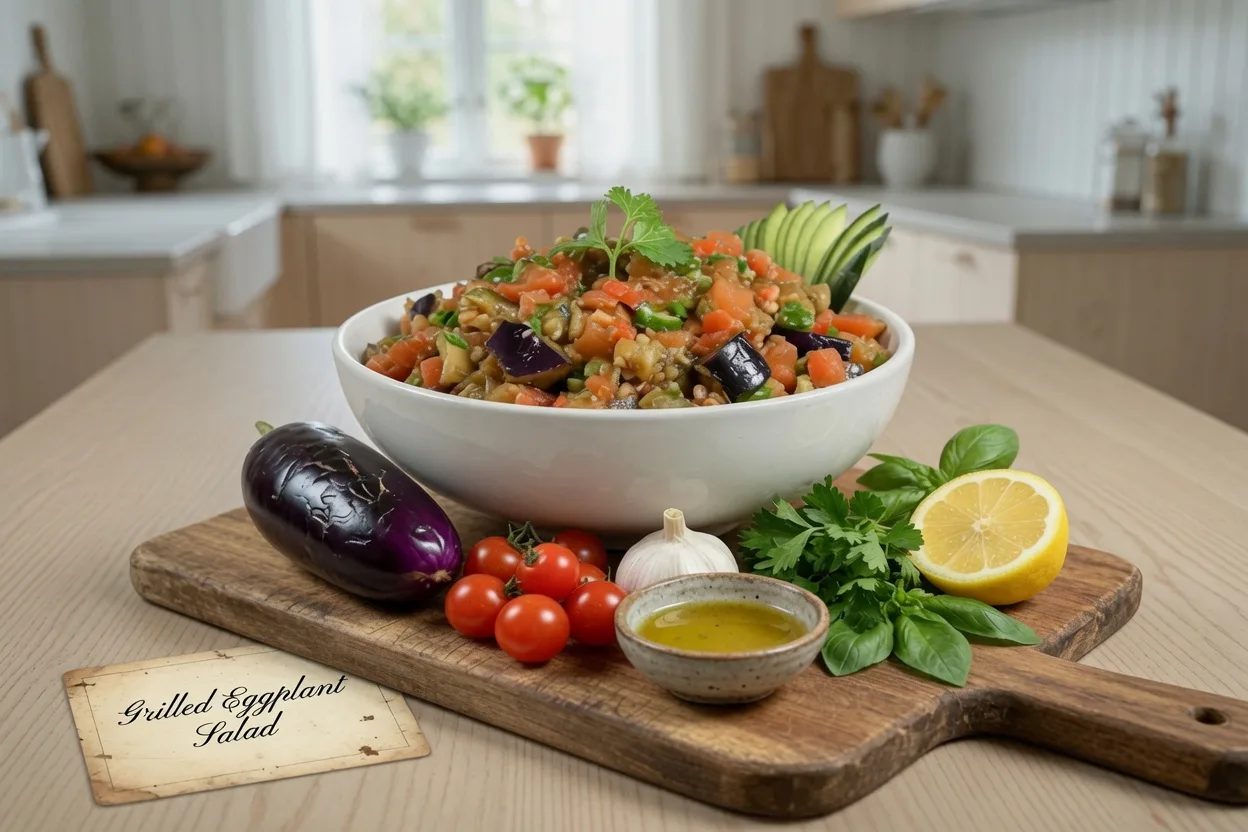
The best Israeli eggplant salad begins with fire. Not a gentle oven roast, not a skillet sear — but a whole eggplant placed directly on a gas burner flame, left to char and collapse into itself while the skin blackens, blisters, and falls away. The flesh inside transforms: sweet, smoky, deeply tender, carrying a flavor that no oven can replicate. This is salat hatzilim (סלט חצילים) — the grilled eggplant salad that appears on nearly every Israeli Shabbat table, every mezze spread, and every Friday market stall from Tel Aviv to Jerusalem.
It is one of the simplest dishes in the entire Jewish culinary canon. Two eggplants, three cloves of garlic, a lemon, olive oil, salt, parsley. That is it. The smoke does the work. What emerges — after charring, steaming, peeling, draining — is a salad with a complexity that belies its ingredient list: sweet and sharp, smoky and bright, silky and slightly rough from the rough chop that gives it texture. Scooped onto a torn piece of laffa or spread across warm challah, it is one of the great simple pleasures of Israeli home cooking.
Grilled eggplant salad is a staple across Sephardic, Mizrachi, and Israeli Ashkenazi tables alike. Iraqi Jews serve a version with tomato and cumin. Yemenite families add a touch of hawaij. Moroccan versions sometimes include roasted peppers. The base, however, is constant: charred eggplant, garlic, lemon, oil. This recipe gives you that base — perfected — with variations for every minhag.
Serve this alongside Laffa, Pita, or Classic Challah for a complete Shabbat mezze. It also pairs beautifully with Sambusak and Moroccan Khobz.
What Makes This Eggplant Salad Special
- Direct-flame charring, not oven roasting — placing the eggplant on a live gas burner produces genuine smokiness that an oven cannot achieve. The char is the flavor. Broiler is an acceptable substitute; oven roasting is not.
- Salting and draining after peeling — the charred flesh holds moisture that can make the salad watery. A 15-minute drain in a colander after salting concentrates the flavor and gives the salad body rather than puddles.
- Rough hand-chopping, not blending — a food processor makes babaganoush (a smooth dip). This is a salad: coarsely hand-chopped, with pieces that have texture and presence. The difference is significant at the table.
- Raw garlic, added after cooking — garlic added to the hot eggplant mellows too quickly. Adding raw minced garlic to the cooled flesh gives a sharper, more alive bite that balances the sweetness of the char.
- Rested before serving — 20 minutes at room temperature after mixing allows the garlic and lemon to penetrate the flesh and the flavors to integrate. Do not skip this.
The Tradition: Salat Hatzilim on the Israeli Shabbat Table
In Israeli food culture, the Shabbat table is built around salatim — the salads. A proper Friday night spread might include eight to twelve small dishes before the main course even arrives: hummus, tehina, tabbouleh, roasted peppers, pickled vegetables, white bean salad, matbucha — and always, almost without exception, salat hatzilim. The eggplant salad is the anchor of the Israeli mezze.
The tradition draws from multiple streams of Jewish cooking. Mizrachi Jews — particularly Iraqi, Syrian, and Persian communities — had long prepared roasted eggplant dishes flavored with garlic and lemon. When waves of immigration brought these communities to Israel alongside Moroccan, Yemenite, and later North African Jews, their salatim blended and evolved into the distinctly Israeli mezze culture that exists today. The eggplant salad is one of its most democratic expressions: virtually every community makes it, every family has a version, and every version is somebody’s definitive one.
For Ashkenazi families who may be less familiar with mezze culture, this dish is a revelation — a reminder of how profoundly the Israeli melting pot reshaped Jewish cuisine. It is served at room temperature (never cold from the refrigerator), always with good bread, and always with the understanding that the guests will wipe the bowl clean.
Kosher Observance & Halachic Notes
Kosher Classification: Pareve
This salad is entirely pareve — no meat, no dairy, no egg. It can be served at either a meat or dairy Shabbat meal without restriction. If serving at a meat meal, ensure the olive oil is certified kosher and has not been used for dairy.
Checking Insects: Parsley
Fresh flat-leaf parsley requires checking for insects (bedikat tola’im) before use. The standard method:
- Separate the leaves from the stems.
- Soak in a bowl of water with a small amount of vegetable wash or dish soap for 1–2 minutes.
- Agitate gently, then lift the parsley out and inspect a few leaves against a light source.
- Rinse well under running water and inspect the rinse water for insects.
Alternatively, use fresh parsley that carries a reliable kosher certification for insect-free produce (available in many Jewish communities), or substitute with dried parsley (no checking required).
Eggplant: No Insect Concern
Eggplant flesh is considered free of insect concern by most poskim and requires no special checking beyond visual inspection of the cut flesh. The seeds are permissible.
Brachot (Blessings)
- Before eating: Borei Pri Ha’adama — eggplant is a ground vegetable (pri ha’adama). This bracha covers the entire salad.
- After eating: Borei Nefashot.
- At a Shabbat meal where HaMotzi was recited over challah: no separate bracha is required for the salad — it is covered by HaMotzi when served as part of the meal.
Shabbat Preparation
This salad is ideal for Shabbat: it is prepared entirely before Shabbat (the flame charring cannot be done on Shabbat), improves with a few hours of rest, and is served at room temperature. Make it Friday afternoon; cover and leave at room temperature until serving. Do not refrigerate if serving within 4–5 hours.
Ingredients
| Ingredient | Amount (metric) | Amount (volume) |
|---|---|---|
| Large globe eggplants | 2 (approx. 1 kg / 2.2 lbs total) | — |
| Garlic cloves, minced | 3 cloves | 3 cloves |
| Fresh lemon juice | 45 ml | 3 Tbsp |
| Extra-virgin olive oil | 45 ml | 3 Tbsp |
| Fine sea salt | 5 g | 1 tsp (plus more to taste) |
| Freshly ground black pepper | — | ¼ tsp |
| Fresh flat-leaf parsley, finely chopped (checked) | 15 g | 3 Tbsp |
Optional Additions
- 1 medium tomato — seeded, finely diced; adds freshness and colour (Iraqi/Syrian style)
- 1 Tbsp raw tahini — whisked in with the lemon and oil for a creamier, richer texture
- 1 roasted red pepper — charred, peeled, and diced; Moroccan variation
- ¼ tsp ground cumin — adds warmth; common in Iraqi and Yemenite versions
- Pomegranate seeds — scattered over the top for Rosh Hashana or Sukkot serving
Equipment
- Gas burner or outdoor grill — for direct-flame charring. A broiler on highest setting works as a fallback.
- Large bowl with a lid or plate — for steaming the charred eggplants
- Colander and bowl — for draining
- Cutting board and chef’s knife or fork — for chopping
- Tongs — for turning the eggplant over the flame
Step-by-Step Instructions
Step 1: Char the Eggplant
Turn a gas burner to medium-high flame. Place one eggplant directly on the grate over the flame. The eggplant should rest on the burner as close to the flame as possible — there is no pan, no foil, nothing between the eggplant and the fire.
Cook for 10–14 minutes total, turning with tongs every 2–3 minutes, until:
- The skin is completely charred and collapsed — black all over, not just spotted
- The eggplant has visibly deflated and softened throughout — it should feel completely soft when pressed with tongs
- Juices are running out of any cracks in the skin
Repeat with the second eggplant. While one chars, the other can rest.
Broiler method (if no gas flame): Place eggplants on a foil-lined baking sheet directly under the broiler, set to maximum heat. Broil for 15–20 minutes, turning every 5 minutes, until completely charred on all sides and fully collapsed. The smoke flavour will be less intense than flame-charring but still present.
Step 2: Steam and Peel
Transfer the charred eggplants immediately into a large bowl and cover tightly with a lid or plate. Let them steam in their own heat for 10–15 minutes. This makes peeling dramatically easier — the steam loosens the skin from the flesh.
Once cool enough to handle, peel off the charred skin by hand. It should come away in large pieces. Do not rinse with water — rinsing washes away the smoke flavour.
Remove the stem. If there are any large seed clusters that look particularly wet or bitter, scrape them away, but most seeds are fine to leave.
Step 3: Salt and Drain
Place the peeled eggplant flesh in a colander set over a bowl. Sprinkle with ½ tsp salt and leave to drain for 15 minutes. You will see brownish liquid collect in the bowl below — this is normal and desirable. Press the flesh gently with your hand or the back of a spoon to encourage draining.
After draining, transfer the flesh to a cutting board.
Step 4: Chop
Using a large knife or a fork, coarsely chop the eggplant flesh. You are looking for a rough, uneven texture with pieces ranging from 5–15 mm — not a smooth paste. Some fibrous strings are fine. The goal is a salad with body, not a smooth dip.
Transfer to a mixing bowl.
Step 5: Dress and Mix
Add to the chopped eggplant:
- The minced garlic
- The lemon juice
- The olive oil
- The remaining salt (adjust to taste) and the black pepper
Mix well. Taste — the eggplant should taste smoky and bright, with garlic that bites back. Adjust lemon and salt as needed.
Add the chopped parsley and fold in. If using any optional additions (tomato, tahini, cumin), add them now.
Step 6: Rest and Serve
Cover the bowl and leave at room temperature for at least 20 minutes before serving. This is not a step to skip — the flavours integrate and the garlic mellows slightly from raw to something more cohesive.
Serve at room temperature, drizzled with a little extra olive oil and a final scattering of parsley. Provide torn laffa, pita, or challah alongside for scooping.
Storage & Make-Ahead
- Room temperature: Serve within 4–5 hours of making. Keeps well on the Shabbat table through the entire meal.
- Refrigerator: Store in an airtight container for up to 3 days. Remove from the refrigerator 30 minutes before serving — eggplant salad should never be served cold. The garlic flavour intensifies with time.
- Freezing: Not recommended — the texture becomes watery and the fresh flavour is lost on thawing.
- Make-ahead for Shabbat: Ideal. Char and prepare the salad Friday afternoon, leave covered at room temperature until candle-lighting, serve at the Shabbat table. The rest time only improves it.
Troubleshooting Guide
| Problem | Likely Cause | Solution |
|---|---|---|
| Salad is watery | Eggplant not drained long enough; skin rinsed with water | Salt and drain for the full 15 minutes. Never rinse the peeled flesh. Press firmly in the colander to expel liquid. |
| No smoky flavour | Eggplant oven-roasted rather than flame-charred; skin not fully blackened | The skin must be completely charred — black, collapsed, cracked. If using a broiler, go until the skin is truly burnt, not just brown. |
| Skin hard to peel | Not steamed long enough after charring | Cover and steam for the full 15 minutes. The skin should slip off in large pieces. If it resists, give it another 5 minutes covered. |
| Salad tastes bitter | Old eggplant (large seeds and thick, dull skin); insufficient salt-draining | Choose firm, glossy eggplants with small green caps — these are younger and less bitter. Always drain after salting. |
| Garlic is too sharp or harsh | Garlic added to still-hot eggplant, or very large amount | Add garlic only after the eggplant has cooled. Start with 2 cloves if you prefer a milder result. The garlic mellow noticeably after 20 minutes of resting. |
| Salad smells of gas | Eggplant absorbs gas odour if skin not fully charred | Ensure the skin is completely and evenly charred before removing. A truly blackened skin seals the flavour properly. |
Frequently Asked Questions
Can I make this without a gas stove?
Yes, but plan for a different — and slightly lesser — result. A broiler set to maximum heat is the best alternative: place the eggplants on a foil-lined tray directly under the element and turn every 4–5 minutes until completely blackened on all sides. A charcoal grill is actually superior to a gas burner for smoke flavour and produces an outstanding version. An electric stove or induction hob, however, cannot char the skin directly and will produce a roasted rather than smoked eggplant — it will taste good but will lack the defining smokiness. If you have no gas or charcoal, roast the eggplant whole at 230°C (450°F) for 45–50 minutes until completely collapsed, then proceed from Step 2.
What is the difference between salat hatzilim and babaganoush?
Both begin with charred eggplant, but they diverge significantly in method and character. Babaganoush is blended or thoroughly mashed until smooth or semi-smooth, and nearly always includes tahini as a primary ingredient — it is a dip. Salat hatzilim is coarsely hand-chopped, has visible texture, and is dressed with lemon and olive oil rather than tahini (though tahini can be added as an option). Salat hatzilim is lighter and brighter in flavour; babaganoush is richer and more substantial. In Israel, they are understood as distinct dishes and appear separately on the mezze table.
What eggplant variety should I use?
The large, oval globe eggplant (the most common supermarket variety) is ideal for this recipe — its size and flesh density give you the right yield after charring and draining. Choose eggplants that are firm, glossy, and heavy for their size, with tight, fresh green caps. Avoid eggplants with soft spots, dull skin, or very large, mature seeds (a sign of overripeness and potential bitterness). Italian or Japanese eggplants can be used but will yield a more delicate, less robust result and cook faster — reduce charring time accordingly.
How long does grilled eggplant salad keep?
Up to 3 days in the refrigerator in an airtight container. The flavour actually improves after the first few hours as the garlic and lemon permeate the flesh. Always bring to room temperature before serving — cold eggplant salad is muted and loses its appeal. Do not freeze; the texture degrades completely on thawing.
Is this recipe the same as Israeli eggplant dip?
Not quite. What restaurants outside Israel sometimes call “Israeli eggplant dip” is usually babaganoush — a smoother, tahini-enriched preparation. Salat hatzilim is chunkier, lighter, and uses no tahini in its base form. It functions as a salad on the Israeli table — a side dish with texture — rather than a dip for crudites. That said, the line blurs depending on the family and the cook, and many Israelis make versions that sit comfortably between the two.
Get a New Kosher Recipe Every Week
Join our baking community. One recipe, one tip, one story — delivered every Friday before Shabbat.
No spam. Just bread. Unsubscribe anytime.
Complete Your Shabbat Mezze
This salad was made for laffa, pita, or a torn piece of fresh challah. Make the bread to go with it.
Save This Recipe Bake Laffa to Serve With It →
Have questions? Tag us @kosherbreadpro on Instagram or leave a comment below. We answer every one.
You Might Also Enjoy
- Laffa — The Iraqi-Israeli flatbread for scooping and wrapping
- Pita Bread — Classic pocketed flatbread for the mezze table
- Sambusak — Sephardic filled pastries for Shabbat
- Moroccan Khobz — Dense Moroccan daily bread
- Classic Kosher Challah — Shabbat challah to serve alongside
