
Hafrashat Challah — The Mitzvah Only Home Bakers Can Do
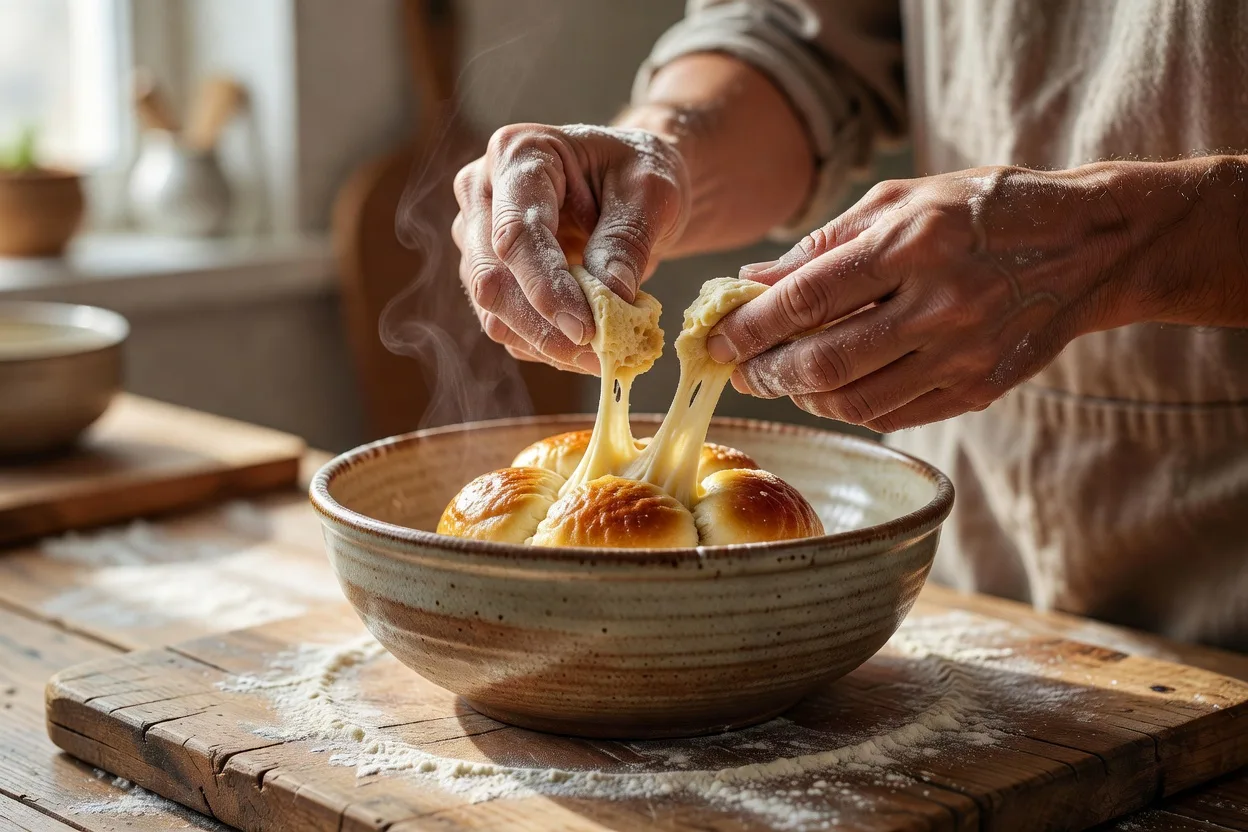
Quick answer: Hafrashat challah is the Torah mitzvah of separating a small piece of dough and setting it aside before baking. It applies when your dough uses at least ~1,250 g of flour. Below that threshold, no separation is needed. Above ~1,666 g, you separate and recite a bracha. The separated piece must be burned — never eaten.
What Is Hafrashat Challah?
The Torah commands in Bamidbar (Numbers 15:20–21): “From the first of your dough you shall set apart a portion as a gift… throughout your generations.” In Temple times, this separated piece — called challah (the word originally means the separated portion, not the loaf) — was given to the Kohanim (priests) as one of the priestly gifts (matanot kehunah).
Since the destruction of the Temple and the suspension of priestly service in ritual purity, we no longer give the separated piece to a Kohen. Instead, the piece is burned. The mitzvah of separation, however, continues as a Torah obligation — one of the three commandments the Talmud lists as belonging specifically to women (Shabbat 31b), alongside kindling Shabbat lights and the laws of family purity.
This is the mitzvah that gives the Shabbat bread its name. The bread we call “challah” is the bread from which the challah portion was taken.
When Does the Obligation Apply?
Hafrashat challah applies to dough made from one of the five grains: wheat, barley, spelt, oats, or rye. Other grains (corn, rice, millet, teff, buckwheat) do not trigger the obligation.
The obligation depends on how much flour you used, not how much finished dough you have:
| Flour weight | What to do | Bracha? |
|---|---|---|
| Under ~1,250 g (under ~10 cups) |
No separation required | — |
| ~1,250 g – ~1,666 g (~10–13 cups) |
Separate a ke-zayit (olive-sized piece) | No bracha |
| Over ~1,666 g (over ~13 cups) |
Separate a ke-zayit (olive-sized piece) | Yes — recite the bracha |
How to Perform Hafrashat Challah — Step by Step
Step 1 — Weigh your flour before mixing
The obligation is based on the flour weight, not the dough weight. Weigh your flour on a kitchen scale before adding it to the bowl. If you are using multiple types of flour (bread flour + whole wheat, for example), they combine toward the threshold.
Step 2 — Mix and develop the dough normally
Make the dough as you normally would. Hafrashat challah is performed on the fully mixed, developed dough — not on raw flour. The dough should be in a single mass (all loaves together in one bowl or on one board) at the time of separation. You cannot separate from one loaf and intend it to cover a second loaf baked separately.
Step 3 — Say the bracha (if applicable)
If your dough exceeds ~1,666 g of flour, recite the bracha before separating:
בָּרוּךְ אַתָּה אֲדֹנָי אֱלֹהֵינוּ מֶלֶךְ הָעוֹלָם אֲשֶׁר קִדְּשָׁנוּ בְּמִצְוֹתָיו וְצִוָּנוּ לְהַפְרִישׁ חַלָּה
Baruch Atah Adonai, Eloheinu Melech ha’olam, asher kid’shanu b’mitzvotav v’tzivanu l’hafrish challah.
Blessed are You, Lord our God, King of the universe, who has sanctified us with His commandments and commanded us to separate challah.
Step 4 — Pinch off a piece the size of an olive
Immediately after the bracha, pinch off a small piece of dough — roughly the size of an olive (ke-zayit, about 28 g or 1 oz). Some authorities require only a very small piece; others prefer a larger portion. A piece about the size of a table olive is universally accepted.
After separating, say: “Harei zo challah” — “This is challah.” This declaration designates the piece as the separated portion.
Step 5 — Dispose of the separated piece
The separated piece may not be eaten — not by you, not by guests, not by pets. It must be burned. Practical methods:
- Gas burner: Hold the piece with tongs directly over the flame until fully charred and unrecognizable.
- Broiler: Place on a small piece of foil under the broiler for 5–8 minutes until black throughout.
- Dedicated container: Wrap in foil and keep in a labeled “challah” jar in the freezer, then burn all accumulated pieces together periodically. Accepted by many authorities as a valid method.
Once burned, the piece may be disposed of in the regular rubbish. It does not require burial.
Common Questions
What if I forgot to separate before baking?
Separation can be performed even after baking. Take a small piece from one of the finished loaves, declare it challah, and burn it. The bracha is no longer recited after baking — the obligation is fulfilled without it, but the bread remains permissible to eat.
Does hafrashat challah apply to cake and cookie dough?
It applies to any dough made from the five grains that has a bread-like character (pat). Cake batters that are poured (rather than kneaded) are disputed — some authorities require separation without a bracha. Cookies generally do not require separation unless the dough is stiff and kneaded and the flour quantity exceeds the threshold. In practice, most Ashkenazi authorities do not require separation from cookie doughs or cake batters; Sephardic practice varies.
Can a non-Jewish person separate the challah?
No. The mitzvah must be performed by a Jewish adult. A non-Jewish person’s separation does not fulfill the obligation. The bread may still be baked, but a Jewish adult must then separate from one of the baked loaves before anyone eats.
Does my bread machine dough require separation?
Yes, if the flour quantity exceeds the threshold. The machine mixing the dough does not change the obligation. Perform the separation after the dough cycle completes, before shaping and baking.
What if my recipe uses mixed grain flours?
Flours from different grains among the five combine toward the threshold if they are mixed into a single dough. If you use 900 g of wheat flour and 400 g of spelt flour in one dough, you have 1,300 g of qualifying flour and must separate (without a bracha, since the threshold for the bracha is not yet reached). Rice flour, almond flour, and other non-qualifying flours do not count.
The Mitzvah in Practice
Hafrashat challah is unusual among mitzvot: it is performed at home, in your kitchen, as part of a mundane act of baking. There is no synagogue, no minyan, no rabbi required. The connection between a home baker separating dough on a Thursday evening and the Kohanim receiving grain offerings in the Mishkan is direct, unbroken across thousands of years — and still enacted, in kitchens, every time someone bakes enough bread.
This is why the Talmud places it among the three mitzvot it associates with women specifically: not because men are exempt, but because women have historically been the ones baking at home. When you make enough challah to separate, you are doing something Temple-era Jews did every week. The piece you burn is the link.
Ready to bake enough challah for hafrashat challah?
Our classic recipe uses 1,000 g of flour — enough for a double batch to cross the threshold and perform the mitzvah with a bracha.
