
What Bracha Do You Make on Hamantaschen?
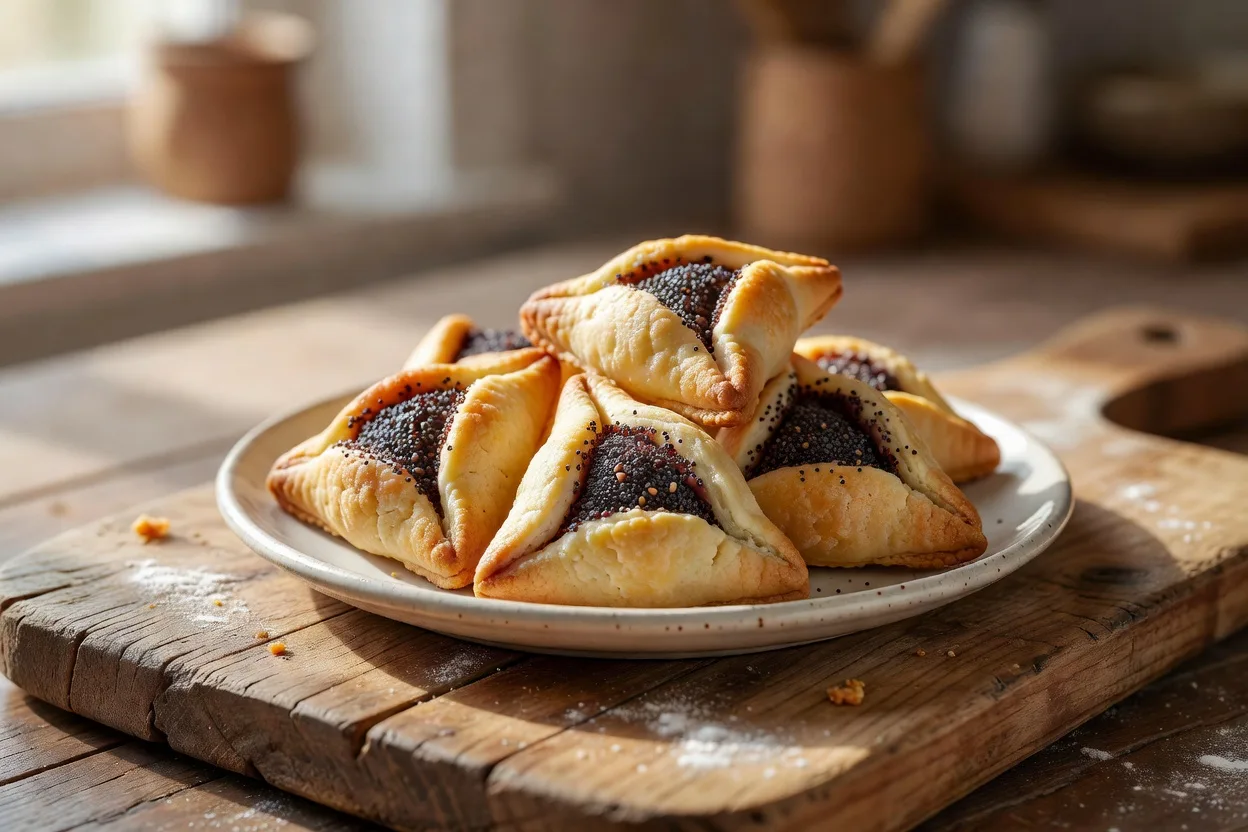
PAREVE (traditional) / DAIRY (some recipes)
Quick answer: The bracha before eating hamantaschen is mezonot (מזונות). They are made from wheat dough but eaten as a pastry, not as bread at a meal. The after-bracha is al hamichya. Exception: if you eat enough to constitute a full meal, hamotzi and birkat hamazon apply instead.
Why Mezonot and Not Hamotzi?
The general rule for brachot on wheat dough products is that most bread earns hamotzi — but hamantaschen fall into a different category. Halacha distinguishes between pat (standard bread, eaten as the main food of a meal) and pat haba’ah b’kisnin (a filled or sweetened dough product that is normally eaten as a snack, dessert, or accompaniment, not as meal bread). Hamantaschen are definitively in the second category.
Three features of hamantaschen satisfy the pat haba’ah b’kisnin classification:
- They are sweet. Hamantaschen dough contains significant sugar — enough to mark the product as a pastry in normal social usage, not a bread.
- They have a filling. The dough is a wrapper for the filling (poppy seed, apricot, chocolate, halvah). This structure places them in the category of kisnin — stuffed or folded dough products.
- They are not eaten as meal bread. Nobody sits down at a Shabbat table and puts hamantaschen out for the main course. They are served as dessert, given as mishloach manot, and eaten as a snack during Purim celebrations.
The Shulchan Aruch (Orach Chaim 168:7–8) establishes that dough products with these characteristics earn mezonot regardless of their wheat content. This ruling is accepted across Ashkenazi and Sephardic authorities with no significant dissent for sweet stuffed pastries.
The Bracha Table
| Situation | Before (bracha rishona) | After (bracha acharona) |
|---|---|---|
| Eating 1–2 hamantaschen as a snack | Mezonot | Al hamichya |
| Eating a large quantity as a full meal (kevi’at se’udah) | Hamotzi (wash hands first) | Birkat hamazon |
| At the Purim seudah (festive meal) — eating hamantaschen alongside bread | Hamotzi covers everything (bread washes it all) | Birkat hamazon |
| Eating a small piece, less than a ke-zayit of dough | Mezonot | No after-bracha required |
The After-Bracha: Al Hamichya
When you recite mezonot before eating, the after-bracha is al hamichya (על המיחיה) — the abbreviated form of the three-faceted blessing that covers grain products, fruit of the vine, and fruit of the seven species. For hamantaschen (wheat dough), the first paragraph of al hamichya applies: “al hamichya v’al hakalkalah…”
Al hamichya is only required if you have eaten a ke-zayit (about 28–30 g) of dough, not filling. If you ate a single small hamantasch, check whether the dough portion alone reached ke-zayit. If the majority of what you ate was filling (poppy seed, jam), the dough bracha acharona may not be required, though most poskim are lenient and include a bracha to avoid uncertainty.
Poppy Seed Filling: Does the Bracha Change?
The filling itself has its own bracha only if eaten separately. When eating hamantaschen whole, the dough is the ikar (primary component) and the filling is the tafel (secondary). The dough’s bracha (mezonot) covers the filling entirely — you do not say a separate bracha on the poppy seed, fruit jam, or chocolate.
This changes only if the filling is the dominant component by volume and the dough is a negligible wrapper — a case that standard hamantaschen do not satisfy. Halachically, the triangular dough shell is substantial enough to be the primary food.
At the Purim Seudah
The Purim seudah (the festive meal, eaten on Purim day) typically begins with bread: lechem mishneh is not required (Purim is not Shabbat or Yom Tov), but most families serve bread to establish a proper meal and enable the serving of meat. When you recite hamotzi on bread, all subsequent foods at the meal are covered — including hamantaschen served as dessert. No separate mezonot is required for the hamantaschen at that point.
If your Purim seudah does not include bread at all — if you are eating only hamantaschen, pastries, and drinks — then recite mezonot on the hamantaschen and hamotzi does not apply unless you eat enough to constitute a meal.
What About Homemade Hamantaschen?
The kashrut of homemade hamantaschen depends on your recipe:
- Oil-based dough, pareve filling (poppy seed, jam, chocolate without butter): Pareve. Can be served at any meal. This is the traditional version.
- Butter-based dough or dairy chocolate filling: Dairy. Cannot be served at or after a meat meal.
- Cream cheese dough: Dairy. Popular in American Jewish baking; cannot be served at a meat meal.
Hafrashat challah generally does not apply to hamantaschen dough because the dough is not baked as bread — it is a sweet pastry dough. Most authorities do not require separation, though if you bake an unusually large batch with a stiff, kneaded wheat dough, consult your rabbi.
Ready to bake hamantaschen that stay closed?
Three fillings — poppy seed, apricot, and chocolate — with the exact pinch technique that keeps the corners sealed through baking.
FAQ
Is the bracha on hamantaschen hamotzi or mezonot?
Mezonot. Hamantaschen are a sweet, filled wheat-dough pastry — they fall into the category of pat haba’ah b’kisnin. The after-bracha is al hamichya. If you eat a large quantity that constitutes a full meal, hamotzi applies instead.
Do I need to wash (netilat yadaim) before eating hamantaschen?
No — not for a small quantity eaten as a snack. Ritual handwashing is required only when eating bread with hamotzi. If you eat so many hamantaschen that the bracha shifts to hamotzi (kevi’at se’udah), then yes — wash first.
What is the bracha on store-bought hamantaschen?
The same: mezonot. The method of production (home vs. commercial) does not change the halachic classification of the food. Check the label for kosher certification and dairy/pareve status before buying.
Does the filling change the bracha?
No. The dough is the primary component (ikar). The filling, whatever it is — poppy seed, apricot, chocolate, halvah — is secondary. The dough’s mezonot covers the entire hamantasch.
What if the hamantaschen only has a very thin dough shell?
If the dough is so thin that the filling clearly dominates by volume and the dough is merely a vessel, the bracha might follow the filling instead. In practice, standard hamantaschen do not reach this point — the triangular dough shell is always substantial. If you are genuinely uncertain, recite mezonot and you will cover both possibilities.
