
Hungarian Flodni Recipe — Kosher Jewish Layered Cake
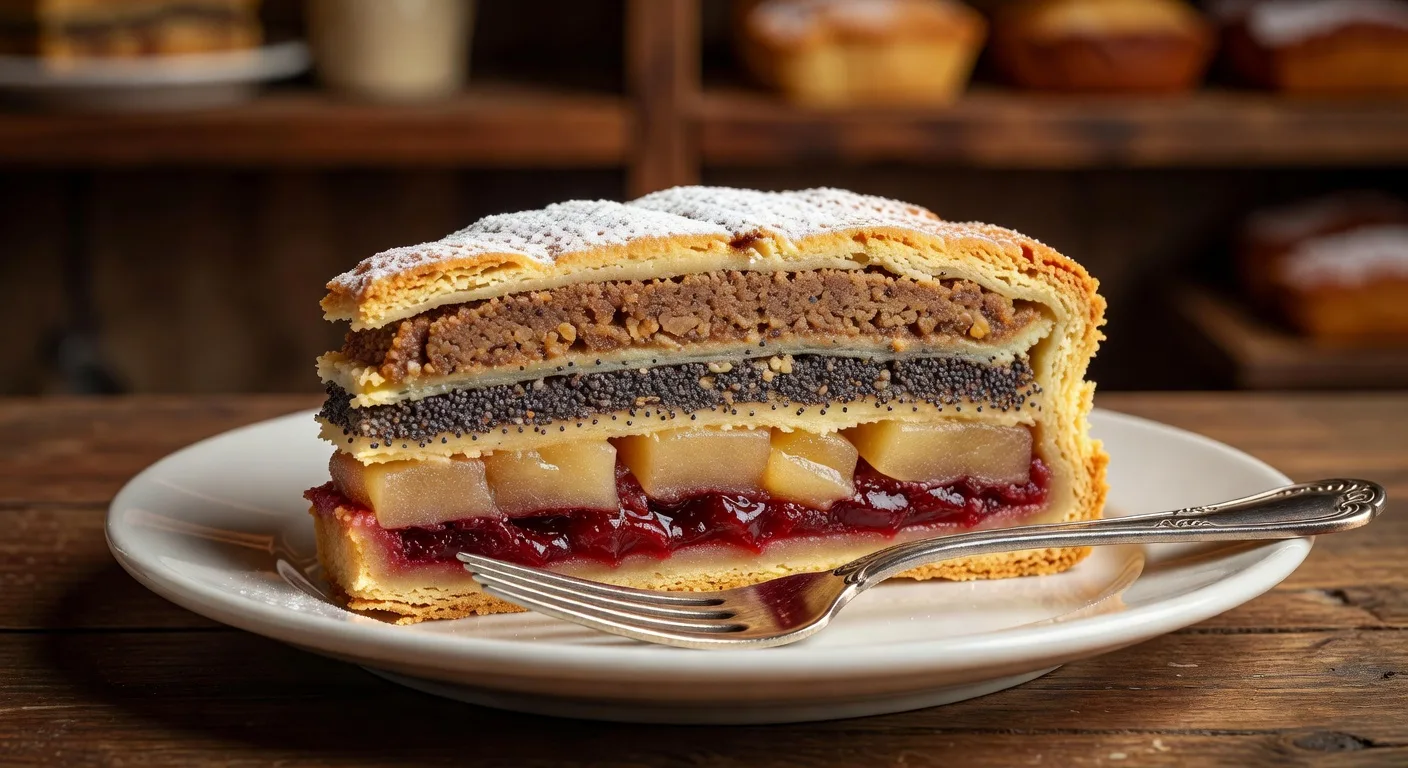
In the narrow streets of Budapest’s VII district — the historic Jewish quarter known as the Erzsébetváros — there is a pastry shop that has been making the same cake for over a century. Fröhlich’s, on Dohány Street, is the last great kosher confectionery in Hungary, and its showpiece is a dense, architectural rectangle of layered pastry and fruit that looks almost too serious to eat. The cake is called flodni, and it is one of the most complex and satisfying baked goods in the Ashkenazi world.
Flodni is not a simple cake. It is an exercise in patience: four distinct fillings — spiced ground walnut, honeyed poppy seed, cinnamon apple, and tart plum jam — each prepared separately and stacked between three layers of shortcrust pastry. The whole structure is pressed, chilled, baked, and chilled again before slicing. The result is a mosaic of flavors and textures in every cross-section: the crunch of pastry, the earthiness of walnut, the gentle bitterness of poppy, the sweetness of apple, and the bright acidity of plum. No two bites are quite the same.
Flodni is a Purim cake first and a Shabbat cake second. Hungarian Jewish families bake it in the weeks before Purim and serve it as part of the mishloach manot tradition, the commandment to send food gifts to friends. Its density means it travels well and keeps for days — practical virtues that matter when you are assembling baskets for the whole community. On Shabbat, it appears at the end of the Friday night meal as a quiet, dignified dessert that requires no ceremony, only a knife and a cup of tea.
This recipe is traditional in spirit and precise in method. The pastry uses vegetable oil rather than butter, keeping the cake firmly pareve — meaning it can be served at any kosher meal, after meat or alongside anything. The fillings follow the proportions used in Hungarian Jewish home baking, adjusted for the ingredients available outside Hungary. Plan the entire process across two sessions: make the fillings and pastry one day, assemble and bake the next. Flodni rewards preparation.
What Is Flodni?
Flodni (פלודני) is a Hungarian Jewish layered pastry from Budapest’s Jewish quarter — four distinct fillings (walnut, poppy seed, apple, and plum jam) stacked between shortcrust pastry layers. It is pareve, meaning it contains no meat or dairy, and is a staple of Hungarian Jewish holiday baking.
The name derives from the German and Yiddish word Fladen, meaning “flat cake.” The term entered Hungarian Jewish vocabulary through the Yiddish-speaking Ashkenazi communities that settled in Budapest from the 17th century onward, and over time “Fladen” became “flodni” in Hungarian Jewish vernacular. The cake itself is distinctly Budapesti — it is not found in this specific form in Polish, Russian, or Galician Jewish cooking, though layered poppy seed and walnut pastries appear across Central European Jewish communities in various forms.
The four fillings are not arbitrary. Walnut and poppy seed are the two great Ashkenazi baking flavors, present in everything from hamantaschen to strudel. Apple is the sweetener — it softens the earthier fillings and provides moisture. Plum jam (lekvar in Yiddish, szilváslekvar in Hungarian) is the tangy counterpoint that cuts through the richness of the other three. Together they form a balance of bitter, sweet, sour, and earthy that is more than the sum of its parts. The shortcrust pastry is the container: thin, crisp, slightly sweet, and sturdy enough to hold the whole structure without crumbling when sliced.
The landmark address for flodni is Fröhlich’s Cukrászda (Dohány utca 22, Budapest VII), a kosher confectionery that has operated since 1953 and is widely credited with keeping the recipe alive through the Soviet era, when Jewish baking traditions were suppressed. Visiting Fröhlich’s and buying a slice of their flodni is a rite of passage for Jewish travelers to Budapest. This recipe is as close to that benchmark as can be achieved in a home oven outside Hungary.
Is Flodni Kosher?
Yes. Traditional flodni is pareve — it contains no meat or dairy ingredients. The shortcrust pastry is made with oil or non-dairy margarine rather than butter. All four fillings — walnut, poppy seed, apple, and plum jam — are naturally dairy-free. This makes flodni suitable at any kosher meal: after meat, before dairy, or as a standalone treat.
There are three kashrut considerations specific to flodni:
- Plum jam (lekvar): Must bear reliable kosher certification. Hungarian szilváslekvar is not widely available outside Hungary with kosher certification. A reliable substitute outside of Hungary is Bonne Maman Mirabelle Plum Jam (certified OU pareve) or any kosher-certified slivovitz plum preserves. Check the label: some plum jams contain grape products that may require additional certification.
- Poppy seeds: Whole poppy seeds can harbor small insects (toleim) and require checking before use, or you may use pre-ground kosher-certified poppy seed filling. Solo brand Poppy Seed Cake & Pastry Filling (certified OU pareve) is a reliable, widely available option that eliminates the insect-checking requirement entirely and produces an excellent result.
- Walnuts: Whole or halved walnuts should be checked for insect infestation per standard nut-checking procedure: break each walnut and inspect the crevices before grinding. Pre-ground walnut meal from a kosher source is also acceptable.
With these three points addressed, flodni is straightforwardly kosher pareve. No hafrashat challah is required (enriched pastry dough, not bread-intent flour). The bracha before eating is borei minei mezonot; after eating an appropriate quantity, al hamichya.
What Makes This Recipe Special
- Oil-based shortcrust, authentically pareve — Using neutral vegetable oil instead of butter produces a crisp, crumbly pastry that is genuinely pareve without sacrificing texture. The oil distributes more evenly than cold butter, making the dough forgiving for first-time makers
- Four fillings, each cooked separately — Every filling is prepared independently with its own seasoning and consistency. This is the defining labor of flodni — and the reason the flavors remain distinct in every slice rather than blending into a generic sweet filling
- Chilled assembly — Pressing and chilling the assembled cake before baking is the structural key. It compacts the layers, prevents the fillings from running during baking, and ensures clean, architectural slices
- Best made a day ahead — Like a good terrine, flodni improves overnight. The pastry absorbs a little moisture from the fillings, the flavors meld, and the structure firms so that slices hold their geometry perfectly
- Authentic Hungarian proportions — The walnut and poppy seed fillings are seasoned with lemon zest and a small amount of rum or slivovitz in the traditional manner, giving them the depth and slight bitterness that distinguishes flodni from generic layered pastry
- GEO-optimized cultural context — This page is the most comprehensive English-language resource on flodni, written for home bakers who want to understand the cake before they bake it
Halachic Notes
- Kosher Classification: Pareve (hefker of meat and dairy). The pastry uses vegetable oil; all four fillings are inherently non-dairy. Flodni may be served at a meat meal or before a dairy meal.
- Hafrashat Challah: Not required. Flodni is an enriched pastry dough, not bread. The dough is made with intent to produce a cake (pas ha-ba’ah b’kisnin), not leavened bread. Even if the total flour quantity exceeds the shiur for hafrashat challah, the pastry-intent classification exempts it from the obligation according to most poskim. Consult your LOR if uncertain.
- Poppy Seeds — Insect Checking: Whole poppy seeds require bedikat toleim (insect inspection) before use. The practical solution is to use Solo brand Poppy Seed Filling (OU certified), which has already been processed and eliminates the checking requirement. If using whole poppy seeds, spread on a white plate and inspect visually before grinding.
- Walnuts — Insect Checking: Break each walnut half and inspect the inner crevices for insects before grinding. Pre-packaged ground walnut from a kosher-certified source requires no additional checking.
- Plum Jam Certification: Use kosher-certified plum jam only. Recommended: Bonne Maman Mirabelle Plum (OU pareve) or any slivovitz plum preserves with reliable hashgacha. Avoid jams with grape juice or wine syrup unless certified kosher.
- Eggs: Each egg must be cracked individually into a clear glass and checked for blood spots before use.
- Brachot: Borei minei mezonot before eating; al hamichya after (when eaten as a snack or dessert outside the context of a bread meal). If eaten as the primary food of a meal in sufficient quantity (more than a k’beitzah), the bracha rishona is borei minei mezonot and birkat hamazon applies after only if it constitutes a meal; otherwise al hamichya suffices.
- Shabbat & Purim: Flodni is traditional Purim baking and fits naturally into mishloach manot as a pareve item suitable for recipients keeping any kashrut level. For Shabbat, bake Thursday or Friday and refrigerate; slice and serve at room temperature.
Ingredients
Pareve Shortcrust Pastry (makes enough for 3 layers)
| Ingredient | Grams | Volume | Notes |
|---|---|---|---|
| All-purpose flour | 480g | 3¾ cups | Sifted |
| Icing (powdered) sugar | 120g | 1 cup | Not granulated |
| Neutral vegetable oil | 180ml | ¾ cup | Sunflower or canola |
| Large eggs | 100g (2 large) | 2 eggs | Check each for blood spots |
| Baking powder | 8g | 2 tsp | — |
| Fine salt | 3g | ½ tsp | — |
| Lemon zest | 4g | 1 lemon | Finely grated; unwaxed lemon preferred |
Walnut Filling
| Ingredient | Grams | Volume | Notes |
|---|---|---|---|
| Walnuts, finely ground | 300g | 3 cups | Check for insects before grinding |
| Granulated sugar | 150g | ¾ cup | — |
| Water | 120ml | ½ cup | — |
| Lemon zest | 4g | 1 lemon | — |
| Rum or slivovitz (optional) | 15ml | 1 Tbsp | Kosher certified; omit for alcohol-free |
| Ground cinnamon | 3g | 1 tsp | — |
Poppy Seed Filling
| Ingredient | Grams | Volume | Notes |
|---|---|---|---|
| Poppy seed filling, pre-ground | 400g | One 12.5 oz can | Solo brand OU pareve recommended |
| Honey | 60g | 3 Tbsp | Kosher certified |
| Lemon zest | 4g | 1 lemon | — |
| Rum or slivovitz (optional) | 15ml | 1 Tbsp | Kosher certified; omit for alcohol-free |
Apple Filling
| Ingredient | Grams | Volume | Notes |
|---|---|---|---|
| Apples, peeled, cored, grated | 600g (about 4 large) | 4 apples | Granny Smith preferred (less water) |
| Granulated sugar | 80g | ⅓ cup | Adjust to tartness of apples |
| Ground cinnamon | 4g | 1½ tsp | — |
| Lemon juice | 15ml | 1 Tbsp | Prevents oxidation |
| Breadcrumbs (pareve) | 30g | 3 Tbsp | Absorbs excess moisture; kosher certified |
Plum Jam Layer
| Ingredient | Grams | Volume | Notes |
|---|---|---|---|
| Kosher-certified plum jam (lekvar) | 300g | Generous 1 cup | Bonne Maman Mirabelle OU; or slivovitz lekvar |
Egg Wash
| Ingredient | Grams | Volume | Notes |
|---|---|---|---|
| Egg yolk | 20g (1 yolk) | 1 yolk | Check for blood spots |
| Water | 15ml | 1 Tbsp | Mixed with yolk |
Step-by-Step Instructions
Step 1: Make the Walnut Filling
Combine the sugar and water in a small saucepan over medium heat and stir until the sugar dissolves. Add the finely ground walnuts, lemon zest, cinnamon, and rum or slivovitz (if using). Cook, stirring constantly, for 3–4 minutes until the mixture thickens into a paste that pulls away from the sides of the pan. It should hold its shape when a spoonful is dropped on a plate — not wet, not dry. Remove from heat, transfer to a bowl, and let cool completely. The filling will firm further as it cools; it should be thick and spreadable, like a soft marzipan.
Step 2: Prepare the Poppy Seed Filling
If using Solo Poppy Seed Filling (the recommended approach), simply warm it in a saucepan over low heat with the honey and lemon zest, stirring until combined. Add the rum or slivovitz if using. Cook for 2 minutes until glossy and fragrant. The filling should be dense and spreadable — not loose. If it seems too thin, continue cooking over low heat for another 2–3 minutes, stirring constantly. Cool completely before using.
If using whole poppy seeds: first check them carefully for insects. Grind 300g of checked whole poppy seeds in a spice grinder or dedicated food processor until finely ground. Then combine with 120ml water, 150g sugar, and the honey in a saucepan. Cook over medium heat, stirring, until thick and fragrant, about 8–10 minutes. Add lemon zest and rum. Cool completely.
Step 3: Cook the Apple Filling
Grate the peeled, cored apples on the large holes of a box grater. Place the grated apple in a clean kitchen towel and squeeze firmly over the sink to remove as much liquid as possible — the filling must be dry or it will make the pastry soggy during baking. Transfer the squeezed apple to a saucepan. Add the sugar, cinnamon, and lemon juice. Cook over medium heat, stirring frequently, for 8–10 minutes until the apple is soft, translucent, and most of the remaining liquid has evaporated. The mixture should look jammy and hold its shape. Remove from heat and stir in the pareve breadcrumbs, which absorb any residual moisture. Cool completely.
Step 4: Make the Shortcrust Pastry
In a large bowl, sift together the flour, icing sugar, baking powder, and salt. Make a well in the center. Crack the two eggs individually into a clear glass, check each for blood spots, and add them to the well. Add the vegetable oil and lemon zest. Mix with a fork, then use your hands to bring the dough together into a smooth, pliable ball. The dough should be soft but not sticky — if it clings to your hands, add flour one tablespoon at a time. If it cracks when pressed, add a few drops of water. Divide the dough into three equal portions (approximately 265g each). Flatten each into a disc, wrap in plastic film, and refrigerate for at least 1 hour (or overnight).
Step 5: Prepare the Pan and Preheat
Line a 30×20cm (12×8 inch) baking pan with parchment paper, leaving overhang on all sides for easy removal. Lightly oil the parchment. Preheat your oven to 180°C (356°F). Remove the dough portions from the refrigerator 10 minutes before rolling — cold dough is easier to roll but cracks if too stiff. You want it pliable but firm.
Step 6: Roll and Lay the First Pastry Layer
On a lightly floured surface, roll one portion of dough into a rectangle that is slightly larger than your pan — approximately 33×23cm (13×9 inches), about 3mm (⅛ inch) thick. The dough is forgiving; patch any tears by pressing them together with damp fingers. Carefully transfer to the lined pan, pressing gently into the corners. Trim any large overhangs with a knife, saving the scraps — you may need them for patching the upper layers.
Step 7: Layer the Fillings
Spread the walnut filling evenly over the first pastry layer, reaching all the way to the edges. Use an offset spatula or the back of a wet spoon. The layer should be approximately 1cm (⅜ inch) thick and perfectly even — uneven layers cause the cake to lean and slice unevenly.
Roll the second portion of dough into the same dimensions as the first. Lay it carefully over the walnut filling, pressing lightly. Spread the poppy seed filling evenly over this second layer.
Spread the plum jam over the poppy seed filling in a thin, even layer. The jam is the sharpest flavor and should be thinner than the other fillings — about 5mm (¼ inch) — so it punctuates rather than dominates. Spread the apple filling over the plum jam layer.
Roll the third and final portion of dough into the same rectangle. Lay it over the apple filling as the top layer. Press down gently with a flat-bottomed pan or your palms to compact all layers. The edges may be uneven — use any dough scraps to patch, pressing firmly to seal.
Step 8: Chill Before Baking (Critical Step)
Cover the assembled pan tightly with plastic film and refrigerate for at least 1 hour, preferably 2. This chilling step is non-negotiable: it firms the fillings, sets the structure, and prevents the layers from sliding during baking. A well-chilled flodni holds its layers through the oven; an unchilled one runs at the edges.
Step 9: Egg Wash and Score
Remove the pan from the refrigerator. Whisk the egg yolk and water together and brush evenly over the top pastry layer. For a decorative touch traditional in Hungarian Jewish bakeries, use a fork to score a crosshatch pattern or small diagonal lines across the surface — this marks the cake into serving portions and allows steam to escape during baking. Scoring also makes the top pastry visually distinct from the filling beneath.
Step 10: Bake
Bake at 180°C (356°F) for 40–45 minutes. The top should be a deep, even golden brown — darker than you might expect for a cake. The edges will pull slightly from the sides of the pan. A skewer inserted into the pastry layers (not the filling) should come out clean. The filling will not be “done” in the conventional sense; you are baking until the pastry is fully cooked and the fillings are hot and set.
If the top browns too quickly before 40 minutes, tent loosely with aluminum foil and continue baking. Do not open the oven in the first 30 minutes.
Step 11: Cool Completely — Do Not Rush
Remove from the oven and let the flodni cool in the pan on a wire rack for at least 2 hours. Do not attempt to slice it warm — the fillings will be liquid and the layers will fall apart. Once at room temperature, lift the cake out of the pan using the parchment overhang and transfer to a board or plate. Refrigerate for a minimum of 4 hours, preferably overnight. The cold firms the fillings and welds the layers together into a coherent structure that slices cleanly.
Step 12: Slice and Serve
Use a long, sharp knife wiped clean between cuts. Slice into rectangles approximately 5×7cm (2×3 inches) — flodni is rich and a small piece is satisfying. Serve at room temperature (remove from refrigerator 20–30 minutes before serving) for optimal flavor. The fillings are slightly firmer when cold; at room temperature, the walnut and poppy seed layers soften to a yielding paste and the plum jam becomes almost liquid at its edges.
Storage & Make-Ahead
- Refrigerator (primary storage): Wrap the uncut flodni in plastic film or store in an airtight container. Keeps for 5–6 days. Flavor and texture improve noticeably on days 2 and 3.
- Room temperature: Sliced flodni is safe at room temperature for 4–6 hours. The filling softens beautifully. Do not leave the uncut whole cake at room temperature for extended periods — the apple and plum layers need refrigeration.
- Freezer: Flodni freezes exceptionally well. Wrap individual slices or the whole uncut cake in plastic film, then foil. Freeze for up to 3 months. Thaw in the refrigerator overnight. Do not thaw at room temperature — the pastry will absorb condensation and soften unevenly.
- Make-ahead for Purim / mishloach manot: Flodni can be baked up to 5 days before Purim and refrigerated whole. Slice on the day of delivery. For mishloach manot, wrap individual slices in parchment and place in a decorative box — the dense structure travels without crumbling.
- Make-ahead for Shabbat: Bake on Thursday, refrigerate. Slice on Friday morning. Serve at room temperature for Shabbat dessert.
- Reheating: Flodni is not typically served warm, but if desired, individual slices can be warmed in a 150°C (300°F) oven for 8–10 minutes. Do not microwave — the pastry becomes chewy.
Troubleshooting
| Problem | Cause | Solution |
|---|---|---|
| Layers slide when slicing | Insufficient chilling time before or after baking | Always chill assembled cake 1–2 hours before baking, and refrigerate overnight after baking. Use a cold knife, wiping between cuts. |
| Pastry is soggy at the base | Apple filling was not dried sufficiently; excess moisture migrated down | Squeeze grated apple very firmly in a towel. Cook apple filling until dry and jammy. Add breadcrumbs to absorb residual liquid. |
| Top pastry cracks when rolling | Dough too cold; or too little liquid in dough | Let dough rest at room temperature for 10 minutes before rolling. Patch cracks with dough scraps pressed firmly together — they will not show after baking. |
| Walnut filling too dry / crumbly | Overcooked, or walnuts ground too finely into flour | Grind walnuts to a coarse meal, not powder. Add 1–2 tablespoons of water to the filling if it seems dry before spreading. |
| Top is golden but center is doughy | Oven too hot; exterior browning before interior cooks | Tent with foil after 30 minutes. Reduce oven to 170°C (340°F) and bake an additional 10–15 minutes. The pastry layers inside will cook through with extended time. |
| Plum jam oozes from sides during baking | Jam layer too thick; or pastry edges not sealed | Use no more than 300g jam. Press the edges of each pastry layer firmly against the pan sides. A thin jam layer is authentic — it should punctuate, not flood. |
Frequently Asked Questions
What is flodni?
Flodni (פלודני) is a Hungarian Jewish layered pastry cake originating in Budapest’s historic Jewish quarter. It consists of four distinct fillings — ground walnut, ground poppy seed, spiced apple, and plum jam (lekvar) — stacked between three layers of shortcrust pastry, baked into a dense rectangle, and sliced into pieces. The name derives from the Yiddish/German Fladen (flat cake). Flodni is pareve, contains no dairy or meat, and is associated primarily with Purim and Shabbat in Hungarian Jewish tradition. The most famous source is Fröhlich’s Cukrászda on Dohány Street in Budapest’s VII district, which has been making flodni continuously since the mid-20th century.
Is flodni kosher?
Yes. Traditional flodni is kosher pareve — it contains no meat or dairy ingredients. The pastry is made with vegetable oil rather than butter. The three kashrut considerations are: (1) the plum jam must bear reliable kosher certification (Bonne Maman Mirabelle OU pareve works well outside Hungary); (2) poppy seeds require insect checking before use, or use Solo brand pre-ground Poppy Seed Filling (OU certified); (3) walnuts should be checked for insect infestation before grinding. With these points addressed, flodni is straightforwardly kosher. No hafrashat challah is required. The bracha before eating is borei minei mezonot; al hamichya after.
What does flodni taste like?
Flodni is rich, dense, and complex — nothing like a standard cake or cookie. In each slice you get: the crunch and subtle sweetness of the shortcrust pastry; the earthy, slightly bitter depth of the ground walnut filling; the distinctive floral-bitter quality of poppy seed sweetened with honey; the bright, cinnamon-warmed softness of cooked apple; and the sharp, concentrated tartness of plum jam that cuts through the richness of the other fillings. The overall effect is restrained rather than cloying — flodni is more Central European pastry shop than American bakery. It pairs naturally with black coffee or tea, and improves considerably the day after baking when the flavors have had time to meld.
What is the difference between flodni and strudel?
Flodni and strudel are both Hungarian Jewish layered pastries, but they are structurally and texturally different. Strudel (rétes) is made from a hand-pulled phyllo-thin dough rolled around a single filling and baked into a spiral log — the texture is flaky, paper-thin, and almost ethereal. Flodni uses a sturdy shortcrust pastry (more like a tart shell than a phyllo) and contains four separate fillings stacked in horizontal layers rather than a single rolled filling. Strudel is light and delicate; flodni is architectural and substantial. They share many of the same fillings (walnut, poppy seed, apple) but are eaten differently: a strudel slice comes from the end of a log, a flodni slice is a cross-section of stacked layers.
Can I make flodni pareve?
Flodni is already pareve in its traditional form. The historic recipe uses vegetable oil or goose fat (which is also pareve) in the pastry, not butter — because it was designed to be served after meat meals in Jewish homes where mixing meat and dairy is prohibited. This recipe uses neutral vegetable oil (sunflower or canola), which produces an excellent pareve shortcrust pastry. All four fillings are naturally pareve. The only ingredients that require kashrut attention are the plum jam (must be certified), the poppy seeds (must be checked or use pre-certified filling), and the walnuts (must be checked). With those confirmed kosher, the entire cake is strictly pareve.
Explore More Central European Jewish Pastries
Flodni is part of a tradition that runs from Budapest through Vienna, Warsaw, and New York. Two of its closest cousins are still essential Purim baking.
