
Kosher Kofta Curry — Spiced Meatball Curry
Sephardic & Mizrachi Kitchen
Kosher Spiced Meatball Curry — Fleishig
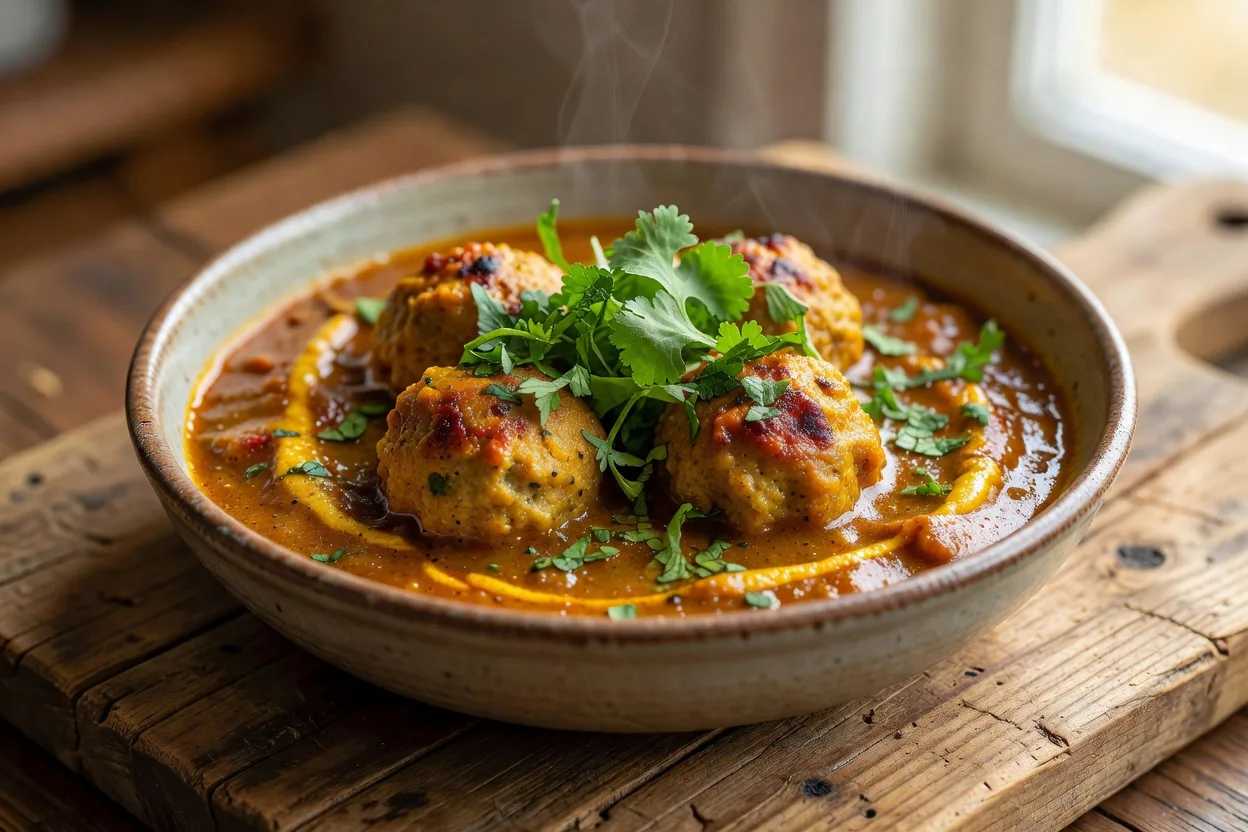
Ground lamb kofta seasoned with cumin, coriander, cinnamon & allspice — simmered in a golden tomato-ginger sauce. A Mizrachi classic, fully kosher, deeply fragrant.
The word kofta — from the Persian kūftah, meaning “pounded” or “ground” — tells the whole story in a single syllable. Long before supermarket ground meat existed, cooks from Tehran to Baghdad to Alexandria were pounding fresh cuts with mortar and spice, shaping the paste into elongated cylinders or round balls, and dropping them into fragrant braises. This is one of the oldest techniques in the culinary world, and it arrived in Jewish kitchens along the same spice-road arteries that carried saffron west and cinnamon east.
Among Mizrachi and Sephardic Jewish communities — those rooted in Iraq, Iran, Syria, Morocco, Yemen, and the Indian subcontinent — kofta is not a restaurant novelty. It is Shabbat food, weeknight food, the thing a grandmother makes when family comes unexpectedly and the pantry must perform. The Mizrachi spice profile that defines this recipe — cumin, coriander, cinnamon, allspice, a whisper of nutmeg — is not exotic. It is home. Iraqi Jews called a version of this dish kubbeh hamusta in its dumplings form, while Iranian Jews braised lamb kofta in turmeric-kissed tomato broth across generations. The recipe you are about to make sits at the confluence of all those traditions.
The curry sauce here is not Indian curry in the restaurant sense, but rather the broader Middle Eastern interpretation of the word: a wet, aromatic, tomato-based sauce deepened with ginger, garlic, turmeric, and garam masala. Coconut milk replaces dairy cream, keeping the dish fully fleishig (meat-only, no dairy contact) and adding a subtle sweetness that balances the acidity of the tomatoes. Serve it over rice or alongside a fresh laffa or warm pita, and you have a complete Shabbat or weeknight meal that is as impressive to guests as it is effortless to execute.
A quick note for searchers who arrived via the query “kofat” — you are in exactly the right place. “Kofat” is a phonetic spelling of “kofta” that reflects the way the word sounds when spoken quickly in Arabic and Hebrew-inflected speech. The dish is the same, the flavor is ancient, and this recipe is fully kosher. Welcome to the table.
What Makes This Kofta Special
-
◆
Authentic Mizrachi spice ratio.
Cumin, coriander, cinnamon, and allspice in specific proportions replicate the aromatic profile of Iraqi and Iranian Jewish kofta. Not one spice dominates — they chorus together. -
◆
Seared, then simmered.
Browning the kofta in a hot pan before adding them to the sauce creates a Maillard crust that survives braising, giving each meatball a textural contrast — slightly firm exterior, tender interior. -
◆
Coconut milk keeps it fleishig.
Traditional kofta sauces sometimes use yogurt or cream. Coconut milk achieves the same silky body and gentle sweetness — without any dairy contamination. Certified kosher coconut milk is widely available. -
◆
Kosher breadcrumbs as binder.
A small quantity of kosher-certified panko or fine breadcrumbs binds the kofta without drying them out — lamb’s natural fat content keeps everything moist even after simmering. -
◆
Freezes beautifully.
Both the kofta and the sauce freeze separately and together, making this ideal for Shabbat batch cooking. Reheat on the stovetop with a splash of water and the sauce rebounds to full depth. -
◆
One-pan, one-hour meal.
From raw ingredients to a steaming platter, this recipe takes 60 minutes and uses a single large sauté pan or Dutch oven. Less cleanup, more Shabbat.
Halachic Notes
● Fleishig (Meat) Status. This recipe is fully fleishig. It contains ground lamb (or beef) and must be cooked and served in meat vessels. Do not add any dairy ingredient — butter, cream, yogurt, cheese — at any stage. Coconut milk is pareve and is the correct substitution for any dairy cream the sauce might otherwise require.
● Waiting After Meat. After eating this dish, the standard Ashkenazic practice is to wait 6 hours before consuming dairy. Many Sephardic and Yemenite communities wait 1 hour (or after the next meal). Follow your family’s minhag (custom).
● Hafrashat Challah — Not Applicable. This recipe contains no bread dough. The kosher breadcrumbs used as a binder are a minor ingredient and do not trigger the obligation to separate challah. Use only certified kosher breadcrumbs (look for OU, OK, Star-K, or equivalent on the package).
● Checking Eggs. The kofta mixture uses one egg as a binder. Each egg must be checked individually for blood spots before use. Crack the egg into a clear glass or bowl, inspect it in good light, and discard any egg with a blood spot on the yolk or white. If in doubt, consult your rabbi.
● Pas Yisroel — Not Applicable. This recipe does not involve bread baking. If serving with laffa or pita, verify that the bread bears a Pas Yisroel designation if your community requires it.
● Brachot (Blessings).
• Before eating kofta alone: Shehakol nihyeh bidvaro (שהכל נהיה בדברו) — the general blessing for meat and cooked dishes.
• Before eating kofta with pita or laffa as part of a bread-based meal: Hamotzi lechem min ha’aretz covers all foods at the meal, including the kofta.
• After the meal: Birkat Hamazon (Grace After Meals) when bread was served; Borei nefashot if no bread was consumed.
Ingredients
The Kofta (Meatballs)
Makes approximately 20–24 kofta, each about 40g (1½ oz)
| INGREDIENT | GRAMS | VOLUME / NOTES |
|---|---|---|
| Ground lamb (or beef, 80/20 lean-fat) | 700 g | 1½ lbs |
| Kosher breadcrumbs (panko or fine) | 50 g | ½ cup |
| Egg, large (checked for blood spots) | 50 g | 1 large egg |
| Yellow onion, grated on box grater | 80 g | ½ medium onion |
| Fresh flat-leaf parsley, finely chopped | 20 g | ¼ cup packed |
| Ground cumin | 4 g | 2 tsp |
| Ground coriander | 3 g | 1½ tsp |
| Ground cinnamon | 2 g | 1 tsp |
| Ground allspice | 1 g | ½ tsp |
| Ground black pepper | 2 g | 1 tsp |
| Kosher salt | 8 g | 1½ tsp (or to taste) |
The Curry Sauce
| INGREDIENT | GRAMS | VOLUME / NOTES |
|---|---|---|
| Neutral oil (avocado, sunflower, or light olive) | 30 g | 2 tbsp |
| Yellow onion, finely diced | 200 g | 1 large onion |
| Garlic cloves, minced | 20 g | 5–6 cloves |
| Fresh ginger, grated or minced | 15 g | 1 tbsp (1-inch knob) |
| Crushed tomatoes (canned, kosher certified) | 400 g | 1 × 14 oz can |
| Coconut milk, full-fat (kosher certified, pareve) | 200 g | ¾ cup (half a 400g can) |
| Tomato paste (kosher certified) | 30 g | 2 tbsp |
| Ground turmeric | 3 g | 1½ tsp |
| Garam masala | 4 g | 2 tsp |
| Ground cumin | 2 g | 1 tsp |
| Cayenne pepper (optional, for heat) | 0.5–1 g | ¼–½ tsp |
| Kosher salt | 6 g | 1 tsp (or to taste) |
| Water or light chicken/beef stock (kosher certified) | 120 g | ½ cup |
To serve: basmati rice, or laffa / pita bread. Fresh cilantro and lemon wedges for garnish.
Step-by-Step Instructions
1
Check the Egg & Mix the Kofta
Begin by cracking your egg into a clear glass bowl. Hold it up to good light and inspect both the yolk and white for any blood spots. A clean egg continues on; a spotted egg is set aside. This is not optional — it is halacha.
In a large mixing bowl, combine the ground lamb, kosher breadcrumbs, checked egg, grated onion (squeeze out the excess liquid with your hand first — this prevents soggy kofta), chopped parsley, and all spices and salt. Using clean hands, mix with firm, deliberate strokes for about 90 seconds until the mixture is homogeneous but not overworked. Overworking compacts the proteins and makes the kofta dense. Stop when you can no longer see distinct threads of egg or breadcrumb. Cover the bowl and refrigerate for 20 minutes while you make the sauce base — chilling firms the fat in the lamb and makes shaping much easier.
2
Build the Sauce Base
Heat the oil in a large, wide sauté pan or Dutch oven over medium heat (about 175°C / 350°F surface temperature). Add the diced onion and a pinch of salt. Cook, stirring occasionally, for 8–10 minutes until the onion is soft, translucent, and just beginning to take on a golden edge at the corners. Do not rush this step: properly sweated onion is the sweetness backbone of the entire sauce.
Add the minced garlic and grated ginger. Stir constantly for 90 seconds until fragrant — the kitchen should smell like warmth itself. Then add the turmeric, garam masala, and cumin directly to the onion mixture. Stir for 60 seconds, toasting the spices in the oil. This blooming step releases the fat-soluble aroma compounds from the spices and is the single most impactful technique for depth of flavor in any curry.
3
Add Tomatoes & Simmer the Sauce
Add the tomato paste and stir it into the spiced onion base for 60 seconds to cook off its raw edge. Then pour in the crushed tomatoes and the water or stock. Stir to combine, scraping any spice deposits off the bottom of the pan. Bring to a gentle simmer, reduce heat to low-medium, and let the sauce cook uncovered for 10 minutes while you shape the kofta.
After 10 minutes, stir in the coconut milk. The sauce will lighten in color from deep red to a warm brick-orange. Taste for salt and cayenne. The sauce should be rich, fragrant, and slightly loose — it will thicken further once the kofta are added.
4
Shape the Kofta
Remove the kofta mixture from the refrigerator. Dampen your hands lightly with cold water — this prevents the meat from sticking to your palms. Scoop out portions of approximately 40 g (1½ oz) each and roll between both palms into smooth, tightly packed spheres. You should get 20–24 kofta from this batch. Place them on a plate or baking sheet as you work.
If you prefer the traditional elongated shape (like a torpedo), simply roll each ball in your palms while simultaneously applying gentle end-to-end pressure. Both shapes cook identically — choose based on how you plan to serve them. Round for plating over rice; elongated for tucking into laffa.
5
Sear the Kofta
In a separate pan (or remove the sauce temporarily to a bowl if working with one pan), heat a thin film of oil over high heat until shimmering. Working in batches — do not crowd the pan — sear the kofta for 2 minutes per side, turning once or twice, until each meatball has a deep brown crust on at least two faces. The kofta will not be cooked through at this stage, and that is correct. Internal temperature at this point will be around 50–55°C (120–130°F). They will finish cooking in the sauce.
Why sear before braising? The Maillard reaction at high heat creates hundreds of flavor compounds on the surface that a simmer alone cannot produce. The crust also provides structural integrity, preventing the kofta from falling apart in the sauce. Do not skip this step.
6
Braise Kofta in Sauce
Nestle the seared kofta into the simmering curry sauce, spooning sauce over the top of each meatball. Reduce heat to low, cover the pan, and simmer gently for 15–18 minutes. The kofta are fully cooked when an instant-read thermometer reads 71°C (160°F) at the center. At this temperature, the lamb is safe, juicy, and perfectly textured — not dry. Ground lamb can tolerate slightly lower internal temperatures than beef (USDA minimum for ground meat is 71°C / 160°F regardless of species).
During the braise, the kofta release their fat and spiced juices into the sauce, the sauce penetrates the surface of the kofta, and the two become a unified dish. This exchange is the soul of braised meatball cooking across every culture that practices it.
7
Adjust & Finish
Uncover the pan. If the sauce is thinner than you prefer, raise the heat to medium and simmer uncovered for 5 more minutes, stirring gently around the kofta. If it has thickened too much, add a splash of water or stock. Taste the sauce one final time and adjust salt, cayenne, and a squeeze of lemon juice to brighten the whole dish.
Serve directly from the pan (it holds heat beautifully) over basmati rice, or transfer to a warmed serving platter with fresh cilantro scattered generously over the top and lemon wedges alongside. This dish is designed to be scooped up with laffa bread — a thick, pillowy flatbread whose chewy texture absorbs the curry sauce the way a sponge absorbs water.
8
For Shabbat Service
This dish is an ideal Shabbat main course because it improves overnight. Prepare completely on Friday, cool, and refrigerate. Reheat on the stovetop before Shabbat candle lighting, transfer to a covered pot on a blech or hot plate, and serve at Friday night dinner or Shabbat lunch. The kofta will be even more tender and the sauce more deeply integrated after 12–24 hours of rest.
The kofta and sauce may also be prepared entirely on Thursday and refrigerated, allowing you to focus on challah baking on Friday. See our Classic Kosher Challah recipe for your Friday bread pairing.
Storage & Make-Ahead
Room Temperature
Up to 2 hours after cooking. Meat dishes should not be left out beyond this in a kosher kitchen context.
Refrigerator
4–5 days in a sealed container (meat vessels only). Flavor deepens significantly by Day 2.
Freezer
Up to 3 months. Freeze kofta submerged in sauce in freezer-safe containers. Thaw overnight in the fridge.
Reheating
Stovetop on low heat with lid on and a splash of water. Stir gently every few minutes. Microwave works but stovetop preserves texture better.
This dish freezes beautifully. Double the batch and freeze half in Shabbat-sized portions (6 kofta per container). A Shabbat main course that requires zero Friday effort is worth every extra 20 minutes of prep today.
Troubleshooting
| PROBLEM | CAUSE | SOLUTION |
|---|---|---|
| Kofta fall apart in the sauce | Not enough binder, mixture too wet, or skipped the searing step. | Squeeze more liquid from the grated onion. Add an extra tbsp of breadcrumbs. Always sear before braising — the crust is structural. |
| Kofta are dense and rubbery | Mixture was overworked, compacting proteins. | Mix only until ingredients are just combined — 90 seconds by hand. Do not use a stand mixer or food processor for the final mix. |
| Sauce is too thin | Too much added liquid, or lid left on during final simmer. | Simmer uncovered for 5–8 minutes on medium heat after braising, stirring gently. The sauce will concentrate quickly. |
| Sauce tastes flat or one-dimensional | Spices were not bloomed in oil before adding liquid, or onions were not properly caramelized. | Always bloom spices in hot oil for 60 seconds. Cook onions fully before adding garlic. A squeeze of lemon at the end brightens the whole dish. |
| Kofta are dry after reheating | Reheated uncovered at too high a temperature, or not enough sauce stored with the kofta. | Always store and reheat kofta submerged in sauce. Reheat on low with the lid on. Add a splash of water before reheating if the sauce has thickened in the fridge. |
Frequently Asked Questions
What does “kofat” mean? Is it a different dish from kofta?
“Kofat” is not a separate dish — it is a phonetic spelling of “kofta” as it sounds when spoken in Arabic or Hebrew-accented speech. The word comes from the Persian kūftah (“pounded meat”). Whether you spell it kofta, kofat, koufta, kafta, or kefta, the dish is the same: spiced ground meat shaped into balls or cylinders and cooked. The spelling variation is common on menus in Sephardic and Israeli restaurants and communities.
Can I use ground chicken instead of lamb or beef?
Yes, with one important adjustment. Ground chicken is leaner than lamb or beef (80/20), which means the kofta can dry out more easily. Add 15 g (1 tbsp) of olive oil directly to the kofta mixture to compensate for the reduced fat. Use dark meat ground chicken rather than white meat if possible — it has higher fat content and far more flavor. The spice profile works beautifully with chicken. Ensure your chicken is kosher certified and checked for blood spots as with the egg.
Is kofta the same as meatballs?
They are related but distinct. Both are ground meat shaped and cooked, but the philosophical difference lies in the spice architecture. Western meatballs (Italian-American, Ashkenazi, Swedish) rely primarily on breadcrumbs, egg, and mild seasoning — the meat flavor leads. Kofta foregrounds aromatics: cumin, coriander, cinnamon, allspice, ginger — the spice profile leads, with the meat as the vehicle. Kofta also typically use a higher meat-to-binder ratio than meatballs. They are a different eating experience, even if the technique overlaps.
Why does the recipe use coconut milk instead of yogurt or cream?
Kashrut. Yogurt and dairy cream are milchig (dairy), and cannot be combined with meat in a kosher kitchen. Many traditional kofta curry recipes call for yogurt as a tenderizing, creamy element. Coconut milk is pareve (neither meat nor dairy) and achieves a similar silky body and gentle sweetness. It also adds a subtle tropical undertone that pairs surprisingly well with the Mizrachi spice profile. Full-fat coconut milk is essential — the lighter versions lack body.
What bread should I serve with kofta curry?
The traditional pairing in Mizrachi kitchens is a thick, pillowy flatbread that can act as both utensil and vehicle — used to scoop and wrap the kofta. Our laffa bread recipe is the ideal match: large, chewy, lightly charred, baked directly on a very hot surface. Pita works well for individual portions. For a Shabbat table, challah alongside basmati rice creates a beautiful combination of traditions. Alternatively, serve over rice alone for a gluten-free meal.
Ready to Cook
Save This Recipe to Your Kitchen
Bookmark this page and return whenever you need a showstopping, fully kosher Shabbat main that takes under an hour from raw ingredients to the table.
Or explore our complete guide to kosher baking to deepen your knowledge of Jewish culinary traditions.
