
Purim Cookies & Pastries: Complete Guide to Jewish Baking for Purim
When is Purim? Purim 2026 was March 5–6. Purim 2027 will be February 21–22, 2027. Start baking for mishloach manot no later than February 14.
Purim is the most joyful day on the Jewish calendar — and the most generously baked. The Torah commandment of mishloach manot (sending food gifts to friends) and matanot l’evyonim (gifts to the poor) makes the Jewish kitchen busier on Erev Purim than almost any other day of the year. Every culture within the Jewish world has its own Purim specialties, but the common thread is sweetness, generosity, and the joy of the hidden miracle.
Below is a complete guide to every traditional Purim baked good — Ashkenazi, Sephardic, and Mizrachi — with the history behind each one and a link to the tested recipe.
Hamantaschen — The Iconic Purim Cookie
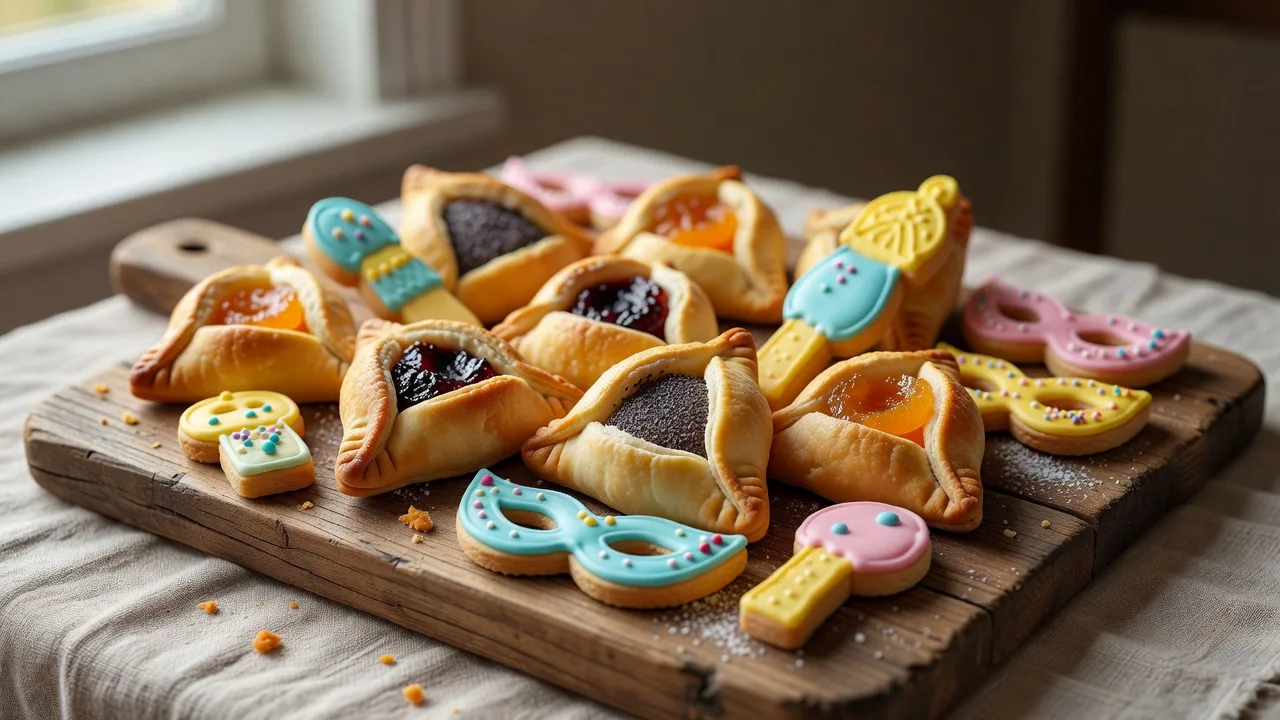
The three-cornered filled cookie that has become synonymous with Purim worldwide. The name means “Haman’s pockets” in Yiddish — referring to Haman, the villain of the Purim story whose plot to destroy the Jewish people was foiled by Queen Esther and Mordechai. The triangular shape is said to represent Haman’s hat (though some say his ears or his pocket in which he carried the lottery tickets for the destruction of the Jews).
Hamantaschen are made from either a cookie dough (shortbread-style, crisper, holds its shape better) or a yeasted dough (softer, more bread-like). The most traditional fillings are poppy seed (mohn) and prune jam (lekvar), both distinctly Ashkenazi. Modern hamantaschen now come in chocolate, peanut butter, Nutella, cheese, and countless other variations.
The key baking challenge — the one that separates good hamantaschen from great ones — is keeping the three corners sealed during baking so the filling does not escape. This requires the right dough consistency, the right amount of filling (not too much), and the right pinching technique.
→ Hamantaschen Recipe — two doughs (dairy & pareve), five fillings, and the pinching technique that actually keeps them closed.
Kosher status: Pareve or dairy depending on the dough. A pareve dough can be served at any meal.
Rugelach — The Crescent of the Jewish Kitchen
Crescent-shaped rolled pastries, made from a cream cheese dough (the American Jewish version) or a yeasted dough (the Eastern European original). The cream cheese dough was popularised in 20th-century America and produces a flaky, tangy, tender pastry that is now considered the classic. The filling is typically apricot jam, chocolate, cinnamon-walnut, or poppy seed — rolled inside the dough before cutting into crescents.
The word rugelach is Yiddish for “little twists” — a diminutive of rugel (twist). They are eaten year-round in Jewish households but are especially associated with Purim mishloach manot baskets because they are easy to package, travel well, and are universally loved.
→ Rugelach Recipe — cream cheese dough, three fillings (chocolate, apricot, cinnamon walnut), dairy and pareve options.
Kosher status: Dairy (cream cheese dough). For a pareve mishloach manot, use the yeasted version.
Mandelbrot — Jewish Biscotti
Twice-baked almond cookies that are the Jewish equivalent of Italian biscotti. The word mandelbrot means “almond bread” in Yiddish. The dough is formed into a log, baked, sliced, and baked again until crispy. Mandelbrot are pareve, making them ideal for mishloach manot that needs to be served alongside a meat or pareve meal.
Unlike Italian biscotti (which uses butter), traditional mandelbrot uses oil — making it inherently pareve and suitable after a meat meal. Variations include chocolate-dipped, dried fruit, chocolate chip, and the Sephardic version (biscotti di mandorle) which is closer to the Italian original.
→ Mandelbrot Recipe — crispy, twice-baked, pareve. Classic almond and chocolate-dipped versions.
Kosher status: Pareve. Suitable after any meal.
Kichel — The Original Jewish Kiddush Cookie
Crispy Ashkenazi bow-tie cookies, dry and airy, sprinkled with sugar. Kichel (singular: kichel, Yiddish for “little cookie”) are made from a very simple dough of flour, oil, eggs, and sugar, twisted into bow-tie or diamond shapes and baked at high heat until puffed and golden. They are almost comically simple in their recipe but require precise technique to achieve the characteristic crispiness.
Kichel have been the default kiddush cookie in Ashkenazi synagogues for generations — they are pareve, they don’t crumble, they travel perfectly in a tin, and they pair with both herring and honey cake. For Purim mishloach manot, a tin of kichel is both nostalgic and practical.
→ Kichel Recipe — crispy Ashkenazi bow-tie cookies. Pareve. Ready in 45 minutes.
Kosher status: Pareve.
Schnecken — Cinnamon Pecan Sticky Buns
The Ashkenazi version of the cinnamon roll: yeasted dough baked over a layer of caramelised pecans and honey. Schnecken means “snails” in German — the spiral shape. They are richer and stickier than standard cinnamon rolls because the caramel topping (which becomes the bottom during baking) is built into the pan before the rolls go in. When inverted, each roll is glazed with a dark, brittle honey-pecan caramel.
Schnecken appear in mishloach manot baskets because they are indulgent, beautiful, and can be made either dairy (with butter) or pareve (with margarine or oil).
→ Schnecken Recipe — honey-caramel pecan sticky buns. Dairy or pareve versions.
Kosher status: Dairy or pareve depending on fat used.
Poppy Seed Roll (Mohnstrudel) — The Purim Classic
A yeasted dough rolled around a thick filling of ground poppy seeds, honey, and sometimes raisins. Poppy seeds (mohn in Yiddish) are one of the most distinctly Ashkenazi Purim flavours — they appear in hamantaschen, kichel, mohnstrudel, and mohn cake. The connection is linguistic as well as culinary: the Yiddish word mohn (poppy) sounds like Haman, giving the act of eating poppy seeds on Purim an extra layer of symbolic satisfaction.
→ Poppy Seed Roll Recipe — soft yeasted dough, thick mohn filling, sliced like a jelly roll. Pareve.
Kosher status: Pareve.
Sephardic & Mizrachi Purim Sweets
Walnut Ma’amoul
The crumbly semolina cookie of Sephardic and Levantine Jewish communities, filled with spiced walnuts and shaped in a decorative wooden mold. Ma’amoul are eaten at Purim, Shavuot, and Eid in the broader Middle East — but in Sephardic homes they are strongly associated with Purim. The walnut filling is spiced with rose water, cinnamon, and sometimes orange blossom water.
→ Walnut Ma’amoul Recipe (pareve)
Kiflice (Balkan Jewish Crescents)
Tender crescent-shaped pastries from the Sephardic Jews of the Balkans (Yugoslavia, Greece, Bulgaria). Made from a rich, flaky dough filled with walnuts and powdered sugar. Kiflice are a Purim staple in Bosnian, Serbian, and Greek Jewish communities. Similar in shape to rugelach but with a distinctly different dough and filling tradition.
→ Kiflice Recipe (pareve)
Syrian Ka’ak (Sweet Sesame Cookies)
Sesame-coated bracelet cookies from the Syrian Jewish community — crispy, anise-scented, and addictive. Ka’ak (not to be confused with the savory Jerusalem ka’ak) are a Syrian Purim gift staple. They keep for weeks in a tin, travel perfectly, and are universally appreciated.
→ Syrian Ka’ak Recipe (pareve)
Planning Your Mishloach Manot Baking
| Baked good | Kosher status | Makes ahead | Ships/travels? |
|---|---|---|---|
| Hamantaschen | Pareve or dairy | 3 days ahead | ✅ Excellent |
| Rugelach | Dairy | 5 days ahead | ✅ Excellent |
| Mandelbrot | Pareve | 2 weeks ahead | ✅ Excellent |
| Kichel | Pareve | 2 weeks ahead | ✅ Excellent |
| Schnecken | Dairy or pareve | 1 day ahead | ⚠️ Best same-day |
| Poppy Seed Roll | Pareve | 3 days ahead | ✅ Good (sliced) |
| Ma’amoul | Pareve | 2 weeks ahead | ✅ Excellent |
| Syrian Ka’ak | Pareve | 3 weeks ahead | ✅ Excellent |
Frequently Asked Questions
What are the traditional Purim cookies called?
The most universally known Purim cookie is the hamantaschen — a three-cornered filled cookie named after the Purim villain Haman. Other traditional Ashkenazi Purim baked goods include rugelach, mandelbrot (Jewish biscotti), kichel (bow-tie cookies), and schnecken (cinnamon-pecan sticky buns). Sephardic communities bake ma’amoul (walnut-filled semolina cookies), kiflice (crescent pastries), and Syrian ka’ak (sesame bracelet cookies).
What is the difference between hamantaschen and rugelach?
Hamantaschen are three-cornered cookies with filling pressed into a triangle and pinched shut at the corners. They are made from either a cookie dough (firm, crispy) or a yeasted dough (soft). Rugelach are crescent rolls made from a cream cheese or yeasted dough, rolled around a filling and shaped into small crescents. Both are Purim staples, but hamantaschen are distinctly seasonal while rugelach are eaten year-round.
Can Purim cookies be made pareve for mishloach manot?
Yes. Hamantaschen, mandelbrot, kichel, poppy seed roll, ma’amoul, and Syrian ka’ak are all naturally pareve — suitable for recipients who keep strictly kosher and may receive your gift at a meat meal. Rugelach made with cream cheese are dairy. Schnecken can be made pareve by substituting margarine or oil for butter. Always label dairy items in your mishloach manot clearly.
How far in advance can I bake Purim cookies?
Mandelbrot and kichel can be baked 2 weeks ahead — they improve with time in an airtight tin. Hamantaschen are best 1–3 days ahead (older hamantaschen get soft). Rugelach keep 5 days at room temperature or can be frozen unbaked and baked to order. Ma’amoul keep 2–3 weeks in a tin. Schnecken are best eaten the same day.
What fills a traditional hamantaschen?
The two most traditional Ashkenazi fillings are poppy seed (mohn — the seeds ground with honey and sugar) and prune jam (lekvar). Both have been used since at least the 18th century. Modern variations include apricot jam, chocolate ganache, peanut butter, Nutella, cheese (dairy), and sweetened almond paste. All are halachically acceptable — the traditional fillings are a custom, not a requirement.
Start Baking for Purim 2027
Purim 2027 is February 21–22. Hamantaschen first, then rugelach — give yourself two Shabbatot before Purim to practice each.
