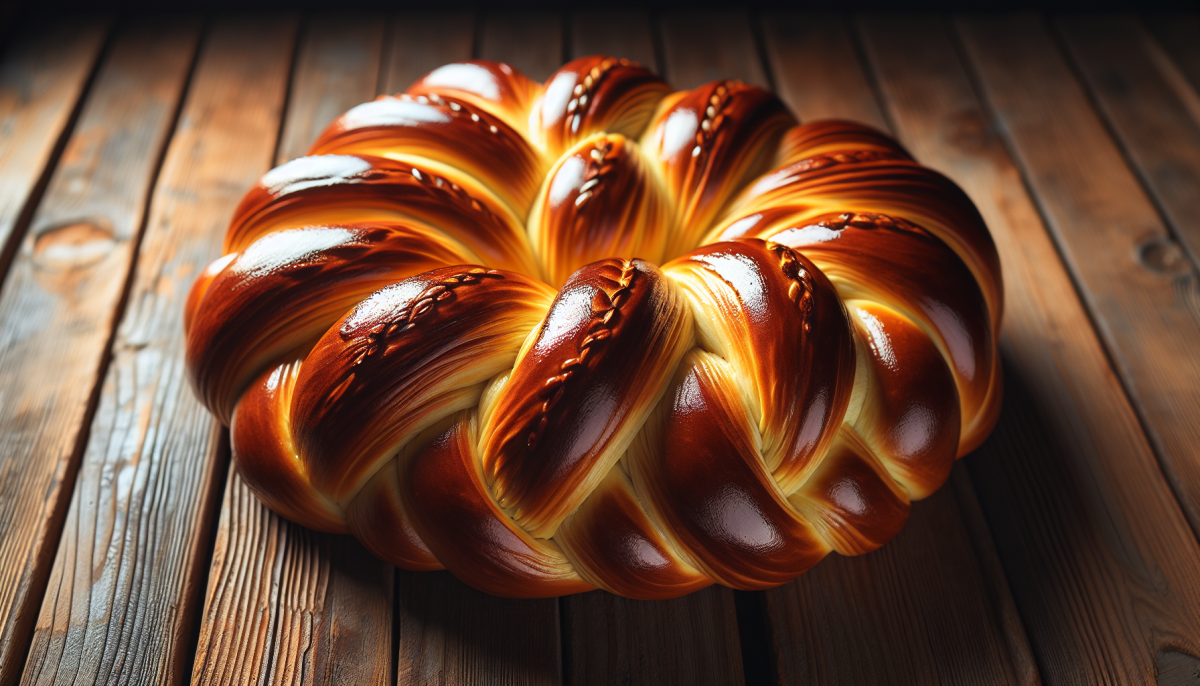
Spelt is one of the five grains mentioned in the Talmud for the mitzvah of challah, making spelt challah not just a health-conscious choice but a deeply traditional one. This ancient grain produces a challah with a nutty, slightly sweet flavor and a tender crumb that’s easier to digest than modern wheat for many people.
The key to great spelt challah is gentle handling. Spelt’s gluten is more fragile than wheat’s, so shorter kneading times and careful shaping produce the best results. The reward is a challah with beautiful color, wonderful aroma, and a flavor complexity that regular flour simply cannot match.
What Makes This Recipe Special
- Ancient grain authenticity — One of the five Talmudic grains for the mitzvah of challah
- Easier digestion — Many people who struggle with modern wheat tolerate spelt well
- Nutty, complex flavor — Deeper taste than white flour challah
- Gentle technique — Shorter kneading preserves spelt’s delicate gluten
Halachic Notes
- Kosher Classification: Pareve — contains no dairy or meat ingredients. Eggs must be checked for blood spots.
- Hafrashat Challah: This recipe uses approximately 500g of flour. If doubling, separate challah without a bracha at 1.2 kg, or with the bracha "ברוך אתה ה׳ אלקינו מלך העולם אשר קדשנו במצותיו וצונו להפריש חלה" at 2.25 kg.
- Pas Yisroel: When a Jewish person lights the oven or contributes to the baking process, this fulfills the Pas Yisroel requirement.
- Brachot: Hamotzi lechem min ha’aretz before; Birkat Hamazon after.
Ingredients
| Ingredient | Grams | Volume | Baker’s % |
|---|---|---|---|
| Whole spelt flour | 300g | 2½ cups | 60% |
| White spelt flour | 200g | 1¾ cups | 40% |
| Warm water | 170g | ¾ cup | 34% |
| Large eggs | 100g (2 large) | 2 eggs | 20% |
| Honey | 60g | 3 Tbsp | 12% |
| Neutral oil | 55g | ¼ cup | 11% |
| Fine sea salt | 8g | 1¼ tsp | 1.6% |
| Instant yeast | 7g | 2¼ tsp | 1.4% |
Instructions
Step 1: Mix
Combine wet ingredients, add flours, salt, and yeast. Mix until combined.
Step 2: Knead
Knead gently for only 5–7 minutes. Spelt gluten is fragile; over-kneading weakens it.
Step 3: First Rise
Oil the bowl, cover, rise 1–1½ hours until nearly doubled. Spelt rises faster than wheat.
Step 4: Shape
Divide into 4 strands, braid gently. Handle the dough as little as possible.
Step 5: Second Rise & Bake
Rise 25–35 minutes. Egg wash and bake at 175°C (350°F) for 28–32 minutes.
Storage & Make-Ahead
- Room temperature: Store in an airtight container for 2–3 days.
- Freezing: Wrap tightly in plastic wrap and foil. Freeze up to 3 months.
- Reheating: Warm at 175°C (350°F) for 8–10 minutes.
Troubleshooting
| Problem | Cause | Solution |
|---|---|---|
| Challah falling apart | Over-kneaded spelt gluten | Knead maximum 7 minutes; handle gently |
| Dense loaf | Too much whole spelt | Use the 60/40 whole-to-white ratio |
| Dry crumb | Spelt absorbs differently | May need 10–15g extra water |
| Quick over-proofing | Spelt ferments fast | Watch dough, not the clock; reduce rise times |
Frequently Asked Questions
Is spelt gluten-free?
No. Spelt contains gluten, though its gluten structure differs from modern wheat. It is not suitable for those with celiac disease.
Can I use 100% whole spelt?
Yes, but the challah will be denser. The 60/40 blend gives the best balance of nutrition and texture.
Does spelt challah keep as well?
Spelt challah is best on day one. It dries out faster than wheat challah, so freeze any leftovers promptly.
Enjoy Your Spelt Challah!
Another treasure from the Kosher Bread Pro collection.
🍞 Get a New Kosher Recipe Every Week
Join our baking community. One recipe, one tip, one story — delivered every Friday before Shabbat.
No spam. Just bread. Unsubscribe anytime.
You Might Also Enjoy
- Whole Wheat Challah — Another wholesome alternative flour challah
- Classic Kosher Challah — The traditional starting point
- Gluten-Free Challah — For those avoiding all gluten
- Olive Oil Challah — Light and fragrant with quality olive oil