Search 150+ Kosher Recipes
Kosher for Passover
If you’ve ever tried the recipe on the back of a gluten-free matzo meal box and ended up with dense, gummy depth charges sinking to the bottom of your soup, you are not alone. The internet is full of Pesach horror stories—gelatinous sinkers that taste like wet cardboard, matzo balls so heavy they could anchor a boat. The problem isn’t you. The problem is the recipe.
Gluten-free matzo meal behaves fundamentally differently from its wheat-based counterpart. Without gluten’s elastic protein network to trap air and create structure, you need a completely different approach. The box recipe—which simply substitutes GF matzo meal into a standard formula—ignores this, and the results are predictably disappointing. You need more fat to coat the starch particles and prevent them from absorbing too much water. You need potato starch to create a tender, less gummy crumb. And you need seltzer—that’s right, sparkling water—to inject tiny air bubbles that survive cooking and give you the light, fluffy texture that everyone deserves at the Seder table.
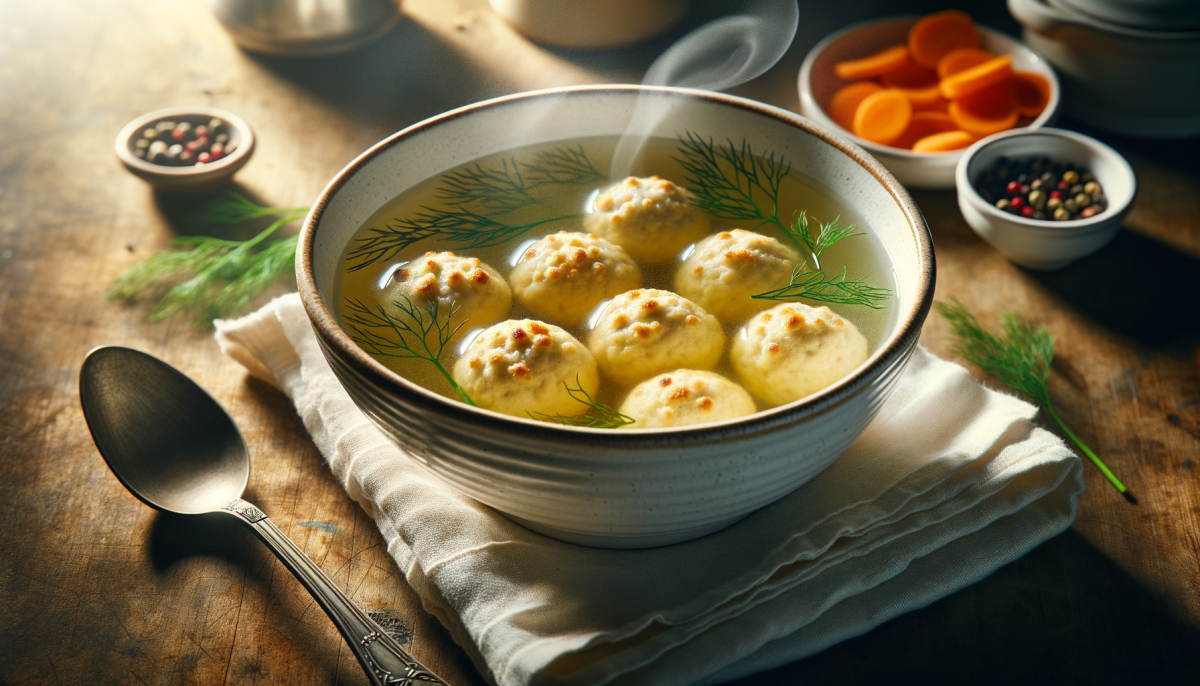
This recipe was developed specifically to solve the “GF matzo ball problem.” Every choice—the fat ratio, the starch blend, the carbonation, the extended rest, the gentle simmer—is engineered to produce matzo balls that are genuinely light, tender, and flavorful. Not “good for gluten-free.” Just good. The kind of matzo balls that float in golden chicken soup and make people ask for seconds without ever knowing they’re GF.
Whether you keep gluten-free for celiac disease, sensitivity, or simply prefer it, these matzo balls belong on your Pesach table. They are the matzo balls your bubbe would have made if she’d had access to better ingredients and a little food science.
What Makes This Recipe Special
- The potato starch secret — A 25% addition of potato starch to the GF matzo meal creates a tender crumb that pure GF matzo meal cannot achieve. It breaks up the gummy, gelatinous texture that plagues most GF matzo ball recipes
- Seltzer for lift — Sparkling water introduces thousands of tiny CO₂ bubbles into the batter. These expand during cooking and create the airy, fluffy interior that GF matzo balls typically lack
- Higher fat ratio — At 60% baker’s percentage, this recipe uses significantly more fat than the box recipe. Fat coats the starch granules, preventing them from absorbing excess water and turning gummy
- Extended cold rest — A minimum 1-hour (ideally 2-hour) refrigeration lets the GF matzo meal fully hydrate and the mixture firm up, so balls hold their shape without being over-compacted
- Schmaltz or oil flexibility — Use schmaltz for the richest, most traditional flavor, or neutral oil for a pareve version that can be served alongside any meal
Halachic Notes
- Kosher Classification: Pareve when made with neutral oil. Fleishig (meat) when made with schmaltz (rendered chicken fat). Most commonly served in chicken soup, making the meal fleishig regardless.
- Kosher for Passover: Use gluten-free matzo meal with a reliable Kosher for Passover hechsher (e.g., Yehuda or Manischewitz GF varieties). Verify all ingredients carry Pesach certification.
- GF Matzo Meal & the Mitzvah of Matzo: If your GF matzo meal is made from oat matzo (oats are one of the five grains subject to chametz), it fulfills the mitzvah of matzo at the Seder. Some GF matzo meals are made from non-grain ingredients—these are fine for matzo balls but would not fulfill the Seder obligation. Check the label.
- Checking Eggs: Each egg must be cracked individually into a clear glass and checked for blood spots before use.
- Hafrashat Challah: Not required for this recipe—the flour quantity is well below the shiur.
- Brachot: Mezonot before eating (contains grain-based matzo meal from oats). Al Hamichya after. If your GF matzo meal is not grain-based, consult your rabbi regarding the appropriate bracha.
Ingredients
| Ingredient | Grams | Volume | Baker’s % |
|---|---|---|---|
| Gluten-free matzo meal (e.g., Yehuda, Manischewitz GF) | 100g | 1 cup | 100% |
| Potato starch | 25g | 3 Tbsp | 25% |
| Large eggs, lightly beaten | 150g (3 large) | 3 eggs | 150% |
| Schmaltz (rendered chicken fat) OR neutral oil | 60g | ¼ cup | 60% |
| Seltzer or sparkling water | 45g | 3 Tbsp | 45% |
| Fine sea salt | 5g | 1 tsp | 5% |
| White pepper (optional) | 1g | ¼ tsp | 1% |
| Onion powder (optional) | 2g | ½ tsp | 2% |
| Fresh dill, finely chopped (optional) | 3g | 1 Tbsp | — |
Instructions
Step 1: Mix the Dry Ingredients
In a medium bowl, whisk together the gluten-free matzo meal, potato starch, salt, white pepper, and onion powder (if using). The potato starch is your secret weapon—it interrupts the gummy texture that pure GF matzo meal creates by absorbing moisture differently and producing a more tender crumb. Set aside.
Step 2: Whisk the Wet Ingredients
In a separate bowl, lightly beat the eggs. Add the schmaltz (or oil) and whisk until well combined. Open a fresh bottle of seltzer or sparkling water—it must be actively fizzy, not flat. Add the seltzer last and whisk gently, just enough to incorporate. You want to preserve as much carbonation as possible. Those tiny bubbles are going to become the air pockets that make your matzo balls light.
Step 3: Combine Wet into Dry
Pour the wet ingredients into the dry ingredients. Using a fork or spatula, fold gently until just combined. Do NOT overmix—you are not making bread dough. Overmixing deflates the carbonation and compresses the mixture, which leads to dense balls. A few small lumps are fine. If using fresh dill, fold it in now with one or two strokes. The batter will be wet and loose—this is correct. It will firm up in the fridge.
Step 4: Refrigerate (Non-Negotiable)
Cover the bowl tightly with plastic wrap and refrigerate for a minimum of 1 hour, and ideally 2 hours or more. This step is absolutely non-negotiable. The GF matzo meal needs time to fully absorb the liquid and swell. If you skip this or cut it short, your matzo balls will not hold together, will be gummy inside, and will likely fall apart in the water. Patience here is the difference between fluffy matzo balls and depth charges.
Step 5: Prepare the Cooking Water
Bring a large, wide pot of well-salted water to a rolling boil (use at least 4 liters / 1 gallon). You want a big pot—matzo balls expand 2–3 times their original size and must not be crowded. Once the water reaches a full boil, reduce the heat to a gentle simmer. You should see lazy bubbles rising slowly to the surface, not a vigorous roil. A hard boil will break the matzo balls apart.
Step 6: Shape the Matzo Balls
Remove the batter from the fridge. Fill a small bowl with cold water and wet your hands. Scoop approximately 2 tablespoons of batter (about the size of a walnut) and roll very gently between wet palms into a rough ball. Do not compress or squeeze. The ball should be loosely formed—think of it as barely holding together. This light touch is critical: over-compacting forces out air and creates dense sinkers. Re-wet your hands between each ball. You should get 12–14 balls.
Step 7: Simmer with the Lid On
Gently lower each matzo ball into the simmering water. They will sink at first—this is normal. Once all the balls are in the pot, cover with a tight-fitting lid. Do NOT peek for 30–35 minutes. Every time you lift the lid, you release steam and drop the temperature, which disrupts the gentle cooking environment these need. Set a timer. Walk away. Trust the process.
Step 8: Test and Serve
After 30–35 minutes, remove the lid. The matzo balls should have floated to the surface and expanded noticeably. Remove one with a slotted spoon and cut it in half. The interior should be fluffy and uniform throughout—no dense, gummy core. If the center is still dense, replace the lid and cook for an additional 5 minutes. Serve immediately in hot chicken soup, or transfer to your soup pot and reheat gently.
Storage & Make-Ahead
- In soup: 3–4 days refrigerated. Matzo balls absorb broth over time, which is delicious but makes them softer.
- Without soup: 3 days refrigerated in an airtight container.
- Frozen (cooked): Up to 2 months. Freeze on a parchment-lined sheet pan until solid, then transfer to a freezer bag. Do not freeze in liquid.
- Reheating: Drop refrigerated matzo balls into simmering soup for 10 minutes. Drop frozen matzo balls directly into simmering soup for 15 minutes—no need to thaw.
- Make-ahead for Pesach: Cook a full batch 1–2 days before Seder. Store in soup in the refrigerator. Reheat gently on the stovetop. Or freeze up to 2 months ahead.
Troubleshooting
| Problem | Cause | Solution |
|---|---|---|
| Dense sinkers that won’t float | Not enough fat, insufficient rest time, or balls over-compacted during shaping | Follow the 60% fat ratio exactly. Rest minimum 2 hours. Roll with wet hands using the lightest possible touch—barely hold them together |
| Gummy, gelatinous texture | Too much liquid, not enough potato starch, or GF matzo meal absorbing excess water | The potato starch is essential—do not skip it. Measure carefully. If batter seems very wet after resting, add 1 Tbsp more GF matzo meal |
| Falling apart in water | Water boiling too aggressively, or batter didn’t rest long enough to hydrate | Reduce to the gentlest possible simmer before adding balls. Rest batter a full 2 hours. If still fragile, add one more egg yolk |
| Balls not expanding | Seltzer was flat, or batter was overmixed deflating the carbonation | Use freshly opened, vigorously fizzy seltzer. Add it last, whisk gently. Fold—don’t stir—when combining wet and dry |
| Bland, flat flavor | Under-salted—GF matzo meal needs more salt than regular matzo meal | Use the full 5g (1 tsp) salt. Also salt the cooking water generously. White pepper and onion powder add depth |
| Too firm or rubbery | Overcooked | Pull at 30–35 minutes. Test one by cutting in half. They continue firming slightly as they cool |
| Uneven cooking | Pot overcrowded—balls need room to expand 2–3 times their size | Use a large, wide pot with at least 4 liters of water. Cook in two batches if needed. Don’t let them touch |
Frequently Asked Questions
Can I use regular matzo meal if I’m not gluten-free?
Absolutely. Reduce the potato starch to 15g (about 1½ tablespoons) and keep everything else the same. Regular matzo meal has some gluten structure of its own, so it needs less starch support. You’ll get even fluffier results. The seltzer trick and high-fat ratio work beautifully with regular matzo meal too—this is a better recipe than the box regardless of which matzo meal you use.
Schmaltz or oil—which is better?
Schmaltz gives a richer, more savory, deeply traditional flavor and slightly better texture because of its fat composition. It’s the gold standard for matzo balls. However, schmaltz makes the recipe fleishig (meat), so the matzo balls can only be served at a meat meal. Use neutral oil (such as avocado or grapeseed) for a pareve version. Do not use butter—matzo ball soup is traditionally made with chicken broth, and dairy plus meat soup would violate kashrut.
Can I make these ahead for the Seder?
Yes, and you should. Cook the matzo balls fully, let them cool, and store them in your chicken soup in the refrigerator for up to 3–4 days. They actually improve as they absorb the broth flavors. Alternatively, freeze cooked matzo balls on a sheet pan, then bag them for up to 2 months. Reheat frozen matzo balls directly in simmering soup for 15 minutes—no thawing needed. This makes Erev Pesach significantly less stressful.
Why do I need to rest the mixture so long?
Gluten-free matzo meal absorbs liquid much more slowly than regular matzo meal because it lacks gluten proteins that swell quickly. Without adequate rest time, the matzo meal hasn’t fully hydrated, which means the excess free liquid inside the ball turns gummy and gelatinous during cooking. The 1–2 hour rest allows full absorption and lets the mixture firm up so you can shape balls that hold together without being compacted. Skipping this step is the number one cause of GF matzo ball failure.
Can I add mix-ins?
Yes. Fresh dill is the classic addition (1 tablespoon, finely chopped). Other excellent options include: finely minced flat-leaf parsley, a pinch of nutmeg for warmth, sautéed finely diced onion (cooled completely before adding), or a teaspoon of finely grated lemon zest for brightness. Fold any additions in gently at the end of Step 3. Avoid anything heavy or wet that would weigh the balls down or add excess moisture.
Light, Fluffy, and Kosher for Pesach
No more gummy sinkers. These gluten-free matzo balls prove that the best Pesach cooking is never a compromise.
Our Matzo Recipe
Pesach Rainbow Cookies
Explore More Recipes
Leave a Reply
You must be logged in to post a comment.