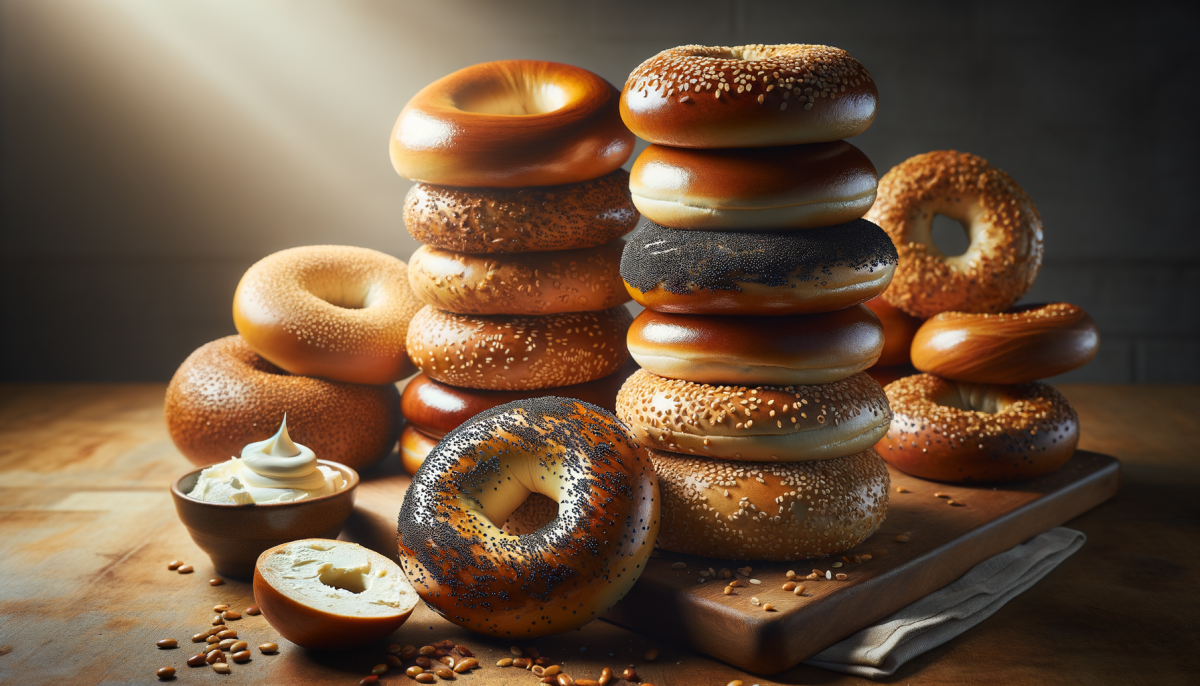
New York Bagel Recipe — Boiled, Chewy, and Perfectly Kosher
This New York bagel recipe will change your mornings forever — stop buying supermarket bagels. Those soft, puffy imposters wrapped in cellophane? They aren’t bagels. They’re round bread with an identity crisis. A real bagel — a New York bagel — has a crackling, malt-kissed crust that shatters under your teeth before giving way to a dense, satisfying chew that no factory line can replicate. Once you pull your first batch from the oven and hear that crust sing as it cools, there is no going back. Every morning without a real bagel is a morning wasted.
You are about to join a very small group of people who can make real bagels at home — the kind that would hold their own on any corner in Brooklyn or the Upper West Side. The kind with a shiny, blistered crust the color of dark honey. The kind with an interior so dense and chewy it fights back when you tear it apart. The kind your family will not believe came out of your own oven.
This recipe is the product of three obsessions coming together: the craft of a master baker, rigorous kosher standards, and the deep food history that makes the bagel one of the most iconic Jewish breads ever created.
Let’s make bagels.
Recipe at a Glance
| Yield | 8–10 bagels (approximately 110–120 g each before baking) |
| Difficulty | Intermediate |
| Active Time | 45 minutes |
| Total Time | 14–26 hours (includes overnight cold retard) |
| Kosher Status | Pareve |
| Bracha | HaMotzi Lechem Min Ha’Aretz |
The Bagel: A Jewish Story
The bagel is inseparable from Jewish history. The earliest written reference appears in the communal regulations of Kraków, Poland, in 1610, where bagels (beygl, from the Yiddish) were listed among the gifts given to women after childbirth. For centuries, bagels were the bread of the Jewish communities of Eastern Europe — affordable, portable, and deeply embedded in daily life. When millions of Ashkenazi Jews emigrated to America in the late 19th and early 20th centuries, they brought their bagel traditions with them. By the 1920s, bagel baking in New York City was controlled almost entirely by Bagel Bakers Local 338, a Jewish labor union whose members hand-rolled every single bagel in the city.
The boiling step — the defining technique that separates a true bagel from ordinary bread — serves a practical purpose. It gelatinizes the starches on the exterior of the dough, creating that signature shiny, chewy crust. But it also carries symbolic weight: the bagel is a bread of intention, a bread that demands an extra step, a bread that refuses to be rushed. That ethos is baked into every one you will make with this recipe.
Kosher Considerations
Kosher Classification: Pareve
This recipe contains no dairy or meat ingredients and is inherently pareve. It can be served alongside any meal.
Bracha (Blessing)
The correct blessing before eating bagels is HaMotzi Lechem Min Ha’Aretz (“Who brings forth bread from the earth”), as bagels are a bread product made from one of the five grains (wheat).
Hafrashat Challah
This recipe uses approximately 500 g of flour, which is below the shiur (minimum amount) requiring hafrashat challah (separation of challah dough). The generally accepted threshold requiring separation with a bracha is approximately 1,666 g (about 3 lb 10 oz / ~14 cups) of flour. If you scale this recipe to that amount or beyond, you must separate a small piece of dough and recite the appropriate blessing. Between approximately 1,230 g and 1,666 g, many authorities require separation without a bracha. Consult your rabbi for the custom you follow.
Ingredient Notes
- Barley malt syrup: Must bear a reliable hechsher (kosher certification). Barley malt syrup is produced through a process involving enzymes, and a hechsher ensures no non-kosher processing agents were used. Common certified brands include Eden Foods (OU) and other nationally available brands. Check the label.
- Bread flour: Plain flour generally does not require a hechsher, but many families prefer to use certified flour. Check for infestation, particularly with whole grain varieties.
- Sesame seeds: Generally do not require a hechsher. No major insect concerns.
- Poppy seeds: Generally do not require a hechsher, but poppy seeds have known insect concerns. It is recommended to check them before use. Some authorities recommend soaking in water and inspecting, or purchasing from a source with kosher certification that includes insect checking.
A Note on Pas Yisroel
When bagels are produced commercially for sale, many observant communities require them to be Pas Yisroel — meaning a Jewish person must have a meaningful role in the baking process (such as lighting the oven or placing the bagels inside). When you bake at home, your bagels are inherently Pas Yisroel. This is one of the many beautiful reasons to bake your own bread.
Ingredients
Bagel Dough
| Ingredient | Grams | Volume (approx.) | Baker’s % |
|---|---|---|---|
| High-protein bread flour (12.5–14% protein) | 500 g | 4 cups | 100% |
| Water (room temperature) | 285 g | 1 cup + 3 Tbsp | 57% |
| Barley malt syrup (with hechsher) | 15 g | 1 Tbsp | 3% |
| Fine sea salt | 10 g | 2 tsp | 2% |
| Instant yeast | 4 g | 1¼ tsp | 0.8% |
Total dough weight: approximately 814 g
Hydration: 57% — this is deliberately low. Bagel dough should feel stiff and dry compared to other bread doughs. Trust the process.
Malt Water Bath (for Boiling)
- 4 liters (about 1 gallon) water
- 30 g (2 Tbsp) barley malt syrup (with hechsher) or 20 g (1½ Tbsp) granulated sugar
Toppings (Optional)
- Sesame seeds
- Poppy seeds (inspect for insects — see kosher notes above)
- Everything mix: sesame seeds, poppy seeds, dried minced garlic, dried minced onion, flaky sea salt
- Coarse or flaky sea salt
- Dried minced onion
- Plain (no topping — equally beautiful)
Equipment You Will Need
- Stand mixer with dough hook (strongly recommended) or a sturdy work surface for hand kneading
- Large baking sheet(s), lined with parchment paper
- Plastic wrap or reusable beeswax wraps
- Large, wide pot (at least 6 quarts / 5.5 liters)
- Slotted spoon or spider skimmer
- Wire cooling rack
- Digital kitchen scale (essential for consistent results)
- Instant-read thermometer
- Small bowls or plates for toppings
Instructions
Step 1: Mix the Dough
In the bowl of a stand mixer fitted with the dough hook, combine the bread flour (500 g), instant yeast (4 g), and salt (10 g). Stir briefly on low speed to distribute.
In a small bowl or measuring cup, dissolve the barley malt syrup (15 g) in the room-temperature water (285 g). The malt syrup is thick and sticky — stir until it is fully incorporated into the water.
With the mixer running on low speed (speed 1–2), pour the malt water into the flour mixture. Mix until the dough comes together into a shaggy mass, about 2 minutes. The dough will look rough and dry. That is exactly right. Resist the urge to add more water.
If mixing by hand: Combine the dry ingredients in a large bowl. Make a well in the center, pour in the malt water, and stir with a wooden spoon or dough scraper until a shaggy dough forms. Turn out onto an unfloured work surface.
Step 2: Knead the Dough (8–10 Minutes)
Increase the mixer speed to medium (speed 3–4) and knead for 8–10 minutes. The dough will transform from rough and shaggy to smooth, stiff, and elastic. It should feel like a firm stress ball — dense and tight, with a satiny surface. When you press a finger into it, it should slowly spring back.
Do the windowpane test: tear off a small piece of dough and gently stretch it between your fingers. You should be able to stretch it thin enough to see light through it without it tearing. If it tears easily, knead for another 2–3 minutes.
If kneading by hand: This will take 12–15 minutes of vigorous kneading. Bagel dough is stiff and will give your forearms a workout. Push, fold, turn, repeat. You can let the dough rest for 5 minutes midway through if needed.
Note: Your stand mixer may struggle slightly with this dough due to its stiffness. This is normal. If the mixer “walks” across the counter, reduce the speed and hold it steady. If the dough hook cannot grab the dough, stop the mixer, push the dough down onto the hook, and restart.
Step 3: Bulk Fermentation (1–1.5 Hours at Room Temperature)
Shape the dough into a smooth ball. Place it in a lightly oiled bowl (or the same mixer bowl, wiped clean and lightly oiled). Cover tightly with plastic wrap.
Let the dough rise at room temperature (72–76°F / 22–24°C) for 1 to 1½ hours, or until it has increased in volume by about 50%. Bagel dough does not double — the low hydration and low yeast percentage mean a slower, more restrained rise. This is intentional.
Step 4: Divide and Pre-Shape
Turn the dough out onto a clean, unfloured work surface. Using a bench scraper or sharp knife, divide the dough into 8 equal pieces (approximately 100–102 g each) for larger bagels, or 10 pieces (approximately 81–82 g each) for standard-sized bagels. Use your kitchen scale for accuracy — consistent sizing means even baking.
Shape each piece into a tight, smooth ball: cup your hand over the dough and move it in small circles on the work surface, using the friction of the surface (not flour) to create tension on the outside of the ball. Set the balls aside, cover loosely with a clean towel or plastic wrap, and let them rest for 5 minutes. This brief rest relaxes the gluten and makes shaping easier.
Step 5: Shape the Bagels
There are two classic methods for shaping bagels. Both work beautifully. Try both and decide which you prefer.
Method A: The Poke Method (Recommended for Beginners)
Take a dough ball and press your thumb through the center to create a hole. Gently stretch and rotate the dough, widening the hole to about 5–6 cm (2–2.5 inches) in diameter. The hole will shrink during proofing and baking, so make it larger than you think you need. Place the shaped bagel on a parchment-lined baking sheet.
Method B: The Roll Method (Traditional)
Take a dough ball and roll it into a rope about 25–28 cm (10–11 inches) long, slightly thicker in the center and tapering at the ends. Wrap the rope around the back of your hand, overlapping the ends by about 3–4 cm (1.5 inches) at the base of your palm. Press and roll the overlapping seam on the counter to seal it. Slide the bagel off your hand and adjust the shape. Place on the parchment-lined baking sheet.
Space the shaped bagels at least 5 cm (2 inches) apart on the baking sheet. They will expand slightly during the cold retard.
The float test (optional but helpful): Before refrigerating, drop one bagel into a bowl of room-temperature water. If it floats within 10 seconds, the dough is ready for the refrigerator. If it sinks and stays down, let the shaped bagels rest at room temperature for another 15–20 minutes, then test again. (Remove the test bagel, pat dry, and return it to the tray.)
Step 6: Overnight Cold Retard (12–24 Hours)
Cover the baking sheet tightly with plastic wrap, ensuring it does not touch the surface of the bagels (you can elevate the wrap with toothpicks or small cups if needed).
Place the tray in the refrigerator (38–40°F / 3–4°C) for a minimum of 12 hours and up to 24 hours.
This cold retard is not optional. It is where the magic happens. The slow, cold fermentation develops complex flavors — a subtle tang, a deeper wheaty sweetness, and a more nuanced aroma — that you simply cannot achieve with a quick room-temperature rise. The cold also firms the dough, making the bagels easier to handle during boiling.
Plan your schedule: Shape the bagels in the evening. Boil and bake them the next morning. Your kitchen will smell extraordinary before anyone else is even awake.
Step 7: Prepare for Boiling and Baking
The next morning, preheat your oven to 450°F (230°C) with a rack positioned in the upper third. If you have a baking stone or steel, place it on the rack and let it preheat for at least 30 minutes. If not, a heavy-duty baking sheet works fine.
Fill a large, wide pot with 4 liters (1 gallon) of water. Add the barley malt syrup (30 g / 2 Tbsp) and stir to dissolve. Bring the water to a vigorous, rolling boil. Then reduce to a gentle but steady boil — you want active bubbles, not a violent eruption that could damage the bagels.
Prepare your toppings: spread each topping on a separate small plate or shallow bowl. Line a clean baking sheet with parchment paper (or use the baking sheet the bagels were on, with fresh parchment).
Remove the bagels from the refrigerator. They go straight from the fridge to the boiling water. Do not let them come to room temperature first.
Step 8: Boil the Bagels
This is the step that makes a bagel a bagel.
Working in batches of 2–3 (do not crowd the pot), gently lower each bagel into the boiling malt water. They should float immediately or within a few seconds.
Boil for 30–60 seconds on the first side, then flip with a slotted spoon or spider skimmer and boil for 30–60 seconds on the second side.
- 30 seconds per side: Yields a thinner, crispier crust and a slightly lighter interior. A good starting point.
- 60 seconds per side: Yields a thicker, chewier crust and a denser crumb. The classic New York style leans toward the longer boil.
The malt water does two critical things: it gelatinizes the surface starches, which creates the bagel’s characteristic shiny, chewy crust, and it deposits a thin layer of malty sweetness on the exterior that caramelizes beautifully in the oven.
Lift each boiled bagel out of the water with the slotted spoon, letting the excess water drip off for a few seconds. If applying toppings, proceed immediately to the next step while the bagel is still wet.
Step 9: Apply Toppings
While the bagel is still wet and glistening from the malt bath, press the top surface gently into your prepared topping plate. The wet surface acts as natural glue. You can also sprinkle toppings over the top by hand for lighter coverage.
Place the topped bagel on the parchment-lined baking sheet. Repeat with all remaining bagels.
Topping guide:
- Sesame: The classic. Generous coating on top. Toasts to a deep gold in the oven.
- Poppy seed: A New York staple. Apply thickly — you want a full, dark crust of seeds. (Remember to inspect for insects per the kosher notes above.)
- Everything: Mix equal parts sesame seeds, poppy seeds, dried minced garlic, dried minced onion, and flaky sea salt. The beloved everything bagel was reportedly invented by David Gussin at a bagel shop in Brooklyn in the 1980s.
- Salt: Use coarse or flaky sea salt only. Pretzel-style. Beautiful in its simplicity.
- Onion: Dried minced onion, applied generously. Some bakers rehydrate it first for a softer finish.
- Plain: No topping at all. Lets the malt crust speak for itself. Never underestimate a plain bagel.
Step 10: Bake (16–20 Minutes)
Place the baking sheet in the preheated 450°F (230°C) oven. If using a baking stone or steel, slide the parchment paper with the bagels directly onto the stone.
Bake for 16–20 minutes, rotating the pan 180 degrees halfway through for even browning. The bagels are done when they are a deep golden brown — darker than you might expect. Do not pull them out at pale gold. You want the color of dark honey, almost mahogany in spots. The crust should look shiny and taut.
For absolute precision, use an instant-read thermometer inserted into the side of a bagel: the internal temperature should read 200–205°F (93–96°C).
Transfer the bagels to a wire cooling rack. Let them cool for at least 10–15 minutes before slicing. Listen for the faint crackling sound as the crust contracts — that is the sound of a proper bagel.
Storage
Homemade bagels contain no preservatives and are best eaten the day they are baked. However:
- Same day: Store at room temperature in a paper bag or loosely covered. Do not refrigerate fresh bagels — it accelerates staling.
- Freezing (recommended for longer storage): Let the bagels cool completely. Slice them in half, then place in a freezer-safe bag with parchment between the halves. Freeze for up to 2 months. Toast directly from frozen — they come back to life beautifully.
Troubleshooting
Wrinkly Bagels
Wrinkles on the surface after boiling usually mean the bagels were over-proofed before boiling. The cold retard went too long, or the dough was too warm when it went into the fridge. Solution: use colder water in the dough, ensure your fridge is at 38–40°F (3–4°C), and do not exceed 24 hours of cold retarding. Also make sure the boiling water is at a steady boil, not a simmer — insufficient heat can cause the surface to wrinkle.
Flat Bagels
If your bagels spread sideways instead of holding their shape, the dough was likely under-developed (not kneaded enough) or the hydration was too high. The gluten network needs to be strong enough to hold the bagel’s structure through boiling and baking. Solution: knead longer until the dough passes the windowpane test, and measure your water by weight (285 g), not volume. Also ensure you are using high-protein bread flour, not all-purpose.
Too Dense / Gummy Interior
Some density is correct — bagels are not supposed to be fluffy. But if the interior is gummy or raw-feeling, the bagels were under-baked. Solution: bake until the internal temperature reaches 200–205°F (93–96°C), and let them cool fully on a rack before cutting. Cutting into a hot bagel traps steam and creates a gummy texture.
Too Bready / Soft / Fluffy
If your bagels taste like regular bread rolls with a hole, the likely culprits are: too much yeast, too much water, skipping the boil, or using all-purpose flour instead of bread flour. The boil is non-negotiable — it is literally what makes a bagel a bagel. Also double-check that your hydration is in the 56–58% range. Bagel dough should feel noticeably stiffer than most bread doughs.
Frequently Asked Questions
Why do you boil bagels?
Boiling is the single most important step in bagel making, and it is what separates a real bagel from round bread. When the raw dough hits the boiling malt water, the surface starches gelatinize — they swell and form a thin, tight skin. This skin does two things: it creates the bagel’s signature shiny, chewy crust, and it limits how much the dough can expand in the oven, keeping the interior dense and compact rather than airy and soft. The malt in the water adds a subtle sweetness and helps the crust develop a deep golden-brown color. Skip the boil and you will have a bread roll with a hole, not a bagel.
What makes a bagel kosher?
Bagels are inherently simple — flour, water, yeast, salt, and malt — and all of these ingredients are kosher. The primary kosher concerns with bagels are: (1) ensuring that any barley malt syrup or other specialty ingredients carry a reliable hechsher (kosher certification); (2) checking poppy seeds for insect infestation; and (3) for commercially produced bagels, the question of Pas Yisroel — whether a Jewish person participated in the baking process. When you bake at home, your bagels are automatically Pas Yisroel. If you are scaling the recipe to use a large amount of flour, remember the obligation of hafrashat challah (see the kosher notes section above).
Can I make bagels without malt syrup?
You can, but the results will not be the same. Barley malt syrup contributes a distinctive flavor — earthy, slightly sweet, with a depth that sugar alone cannot replicate. It also plays a role in crust color and texture. If you cannot find malt syrup, your best substitutes are, in order of preference: (1) malt powder (diastatic or non-diastatic — use the same weight); (2) honey (same weight, but the flavor will be different); (3) brown sugar (same weight); (4) granulated sugar (use slightly less, about 10 g instead of 15 g). The boiling water can use any of these alternatives as well. But if you are serious about bagels, seek out the malt syrup. It is what gives a New York bagel its soul.
How do I store homemade bagels?
Homemade bagels are best within 4–6 hours of baking. Unlike commercial bagels, they contain no preservatives or dough conditioners, so they stale faster. For same-day eating, keep them at room temperature in a paper bag — never refrigerate fresh bagels, as refrigeration accelerates starch retrogradation (staling). For longer storage, freeze them: let them cool completely, slice in half, layer with parchment paper, and seal in a freezer bag. They keep beautifully for up to two months. Toast directly from frozen — the exterior crisps up and the interior steams back to life. A frozen-then-toasted homemade bagel is still vastly better than a fresh supermarket bagel.
What is the difference between New York and Montreal bagels?
Both are legitimate, both are delicious, and partisans on either side will argue until the end of time. The key differences: New York bagels are boiled in water with malt, are generally larger, have a denser, chewier crumb, and are baked in a standard oven. They often have a more restrained sweetness and a puffier shape. Montreal bagels (famously from St-Viateur and Fairmount bakeries) are boiled in water with honey, are smaller and thinner with a larger hole, have a sweeter flavor, and are traditionally baked in a wood-fired oven, which gives them a slightly charred, smoky character. Montreal bagels are always topped (usually sesame or poppy) and are never plain. This recipe follows the New York tradition, but we respect our friends in Montreal deeply.
You Just Made Real Bagels
Take a moment. Look at what you pulled out of that oven. The deep golden crust. The shine. The weight of it in your hand — dense and substantial, nothing like those airy pretenders from the grocery store. Tear one open and listen to the crust crack. See that tight, chewy crumb. Smell the malt.
You did this.
Now spread something wonderful on it and share it with someone you love. That is what bread is for.
Ready for your next baking challenge?
Master Our Classic Challah Recipe → • Bake Puffy Pita Bread →
Save this recipe • Print it • Share it with someone who deserves a real bagel
🍞 Get a New Kosher Recipe Every Week
Join our baking community. One recipe, one tip, one story — delivered every Friday before Shabbat.
No spam. Just bread. Unsubscribe anytime.
You Might Also Enjoy
- Yerushalmi Bagel — Soft, sesame-coated Jerusalem-style
- Bialy — The un-boiled, onion-topped cousin
- Everything Bagel Challah — Bagel seasoning on braided bread
- Everything Bialy — Loaded with seeds and onion
- Pretzel Challah — Another boiled-then-baked dough