Kosher for Passover
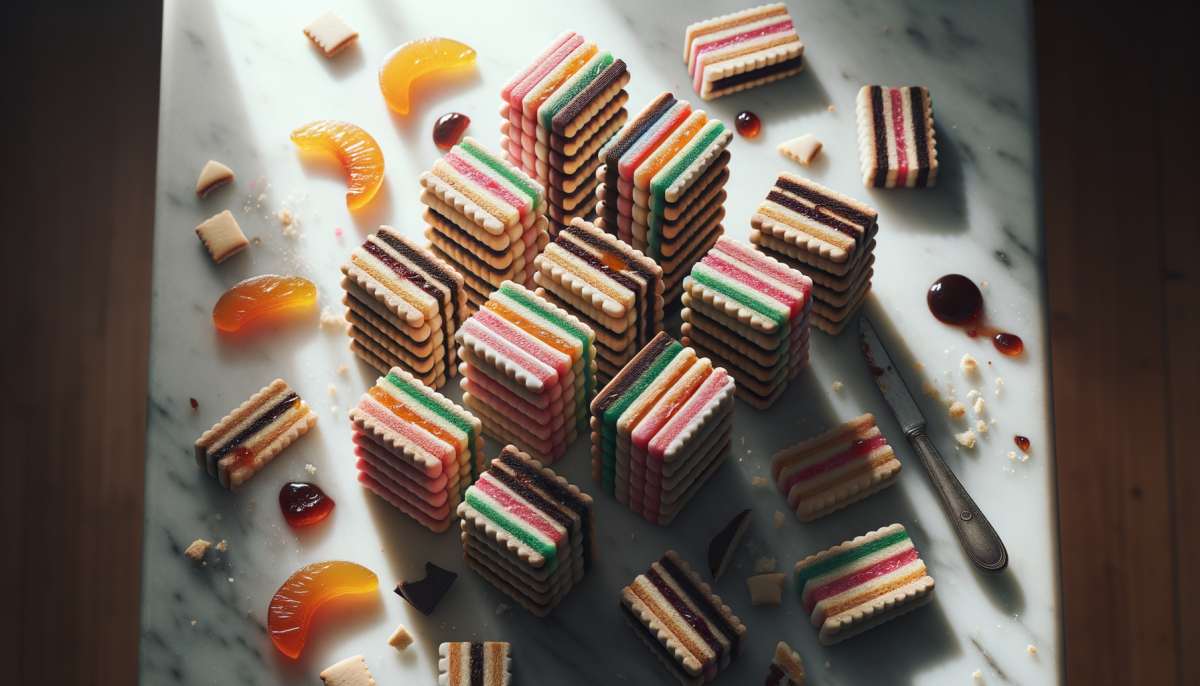
Rainbow cookies—also called Italian tricolor cookies, seven-layer cookies, or Venetian cookies—are one of the great Jewish-Italian American crossover stories. Created by Italian immigrants in New York, they were adopted wholesale by Jewish bakeries, especially for Passover, because the original recipe’s almond-paste base is naturally flour-free. Every Jewish bakery in New York, from Russ & Daughters to Zabar’s, sells them year-round, but they become essential at Pesach when the absence of flour is a feature, not a compromise.
The three layers represent the Italian flag, but in Jewish bakeries they became something else entirely—a symbol of the ingenuity of Passover baking, where constraint breeds the most beloved treats. These are not sad substitutes for “real” cookies; they are the original. The almond paste gives them a dense, frangipane-like texture that no wheat flour cookie can match, and the thin layers of apricot jam and chocolate coating turn each bite into something that tastes far more refined than its humble bakery-case appearance suggests.
Making rainbow cookies is a project, not a quick bake. You’ll whip egg whites, tint batter three colors, bake three thin layers, stack them with jam, press them overnight, and coat both sides in chocolate. But the reward is extraordinary: a slab of jewel-toned, marzipan-scented perfection that slices into dozens of cookies, keeps beautifully for a week or more, and makes every Pesach dessert table look like a New York bakery window.
This recipe is entirely chametz-free and kitniyot-free, relying on potato starch for structure and whipped egg whites for lift. No matzo meal, no compromises. If you’ve ever wondered why rainbow cookies taste better at Passover than the rest of the year—it’s because they were always meant to be made this way.
What Makes This Recipe Special
- Naturally Passover-friendly — No chametz flour, no kitniyot. The almond-paste base is the original Italian formula, not a Pesach workaround
- Bakery-authentic texture — Whipped egg whites provide the lift that makes each layer tender and moist, not dense or crumbly
- Pareve versatility — Made with margarine and pareve chocolate so they can follow any meal; dairy option with butter for an even richer result
- Make-ahead perfection — These actually improve after a day or two as the flavors meld, making them ideal for Pesach prep
- Stunning presentation — The tricolor cross-section with chocolate coating makes a dramatic addition to any Yom Tov dessert spread
Halachic Notes
- Kosher Classification: Pareve when made with pareve margarine and pareve chocolate. Dairy if butter is used. Verify all ingredients carry reliable Kosher for Passover certification.
- Chametz & Kitniyot: This recipe contains no chametz flour and no kitniyot. Ensure chocolate is free of soy lecithin (kitniyot for Ashkenazi practice)—look for sunflower lecithin or lecithin-free chocolate with a KFP hechsher.
- Almond Paste: Must be certified Kosher for Passover. Some brands process on shared equipment with chametz products.
- Food Coloring: Must be kosher-certified. Avoid carmine/cochineal (insect-derived, not kosher). Use beet-based red or synthetic kosher-certified colors.
- Checking Eggs: Each egg must be cracked individually into a clear glass and checked for blood spots before use.
- Hafrashat Challah: Not required—this recipe contains no grain flour.
- Brachot: Shehakol before (no grain content). Some authorities rule Ha’adamah for the almond base—follow your family’s minhag. Borei Nefashot after.
Ingredients
Batter (Makes 3 Colored Layers)
| Ingredient | Grams | Volume | Baker’s % |
|---|---|---|---|
| Almond paste (not marzipan) | 400g | one 8 oz tube + half | 100% |
| Granulated sugar | 150g | ¾ cup | 37.5% |
| Margarine or butter, softened | 225g | 1 cup (2 sticks) | 56% |
| Large eggs, separated | 200g (4 large) | 4 eggs | 50% |
| Almond extract | 5g | 1 tsp | 1.3% |
| Potato starch | 30g | ¼ cup | 7.5% |
| Fine sea salt | 2g | ¼ tsp | 0.5% |
| Red food coloring (kosher, no carmine) | as needed | 5–8 drops | — |
| Green food coloring (kosher) | as needed | 5–8 drops | — |
Assembly
| Ingredient | Grams | Volume |
|---|---|---|
| Apricot preserves (seedless) | 200g | ⅔ cup |
| Semisweet chocolate (KFP certified) | 340g | 12 oz |
Instructions
Step 1: Prepare the Pans
Line three 9×13 inch (23×33 cm) quarter sheet pans with parchment paper. Grease lightly with margarine or cooking spray. Preheat oven to 175°C (350°F) with a rack in the center position.
Step 2: Break Down the Almond Paste
Cut almond paste into small cubes (about 2 cm). Place in the bowl of a stand mixer fitted with the paddle attachment. Add the sugar and beat on medium speed for 3–4 minutes until the mixture resembles fine, sandy crumbles with no large lumps remaining. Scrape down the sides as needed.
Step 3: Cream with Fat
Add the softened margarine (or butter for a dairy version). Beat on medium-high speed until light and fluffy, about 3 minutes. The mixture should be noticeably paler and increased in volume. Scrape the bowl thoroughly.
Step 4: Add Egg Yolks
Add the egg yolks one at a time, beating well after each addition until fully incorporated. Add the almond extract and mix until smooth. Remember: each egg must be cracked into a clear glass and checked for blood spots before adding.
Step 5: Add Potato Starch and Salt
Add the potato starch and salt. Mix on low speed until just combined. The batter will be thick and paste-like. Remove the bowl from the mixer and set aside.
Step 6: Whip Egg Whites
In a separate, perfectly clean and dry bowl, whip the egg whites on high speed until stiff, glossy peaks form, about 3–4 minutes. The whites should hold their shape when the whisk is lifted. Do not over-whip to a dry, grainy texture.
Step 7: Fold Whites into Batter
Fold the whipped egg whites into the almond batter in three additions. Use a large spatula and gentle, sweeping motions—cut down through the center, sweep along the bottom, and fold over. This is the only leavening in the recipe, so preserving the air in the whites is critical. Some streaks of white are fine; do not over-mix.
Step 8: Divide and Color
Weigh the total batter and divide equally among three bowls (approximately 300g each). Leave one bowl plain (this is the white layer). Add red food coloring to the second bowl and fold gently until evenly pink. Add green food coloring to the third bowl and fold until evenly green. Use more drops than you think—the color fades slightly during baking.
Step 9: Spread into Pans
Spread each colored batter into one of the prepared pans. Use an offset spatula to create thin, even layers approximately 6 mm (¼ inch) thick. Take your time here—even layers are critical for proper cookie proportions and a professional appearance. Push batter into the corners.
Step 10: Bake
Bake each pan for 12–15 minutes at 175°C (350°F) until the layers are just set and very lightly golden at the edges. The centers should still feel slightly soft. Do NOT overbake—the layers must remain moist and pliable for assembly. Rotate pans halfway through baking. You can bake all three pans simultaneously if they fit, or bake in batches.
Step 11: Cool and Unmold
Cool the layers in their pans for 10 minutes. Run a knife around the edges, then carefully invert each layer onto a wire rack. Peel off the parchment paper. Allow to cool completely.
Step 12: Warm the Jam
Heat the apricot preserves in a small saucepan over medium-low heat until fluid and easily spreadable. If the preserves have large chunks, press through a fine-mesh strainer for a smooth finish. Keep warm.
Step 13: Assemble Layers
Place the green layer on a parchment-lined sheet pan. Spread half the warm apricot jam evenly over the surface using an offset spatula. Place the white (plain) layer on top, pressing gently. Spread the remaining jam over the white layer. Place the pink layer on top, bottom-side up, to create a perfectly flat top surface.
Step 14: Press and Chill
Cover the assembled layers tightly with plastic wrap. Place another sheet pan on top and weight it down with cans, books, or a cast-iron skillet. Refrigerate for at least 2 hours, and preferably overnight. This compression is essential—it bonds the layers together and creates the characteristic dense, sliceable texture of bakery rainbow cookies.
Step 15: Chocolate Coating
Melt the chocolate in a heatproof bowl set over barely simmering water (double boiler) or in the microwave in 30-second bursts, stirring between each. Spread a thin, even layer of melted chocolate over the top (pink layer) using an offset spatula. Refrigerate for 15 minutes until set. Carefully flip the entire slab over. Spread chocolate evenly over the bottom (green layer). Refrigerate until fully set, about 15 minutes.
Step 16: Trim and Cut
Using a sharp chef’s knife dipped in hot water and wiped dry between cuts, trim all four edges for clean lines (save the trimmings—chef’s snack). Cut into rectangles approximately 3×5 cm (1¼×2 inches). For the cleanest cuts, let the slab sit at room temperature for 5 minutes before slicing so the chocolate doesn’t crack.
Storage & Make-Ahead
- Room temperature: Up to 5 days in an airtight container, stored in a cool place. Chocolate will soften in warm environments.
- Refrigerated: Up to 2 weeks in an airtight container. Bring to room temperature for 10 minutes before serving for best texture.
- Frozen: Up to 3 months. Freeze in a single layer on a sheet pan first, then stack with parchment between layers in a freezer container. Thaw in the refrigerator overnight.
- Make-ahead for Pesach: These cookies improve with age as the flavors meld. Make 1 week ahead and refrigerate, or up to 1 month ahead and freeze. An ideal early Pesach prep project.
Troubleshooting
| Problem | Cause | Solution |
|---|---|---|
| Layers too dense or flat | Egg whites not whipped stiff enough, or folded too aggressively | Whip whites to firm peaks; fold in three additions with gentle, sweeping motions |
| Layers dry and crumbly | Overbaked | Pull from oven at 12 minutes—layers firm up as they cool. They should feel barely set |
| Layers uneven thickness | Batter not divided equally | Use a kitchen scale to weigh batter into three equal portions before coloring |
| Jam leaking out sides | Jam too thin or too much applied | Strain and reduce jam slightly if very runny; spread a thin, even layer |
| Chocolate cracking when cutting | Chocolate too thick, or cookies too cold | Apply a thin chocolate layer; let slab sit 5 minutes at room temp before cutting |
| Colors too pale after baking | Not enough food coloring added | Add more drops than you think necessary—colors fade during baking |
| Layers separating during cutting | Not pressed or weighted long enough | Press under weight for minimum 2 hours, preferably overnight. Ensure jam fully covers each layer |
Frequently Asked Questions
Can I use marzipan instead of almond paste?
Marzipan has a higher sugar content and lower almond content than almond paste, which means less structure and a sweeter result. Almond paste gives these cookies their characteristic dense, flavorful texture. If you must substitute marzipan, reduce the granulated sugar by 50g to compensate for the extra sweetness, but the texture won’t be quite the same.
What if I can’t find KFP chocolate?
Look for any semisweet or bittersweet chocolate that carries a reliable Kosher for Passover hechsher. The key concern for Ashkenazi practice is soy lecithin, which is kitniyot. Seek out chocolate made with sunflower lecithin or no lecithin at all. Brands like Schmerling’s and some Elite varieties offer KFP options. In a pinch, cocoa powder mixed with coconut oil can create a coating, but the result is less polished.
Can I make these dairy?
Absolutely. Substitute butter for margarine and use any KFP dairy or pareve chocolate. The butter version is richer and more traditional to the Italian original. Just be sure to clearly label the cookies as dairy for kashrut purposes, especially if they’ll be served at a communal Pesach table.
Why potato starch instead of matzo cake meal?
Potato starch produces a lighter, more tender crumb that’s closer to the original Italian bakery recipe. Matzo cake meal would add a detectable grain flavor and denser, more crumbly texture. Since the almond paste provides all the body and flavor these cookies need, the small amount of potato starch simply helps bind without changing the character of the batter.
My almond paste is hard—how do I soften it?
Almond paste dries out over time, especially if the package has been opened. Microwave it in 10-second bursts, kneading between each, until pliable. Alternatively, break it into small pieces and let the stand mixer work it with the sugar for an extra minute or two. Fresh almond paste from brands like Solo or Odense is ideal. If your almond paste is truly rock-hard, it may be too old—fresh paste should be firm but malleable, like modeling clay.
More Pesach Baking
Start your Passover baking with Homemade Matzo — the foundation of every Pesach table. Or explore our full Kosher Bread Path for 141 tested recipes.
Chag Pesach Sameach!
These rainbow cookies are proof that Passover baking is not about compromise—it’s about tradition at its most delicious.
Leave a Reply
You must be logged in to post a comment.