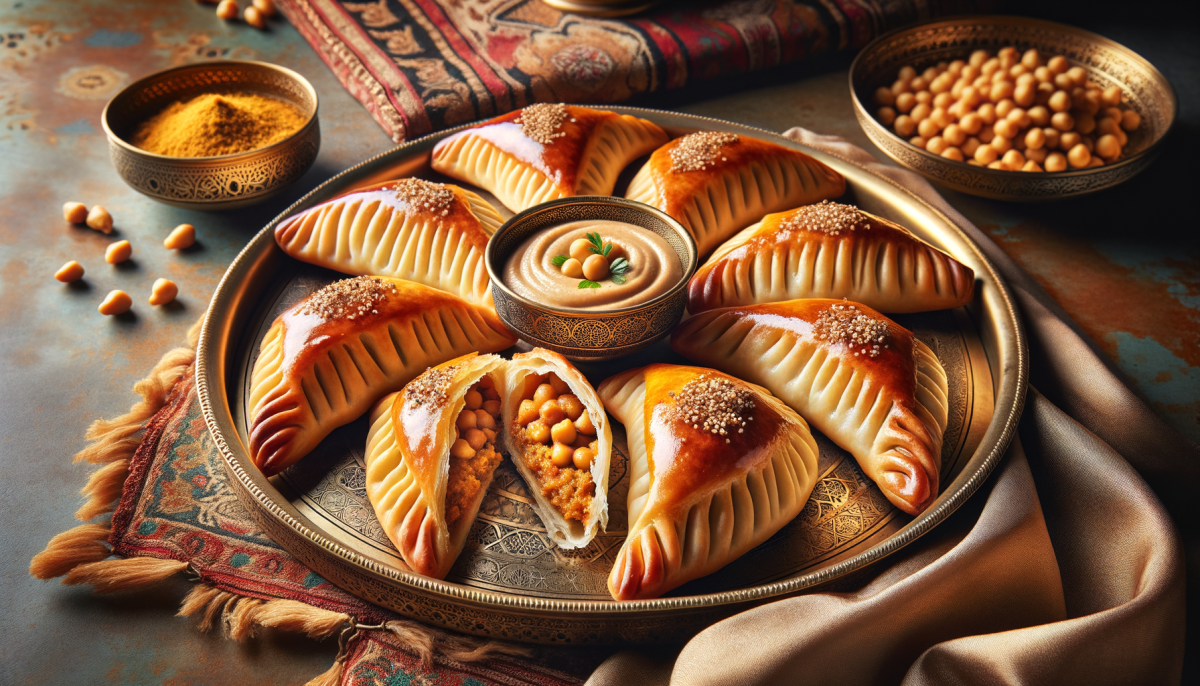
Chickpea Filling • Contains Gluten • Meat option below
~30 pastries
Intermediate
1 hour
2–2.5 hours
Mezonot
Sambusak are the golden, half-moon pastries that have graced the Shabbat tables of Iraqi and Syrian Jewish families for centuries. Imagine biting through a thin, shatteringly crisp shell — enriched with semolina for a sandy, delicate crunch — into a warm, fragrant filling of spiced chickpeas or seasoned lamb. These are not dumplings, not empanadas, not samosas, though they share ancient DNA with all of them. Sambusak are something entirely their own: the quintessential savory pastry of Babylonian Jewry.
In Iraqi Jewish homes, sambusak (sambusak, סמבוסק) were a labor of love, often made in large batches by mothers and grandmothers on Thursday or Friday morning, the kitchen fragrant with cumin and turmeric. The chickpea version — pareve and endlessly versatile — was the most common, served alongside Shabbat lunch, at kiddush, during holidays, and at every celebration from brit milah to Purim. The meat version, rich with spiced ground lamb or beef, appeared at more festive occasions.
What sets sambusak apart from similar pastries around the Middle East is the dough. Iraqi Jewish bakers developed a distinctive mixture of flour and fine semolina, bound with oil rather than butter, creating a crust that is simultaneously flaky, crisp, and tender — and always pareve. The traditional decorative crimping along the sealed edge is not merely beautiful; it ensures a tight seal that keeps the filling inside during baking and announces to everyone at the table that these were made by hand, with care.
Sambusak are one of the great unifying foods of Mizrachi Jewry. From Baghdad to Aleppo, from Calcutta to Tehran, variations appear under different names — sambousek, samsa, sanbusaj — but the spirit is the same: a humble pastry that transforms simple ingredients into something extraordinary through technique, spice, and generations of practice.
What Makes This Sambusak Special
These sambusak honor the Iraqi Jewish tradition while giving you every detail needed to achieve perfect results at home:
- Semolina-enriched dough — the addition of fine semolina to the flour creates the signature sandy, crisp texture that distinguishes Iraqi sambusak from ordinary pastry. The dough is oil-based, making it inherently pareve and easy to work with.
- Two authentic filling options — a classic spiced chickpea filling (pareve) fragrant with cumin, turmeric, and caramelized onions, and a traditional seasoned meat filling with lamb or beef, baharat, and pine nuts.
- Traditional decorative crimping — step-by-step guidance for the signature rope-edge crimp that seals the half-moon shape. This is not just aesthetic — it creates a thick, crunchy border that is one of the best parts of the pastry.
- Baked, not fried — while some traditions deep-fry sambusak, this recipe follows the Iraqi Jewish preference for baking, producing a golden, crisp pastry with less oil and more forgiving timing.
- Freezer-friendly — sambusak freeze beautifully unbaked, making them ideal for preparing ahead of Shabbat, holidays, or entertaining. From freezer to oven to table in under 30 minutes.
The Story of Sambusak: Babylonian Jewish Heritage
The Jewish community of Iraq — historically known as Babylonian Jewry — is one of the oldest Jewish diaspora communities in the world, tracing its roots to the destruction of the First Temple and the Babylonian exile in 586 BCE. For over 2,500 years, Jews thrived in the lands between the Tigris and Euphrates rivers, developing a rich and distinctive culinary tradition that blended ancient Israelite foodways with the flavors of Mesopotamia.
Sambusak are among the most beloved foods of this tradition. The word itself is ancient — derived from the Persian sanbosag, with references appearing in medieval Arab cookbooks dating to the 10th century. Jewish versions, always adapted to the laws of kashrut, became fixtures of communal life. The chickpea sambusak, being pareve, was the great all-purpose pastry: appropriate after a meat meal, at a dairy kiddush, or as a standalone snack. Its simplicity belied its importance — a family’s sambusak recipe was a point of pride, passed from mother to daughter with exacting standards.
The Iraqi Jewish community also developed sambusak traditions linked to specific holidays. During Shavuot, cheese-filled sambusak (sambusak b’jibn) appeared — naturally dairy for the holiday. At Purim, sweet date-filled versions recalled the abundance of the Babylonian date palm groves. And every Shabbat, the savory chickpea sambusak sat alongside t’beet (overnight chicken and rice), amba (mango pickle), and salona (vegetable stew) on the quintessential Iraqi Jewish Shabbat table.
When the vast majority of Iraqi Jews emigrated to Israel in the early 1950s during Operation Ezra and Nehemiah, sambusak traveled with them. Today, these pastries are a staple in Israeli bakeries and homes, and increasingly recognized around the world as one of the great contributions of Mizrachi Jewish cuisine.
Kosher Observance & Halachic Notes
Kosher Classification: Pareve (chickpea filling) or Meat (meat filling)
The chickpea filling and the oil-based dough are fully pareve, making these sambusak suitable to serve at any meal — meat, dairy, or pareve. The meat filling renders the pastries fleishig (meat) — they may not be served at a dairy meal or eaten within the waiting period after dairy, according to your community’s practice. Never combine a cheese filling with a meat filling or meat dough. If making both versions, clearly label and separate them to avoid confusion.
Hafrashat Challah (Separating Challah)
This recipe calls for approximately 400 g of total flour and semolina. According to most Ashkenazi poskim, this amount requires separating challah without a bracha. If you double the recipe (800 g flour/semolina), consult your posek — the threshold for separating with a bracha varies by community. Sephardi practice may differ.
How to perform Hafrashat Challah:
- After the dough is fully mixed, pinch off a small piece — at least a kezayit (roughly 28 g / 1 oz).
- If the total flour exceeds the bracha threshold for your community, recite the bracha:
Hebrew:
בָּרוּךְ אַתָּה ה’ אֱלֹהֵינוּ מֶלֶךְ הָעוֹלָם אֲשֶׁר קִדְּשָׁנוּ בְּמִצְוֹתָיו וְצִוָּנוּ לְהַפְרִישׁ חַלָּהTransliteration:
Baruch Atah Adonai, Eloheinu Melech ha’olam, asher kid’shanu b’mitzvotav v’tzivanu l’hafrish challah.Translation:
“Blessed are You, Lord our God, King of the universe, Who has sanctified us with His commandments and commanded us to separate challah.”
- Say: “Harei zu challah” (“This is challah”).
- Wrap the separated piece in foil and burn it. It may not be eaten.
Checking Eggs for Blood Spots
The egg used in the dough should be cracked individually into a clear glass or small bowl and inspected before adding to the dough. If a blood spot is found, the egg must be discarded entirely.
Pas Yisroel
When a Jewish person sets the oven temperature or contributes to the baking in any way, the sambusak fulfills Pas Yisroel requirements. This is particularly relevant during the Aseret Yemei Teshuvah.
Meat and Dairy Separation
If preparing both chickpea (pareve) and meat versions, use separate bowls, utensils, and baking sheets for the meat filling and assembled meat sambusak. The pareve dough becomes fleishig the moment it contacts meat filling. Never prepare cheese-filled sambusak on the same surface or at the same time as meat-filled sambusak without thorough cleaning between batches.
Brachot (Blessings)
- Before eating: Borei Minei Mezonot — sambusak are considered pas haba’ah b’kisnin (baked goods eaten as a snack, not as a meal bread). If you eat enough to constitute a meal (kevi’at seudah), wash and make HaMotzi instead.
- After eating: Al HaMichya (the abbreviated grace). If you ate a meal quantity and made HaMotzi, say Birkat HaMazon.
Ingredients
Dough
| Ingredient | Grams | Volume | Baker’s % |
|---|---|---|---|
| All-purpose flour (unbleached) | 300 g | 2½ cups | 100% |
| Fine semolina (solet) | 100 g | ⅔ cup | 33% |
| Fine sea salt | 6 g | 1 tsp | 2% |
| Granulated sugar | 10 g | 2 tsp | 3.3% |
| Neutral vegetable oil (sunflower or canola) | 80 g | 6 Tbsp | 27% |
| Large egg, room temperature (check for blood spots) | 50 g | 1 large egg | 17% |
| Cold water | 80 g | ⅓ cup | 27% |
| Total Dough Weight | ~626 g | — | — |
Filling Option 1: Spiced Chickpea (Pareve)
| Ingredient | Amount | Notes |
|---|---|---|
| Cooked chickpeas (canned, drained and rinsed, or home-cooked) | 400 g (one 15 oz can) | Well drained |
| Large yellow onion, finely diced | 1 large (~200 g) | — |
| Vegetable oil | 2 Tbsp (30 ml) | For sautéing |
| Ground cumin | 1½ tsp | Freshly toasted and ground is best |
| Ground turmeric | ½ tsp | — |
| Ground coriander | 1 tsp | — |
| Ground cardamom | ¼ tsp | Optional but traditional |
| Salt | 1 tsp | Adjust to taste |
| Black pepper | ½ tsp | Freshly ground |
| Fresh lemon juice | 1 Tbsp | Brightens the filling |
Filling Option 2: Seasoned Meat (Fleishig)
| Ingredient | Amount | Notes |
|---|---|---|
| Ground lamb or beef (kosher) | 350 g (12 oz) | Not too lean — 15–20% fat is ideal |
| Medium yellow onion, finely diced | 1 medium (~150 g) | — |
| Pine nuts (snobar) | 30 g (3 Tbsp) | Lightly toasted |
| Vegetable oil | 1 Tbsp (15 ml) | For sautéing |
| Baharat spice blend | 1½ tsp | Or ½ tsp each: allspice, cumin, cinnamon |
| Ground cumin | 1 tsp | — |
| Salt | 1 tsp | Adjust to taste |
| Black pepper | ½ tsp | Freshly ground |
| Fresh flat-leaf parsley, chopped | 2 Tbsp | Optional garnish mixed into filling |
For Assembly & Baking
- 1 egg yolk + 1 Tbsp water (egg wash for golden color)
- Sesame seeds or nigella seeds for topping (optional, traditional)
Equipment
- Large mixing bowl
- Rolling pin
- Round cookie cutter or glass — 9–10 cm (3.5–4 inch) diameter
- Fork or fingers for crimping
- Baking sheets lined with parchment paper
- Kitchen scale
- Skillet or sauté pan for fillings
- Potato masher or fork (for chickpea filling)
- Pastry brush (for egg wash)
- Clear glass or small bowl for egg checking
Desired Dough Temperature (DDT)
Target DDT: 20–22°C (68–72°F)
Unlike yeasted bread doughs, this oil-based pastry dough does not rely on fermentation, so DDT is less critical. However, a cool dough is easier to roll and handle. Use cold water straight from the tap. If your kitchen is very warm (above 27°C / 80°F), refrigerate the dough for 15–20 minutes before rolling to prevent it from becoming too soft and oily.
The goal is a pliable, non-sticky dough that rolls thinly without springing back excessively or tearing.
Step-by-Step Instructions
Step 1: Make the Dough
In a large mixing bowl, whisk together the flour, semolina, salt, and sugar until evenly combined.
Crack the egg into a clear glass and inspect for blood spots. If clear, add it to the dry ingredients along with the vegetable oil. Mix with a fork or your fingers until the mixture resembles coarse, damp sand.
Add the cold water gradually, mixing until the dough comes together into a cohesive ball. It should be smooth, pliable, and slightly oily to the touch — not sticky, not crumbly. If it is too dry, add water 1 teaspoon at a time. If too sticky, add a light dusting of flour.
Knead briefly on a clean surface for 2–3 minutes — just until smooth. This is not bread dough; you do not want to develop strong gluten. Overworking will make the pastry tough rather than tender.
Wrap the dough in plastic wrap and let it rest at room temperature for 30 minutes. This rest relaxes the gluten and makes rolling much easier.
Step 2: Prepare the Chickpea Filling (Pareve Option)
Heat the vegetable oil in a skillet over medium heat. Add the diced onion and cook, stirring occasionally, for 8–10 minutes until soft and golden — deeply caramelized onions are the secret to great sambusak filling.
Add the cumin, turmeric, coriander, and cardamom. Stir for 30 seconds until fragrant — the spices should bloom in the oil without burning.
Add the drained chickpeas. Using a potato masher or fork, mash roughly — you want a chunky texture, not a smooth paste. About two-thirds mashed with one-third whole chickpeas remaining is ideal.
Season with salt, pepper, and lemon juice. Taste and adjust — the filling should be boldly seasoned, as the pastry shell will mute the flavors slightly. Remove from heat and cool completely before filling. Warm filling will melt the dough and cause leaks.
Step 3: Prepare the Meat Filling (Fleishig Option)
Heat the vegetable oil in a skillet over medium-high heat. Add the diced onion and cook for 5 minutes until softened.
Add the ground lamb or beef. Break it up with a wooden spoon and cook for 8–10 minutes until fully browned, with no pink remaining. Drain any excess fat if necessary.
Add the baharat, cumin, salt, and pepper. Stir for 1 minute until fragrant. Remove from heat and stir in the toasted pine nuts and parsley (if using).
Cool completely before filling. Taste and adjust seasoning — the filling should be robustly spiced.
Kashrut reminder: If making both fillings, use separate utensils and bowls for the meat filling. The pareve dough becomes fleishig the moment it contacts meat. Assemble meat sambusak on a separate, clean surface or after completing all pareve sambusak.
Step 4: Roll and Cut the Dough
Preheat your oven to 190°C (375°F). Line two baking sheets with parchment paper.
Divide the rested dough in half. Work with one half at a time, keeping the other covered. On a lightly floured surface, roll the dough out to 3 mm (⅛ inch) thickness — thin enough to be delicate but thick enough to hold the filling without tearing.
Using a 9–10 cm (3.5–4 inch) round cutter or the rim of a glass, cut circles from the dough. You should get 15–16 circles per half. Gather the scraps, re-roll once, and cut a few more. Do not re-roll more than once — the dough toughens.
Step 5: Fill and Shape
Working with one circle at a time:
- Place filling — spoon about 1 heaping tablespoon of cooled filling onto the center of the dough circle. Do not overfill — leave a 1 cm (⅛ inch) border around the edge.
- Fold into a half-moon — lift one side of the circle and fold it over the filling to meet the other edge. Press the edges together firmly to seal, pushing out any trapped air.
- Crimp the edge — this is the traditional decorative seal. Starting at one corner of the half-moon, fold a small section of the edge over itself at an angle, press to seal, then fold the next section over the previous fold, creating a rope or braid pattern along the entire curved edge. Alternatively, press the tines of a fork firmly along the edge for a simpler seal.
- Place on baking sheet — arrange the sambusak on the lined baking sheet, spaced 2 cm (1 inch) apart. They do not spread significantly.
Tip: If the dough becomes warm and difficult to handle, refrigerate the circles for 10 minutes before filling. Cold dough crimps more cleanly.
Step 6: Egg Wash and Top
Beat the egg yolk with 1 tablespoon of water. Using a pastry brush, lightly brush the top and crimped edge of each sambusak with the egg wash. This creates the signature deep golden-brown color during baking.
If desired, sprinkle with sesame seeds or nigella seeds — a traditional Iraqi touch that adds flavor and visual beauty.
Step 7: Bake Until Golden
Bake at 190°C (375°F) for 22–28 minutes, rotating the baking sheets halfway through, until the sambusak are deep golden brown on top and bottom. The semolina in the dough gives them a distinctive warm, sandy color that is deeper than ordinary pastry.
Remove from the oven and let cool on the baking sheet for 5 minutes before transferring to a wire rack. Sambusak are excellent warm, at room temperature, or even slightly cool.
The moment they come out of the oven — golden, fragrant with cumin and caramelized onion, their crimped edges dark and crunchy — is when you understand why Iraqi grandmothers made these by the dozen. One is never enough.
Storage & Make-Ahead
- Room temperature: Store baked sambusak in an airtight container at room temperature for up to 2 days. They will soften slightly but remain very good.
- Reheating: Reheat baked sambusak in a 180°C (350°F) oven for 8–10 minutes to restore crispness. Do not microwave — it makes the pastry soft and chewy.
- Freezing (unbaked — best method): Assemble sambusak completely, place on a parchment-lined baking sheet, and freeze until solid (about 2 hours). Transfer to zip-lock bags. Freeze for up to 3 months. Bake directly from frozen at 190°C (375°F) for 28–35 minutes — no thawing needed. Add a few extra minutes to the bake time.
- Freezing (baked): Cool completely, then freeze in airtight containers for up to 2 months. Reheat from frozen in a 180°C (350°F) oven for 12–15 minutes.
- Make-ahead strategy for Shabbat: Assemble sambusak on Thursday evening, refrigerate overnight, and bake Friday morning. Or freeze unbaked up to a month ahead and bake fresh on Friday.
Troubleshooting Guide
| Problem | Likely Cause | Solution |
|---|---|---|
| Pastry is tough and hard | Dough overworked; too much flour added during rolling | Knead only 2–3 minutes — just until smooth. Use minimal flour when rolling. Let the dough rest fully before rolling. |
| Filling leaks during baking | Overfilled; edges not sealed properly; filling was warm | Use no more than 1 heaping tablespoon of filling per pastry. Press edges firmly and crimp thoroughly. Always cool filling completely before assembling. |
| Sambusak are pale after baking | Egg wash too thin or not applied; oven temperature too low | Use egg yolk (not whole egg) for deeper color. Brush generously. Verify oven temperature with a thermometer — bake at a true 190°C (375°F). |
| Dough tears when rolling | Dough too dry; insufficient resting time | Add water 1 teaspoon at a time if dough is crumbly. Allow the full 30-minute rest. If dough springs back, let it relax 5 more minutes. |
| Filling is bland | Under-seasoned; spices not bloomed; onions not caramelized | Season filling boldly — the pastry shell mutes flavors. Toast spices in oil for 30 seconds before adding other ingredients. Cook onions until truly golden. |
| Bottom of sambusak is soggy | Baking sheet overcrowded; filling too wet | Space pastries 2 cm apart. Drain chickpeas thoroughly. For meat filling, drain excess fat after browning. Bake on the lower-middle rack. |
Frequently Asked Questions
What is sambusak?
Sambusak are savory half-moon shaped pastries from the Iraqi and Syrian Jewish culinary tradition. They feature a thin, crisp dough made with flour and semolina, filled with either spiced chickpeas (pareve) or seasoned ground meat. The edges are sealed with a traditional decorative crimp. Sambusak are baked until golden and served at Shabbat meals, holidays, and celebrations. They are one of the signature foods of Babylonian (Iraqi) Jewry, with roots stretching back centuries in the Middle Eastern Jewish diaspora.
Can I make sambusak ahead of time?
Absolutely — sambusak are one of the best make-ahead foods in the kosher kitchen. The ideal method is to assemble them completely (fill, shape, and crimp), then freeze them unbaked on a parchment-lined tray. Once frozen solid, transfer to zip-lock bags where they will keep for up to 3 months. Bake directly from frozen, adding just a few extra minutes to the baking time. This means you can spend a relaxed afternoon making a large batch and have golden, fresh-baked sambusak ready in under 30 minutes whenever you need them.
What is the difference between sambusak and samosa?
While they share ancient roots — both descend from the medieval Persian sanbosag — sambusak and samosa have diverged over centuries. Sambusak use a flour-and-semolina dough that is rolled thin and baked, producing a crisp, sandy-textured pastry. Indian samosas typically use a flour-only dough, are usually deep-fried, and feature different spice profiles (heavy on garam masala, coriander, and green chiles). The fillings also differ: sambusak favor chickpeas with cumin and turmeric or meat with baharat, while samosas often feature potato and peas. Both are delicious — they are cousins, not twins.
Can I make a cheese filling for sambusak?
Yes — cheese-filled sambusak (sambusak b’jibn) are a beloved tradition, especially for Shavuot. A classic filling combines crumbled feta or kashkaval cheese with a pinch of salt and sometimes fresh herbs. However, cheese sambusak are dairy and must never be mixed with or served alongside meat sambusak. Use separate utensils and baking sheets. If making both cheese and meat versions, prepare and bake them in completely separate batches with thorough cleaning between them.
Why is semolina used in the dough?
Semolina is the key to the distinctive texture of Iraqi sambusak. Fine semolina (also called solet in Hebrew) is made from durum wheat and has a coarser, more granular texture than regular flour. When combined with all-purpose flour in the dough, it creates a crisp, sandy, slightly crumbly pastry that is completely different from a soft, flaky pie crust or a chewy bread dough. The semolina also contributes a warm golden color and a subtle nutty flavor. This flour-semolina combination is characteristic of many Middle Eastern and North African pastries.
Bring Iraqi Jewish Tradition to Your Table
Golden, crisp, fragrant with cumin and history — sambusak connect you to 2,500 years of Babylonian Jewish baking. Make a batch, freeze some for later, and share the rest.
Save This Recipe
Try Our Kubaneh Next →
Have questions? Tag us @kosherbreadpro on Instagram or leave a comment below. We answer every one.