
Shavuot Dairy Honey Challah Recipe
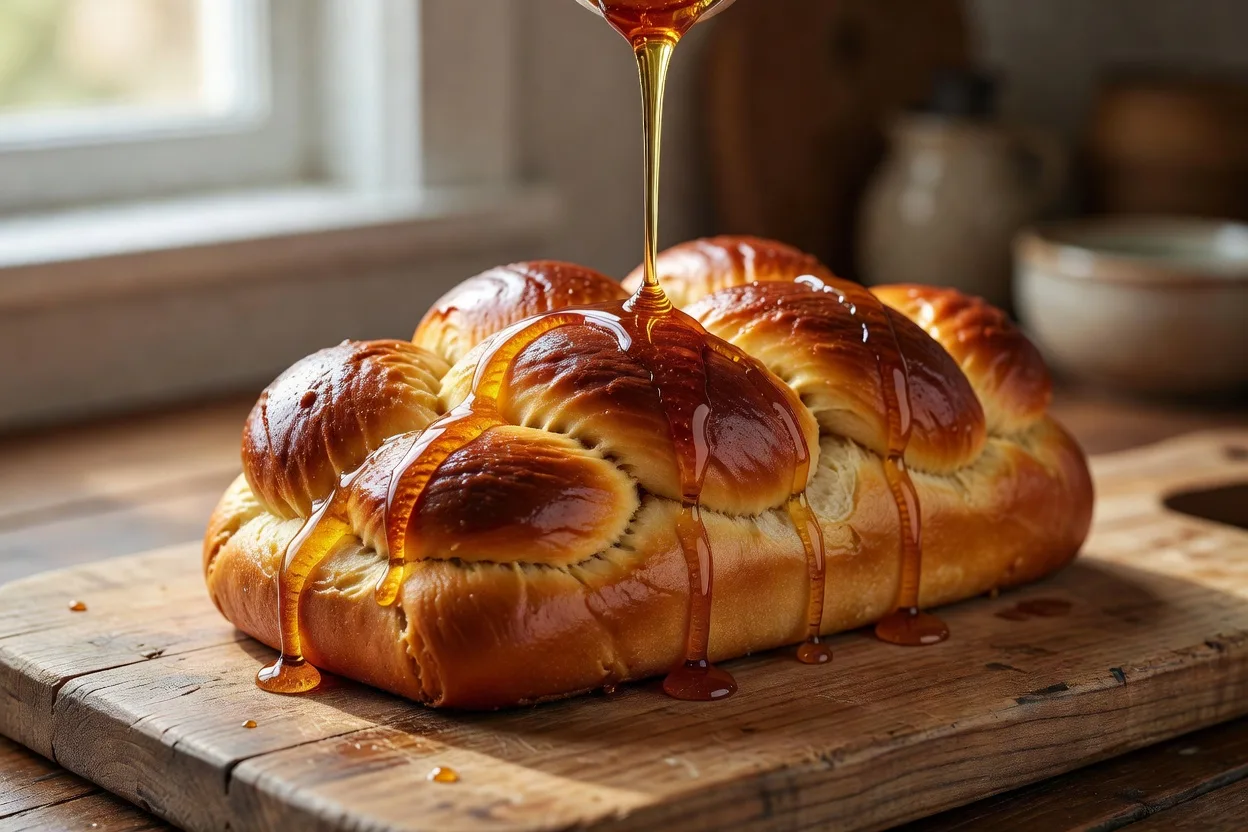
The Challah That Tastes Like Torah
There is something deeply right about bringing a dairy challah to the Shavuot table. Every Shabbat, our challah is pareve — beautiful, golden, egg-enriched — but it is bound by the constraints of a bread that must work alongside both meat and fish. On Shavuot, the kitchen breathes differently. The meat is set aside, and we are free to reach for the butter, the whole milk, the wildflower honey that the Torah itself is compared to.
This challah is enriched in a way that the classic Shabbat loaf is not. The milk adds a faint sweetness and a creamy, soft crumb that stays tender for two full days. The butter, worked slowly into the dough after gluten develops, creates layers of richness you can feel in every pull of the bread. And the honey — three generous tablespoons of it — fills the kitchen with a fragrance that feels, in the most concrete way possible, like celebration.
The six-strand braid is the traditional Shabbat shape, and it is just as appropriate for Shavuot — representing the six days of Creation that culminated in Shabbat, or, on Shavuot, the six orders of the Mishnah that form the body of Oral Torah received at Sinai. If this is your first time doing a six-strand braid, I have included detailed braid instructions below. A three-strand braid is equally valid and equally beautiful.
This is dairy bread. It is the milk-and-honey of Torah made tangible. Bake it on erev Shavuot, wrap it in a clean towel, and carry it to a table surrounded by people who love both the food and what it represents.
What Makes This Challah Special
- Whole milk replaces water entirely — 35% of flour weight, contributing lactose for browning and protein for structure alongside the eggs
- Late-addition butter technique — butter is incorporated only after the dough passes the windowpane test, ensuring maximum gluten development first and a silky, layered crumb after
- Wildflower or acacia honey at 13% hydration — well above most challah recipes, giving a pronounced sweetness that does not overwhelm
- Extended cold-proofing option — shape the night before, refrigerate overnight, and bake fresh on Shavuot morning for maximum flavor development
- Milk egg wash — a dairy-kitchen detail: egg beaten with whole milk gives a mahogany crust that a water wash cannot match
- Sesame optional, pearl sugar ideal — a light scatter of pearl sugar on a dairy Shavuot challah is visually stunning and deeply appropriate for the holiday
✓ Halachic Notes
Classification: This recipe is chalavi (dairy). Do not serve alongside or immediately after meat. Follow your community’s custom for the waiting period between meat and dairy (1 hour for most Ashkenazim, 6 hours for many Sephardim, 3 hours in some German and Dutch traditions).
Cholov Yisrael / Chalav Yisrael: If your standard of kashrut requires Chalav Yisrael, use CY-certified whole milk and butter throughout. In the United States, common CY brands include Mehadrin, Organic Valley (certified in some communities), and local dairy co-ops — verify with your rav. In Israel, most commercial dairy is under Chalav Yisrael supervision.
Hafrashat Challah: This recipe uses 500g of flour, which is below the minimum shiur (threshold) for hafrashat challah (approximately 1,230g of flour by most opinions, corresponding to 43.2 egg volumes). No separation is required for this single-loaf batch. If you double the recipe (1,000g flour), separate challah without a bracha. If you triple it (1,500g flour), opinions differ — consult your posek; some require a bracha at this quantity, others do not.
Checking Eggs: Before adding each egg to the dough, crack it individually into a clear glass or small bowl and inspect for blood spots in the yolk or white. Any egg with a blood spot should be discarded. This applies both to the dough eggs and to the egg wash.
Pas Yisroel: If you or your family requires Pas Yisroel (bread baked with Jewish involvement), bake this challah yourself in your own home — which satisfies the requirement — or purchase ingredients with appropriate certification. Artisan bakeries with a Pas Yisroel hashgacha are increasingly common in major Jewish communities.
Brachot: Recite Hamotzi lechem min ha’aretz before eating challah at a bread meal. After a meal that includes at least a k’zayit (olive-sized portion) of bread, bentch (Birkat HaMazon). If eating this challah as a snack without establishing a meal, recite Mezonot and Al HaMichya after. On Yom Tov (Shavuot), use two whole challahs for the holiday meal in honor of the holiday Lechem Mishneh.
Shavuot Timing: Bake on erev Shavuot (Thursday, May 21 or the day before your local holiday begins). If using the overnight cold-proof method, prepare the dough the evening before. Shavuot candle lighting in 2026 is Thursday evening, May 25 — have the challah fully baked and cooled before candle lighting.
Ingredients
Dough
| Ingredient | Grams | Volume | Baker’s % |
|---|---|---|---|
| Bread flour | 500 g | 4 cups | 100% |
| Whole milk, warm (38°C / 100°F) | 175 g | ¾ cup | 35% |
| Large eggs, room temperature | 150 g (3 eggs) | 3 large | 30% |
| Unsalted butter, softened (Chalav Yisrael if required) | 70 g | 5 tbsp | 14% |
| Honey (wildflower or acacia) | 65 g | 3 tbsp | 13% |
| Granulated sugar | 25 g | 2 tbsp | 5% |
| Fine sea salt | 9 g | 1½ tsp | 1.8% |
| Instant yeast | 7 g | 2¼ tsp | 1.4% |
| Pure vanilla extract | 5 g | 1 tsp | 1% |
| Total dough weight (approx.) | ~1,006 g | ~201% |
Egg Wash & Topping
| 1 large egg | beaten |
| Whole milk | 2 tbsp |
| Fine salt | pinch |
| Pearl sugar or sesame seeds (optional) | to taste |
Instructions
Step 1: Bloom the Yeast (5 minutes)
Warm the milk to 38°C / 100°F — it should feel pleasantly warm on the inside of your wrist, like a baby’s bath. Combine the warm milk with the honey and sugar in the bowl of a stand mixer. Sprinkle the instant yeast over the top and let it sit for 5 minutes until foamy. (If using active dry yeast, allow 10 minutes.) A vigorous foam tells you the yeast is alive and the fermentation ahead will be strong.
Step 2: Build the Initial Dough (10 minutes)
Add the eggs (checked individually) and vanilla extract to the yeast mixture and whisk briefly to combine. Add the flour and salt, keeping the salt away from the yeast at first. Mix on low speed with the dough hook until the flour is hydrated and a shaggy dough forms, about 2 minutes. Increase to medium speed and knead for 6–8 minutes until the dough is smooth and begins to pull cleanly from the sides of the bowl. The dough will feel somewhat slack and tacky at this stage — this is correct.
Step 3: Perform the Windowpane Test
Pinch a small piece of dough between your thumbs and forefingers and gently stretch it into a thin sheet. Hold it up to a light source. If the dough stretches thin enough to see the light through it without tearing, the gluten is sufficiently developed. If it tears immediately, knead for another 2–3 minutes and test again. This step is essential before adding the butter — adding butter too early will interfere with gluten network formation.
Step 4: Incorporate the Butter (15 minutes)
With the mixer running on medium-low, add the softened butter one tablespoon at a time, allowing each addition to fully incorporate before adding the next. The dough will look messy and almost broken during this process — do not panic. Continue mixing at medium speed for another 8–10 minutes after all the butter is added. The dough is ready when it is silky, smooth, pulls cleanly from the bowl walls, and passes the windowpane test again. Take the dough’s temperature: aim for 24–26°C / 75–78°F.
Step 5: First Rise (1.5–2 hours at room temperature, or overnight in the refrigerator)
Shape the dough into a smooth ball and place it in a lightly oiled bowl. Cover tightly with plastic wrap. Room temperature method: Let rise at 21–24°C / 70–75°F until doubled in size, approximately 1.5–2 hours. Cold-proof method (preferred for Shavuot): Refrigerate overnight (8–16 hours). The cold proof dramatically improves flavor and makes Shavuot-morning timing easy — take the dough from the refrigerator 1 hour before shaping to relax.
Step 6: Shape the Challah
Turn the risen dough onto a lightly floured surface and gently deflate. For a six-strand braid: divide the dough into 6 equal pieces (approximately 167g each). Roll each piece into a long rope, approximately 45cm / 18 inches. Lay all six strands parallel. Press them together at the top. Number them 1–6 left to right. The sequence: bring strand 6 over strand 1; bring strand 1 over strand 3; bring strand 5 over strand 6; bring strand 2 over strand 4; bring strand 6 over strand 2. Repeat from “bring strand 1 over strand 3” until the braid is complete. Tuck the ends under. For a three-strand braid: divide into 3 pieces (~335g each), roll into ropes, and braid conventionally. Place on a parchment-lined baking sheet.
Step 7: Second Rise (45–60 minutes)
Cover the shaped challah loosely with plastic wrap or a damp towel. Let it proof at room temperature until noticeably puffed and jiggly, 45–60 minutes. The poke test: press a finger lightly into the dough — it should spring back slowly and not quite fill in all the way. Meanwhile, preheat the oven to 190°C / 375°F.
Step 8: Apply Egg Wash and Bake
Whisk together the egg, milk, and salt until smooth. Using a pastry brush, apply a generous, even coat of egg wash over the entire surface of the challah, working carefully into the crevices of the braid. If using pearl sugar or sesame seeds, scatter them now. Bake in the preheated oven for 30–35 minutes, until the crust is a deep mahogany brown and the internal temperature reads 88–91°C / 190–195°F on an instant-read thermometer. The milk in the egg wash will cause this challah to brown faster than a pareve version — check at 25 minutes and tent loosely with foil if it is browning too quickly.
Step 9: Cool Before Slicing
Transfer immediately to a wire cooling rack. Allow to cool for at least 45 minutes before slicing. This is not optional — the crumb is still setting during this time, and cutting too early will result in a gummy interior. The challah’s fragrance while it cools is part of the Shavuot experience.
Storage & Make-Ahead
Room temperature: Wrap tightly in plastic wrap or store in an airtight bag. Stays fresh for 2 days. The milk content means it will go stale slightly faster than a pareve challah, but the crumb stays softer longer. Do not refrigerate — refrigeration accelerates staling.
Freezing: Freeze the fully baked and cooled challah whole or in slices, wrapped in two layers of plastic wrap and placed in a freezer bag. Keeps for up to 3 months. Thaw at room temperature for 2–3 hours. To refresh: unwrap and warm in a 160°C / 325°F oven for 10 minutes.
Make-ahead baking: The overnight cold-proof method (Step 5) is ideal for Shavuot. Alternatively, bake the challah the day before and refresh in the oven before the holiday meal — 10 minutes at 160°C / 325°F brings it back beautifully.
French toast: Day-old dairy honey challah makes the most extraordinary French toast. Beaten eggs, whole milk, a splash of vanilla, a pinch of salt — soak each slice for 30 seconds per side and cook in butter over medium heat. This is not a recipe suggestion; this is a Shavuot morning imperative.
Troubleshooting
| Problem | Likely Cause | Solution |
|---|---|---|
| Dough is greasy and won’t come together after butter addition | Butter was added before gluten was fully developed, or butter was too warm and melted into the dough | Continue mixing — it will come together. Next time, do the full windowpane test first and use cool (not cold, not melted) butter. |
| Challah browns too quickly | Milk and honey both accelerate browning due to lactose and fructose | Tent loosely with aluminum foil after 25 minutes. The crust color will deepen; the internal temperature is the reliable doneness indicator. |
| Braid unravels in the oven | Strand ropes were too short or not tucked firmly enough at the ends | Roll strands to at least 45cm / 18 inches. Pinch ends firmly and fold under the loaf before the second rise. |
| Crumb is dense and gummy | Underproofed on the first or second rise, or sliced too soon after baking | Trust the visual — the dough must double. Trust the poke test for second proof. And wait the full 45 minutes after baking before slicing. |
| Dough did not rise | Dead yeast, milk too hot (killed yeast), or salt in direct contact with yeast during initial mix | Always check the foam at Step 1. If no foam in 10 minutes, the yeast is dead — start again with fresh yeast. Keep milk under 43°C / 110°F. |
| Challah is pale and crust is soft | Oven temperature too low or egg wash applied too thinly | Verify oven calibration with a thermometer. Apply egg wash generously in two coats: once before the second rise, once just before baking. |
Frequently Asked Questions
Can I make this challah pareve?
Technically yes — substitute oat milk or almond milk for the whole milk, and use a neutral-flavored margarine or refined coconut oil in place of the butter. The result will be good, but it will not be the same recipe. The milk proteins, butterfat, and lactose interact with gluten and the Maillard reaction in ways that plant-based substitutes approximate but do not replicate. If you need a pareve challah, our classic kosher challah recipe was built from the ground up for pareve excellence.
Can I use active dry yeast instead of instant?
Yes. The formulation is identical (7g by weight), but active dry yeast requires proofing: dissolve it in the warm milk and honey for 10 minutes before adding the eggs. Do not add active dry yeast directly to the flour without proofing first, as it needs liquid rehydration to activate reliably.
How do I know if my butter is at the right temperature for incorporation?
The butter should be pliable but not greasy or melting — when you press a finger into it, it should leave an indentation without the butter looking shiny or wet. In baking terms, this is typically 18–20°C / 65–68°F. On a warm Shavuot day, leave it out for only 20–30 minutes; in a cold kitchen, up to 1 hour. If you accidentally melted the butter, do not panic — chill it until it resolidifies before using.
Can I prepare this for Shavuot if the first day falls immediately before Shabbat?
When Shavuot (Yom Tov) is followed immediately by Shabbat — as it is in 2026 in Israel (where Shavuot is one day) — cooking for Shabbat from Yom Tov requires an Eruv Tavshilin. This applies to all cooking and baking for Shabbat done on Yom Tov. Consult your rav for how to set the Eruv Tavshilin and which preparatory baking activities are permitted. In the Diaspora, where Shavuot is two days, the same question arises regarding baking on the second day of Yom Tov for the immediately following Shabbat.
Why does this recipe use bread flour rather than all-purpose?
Bread flour (approximately 12.5–13% protein) builds a stronger gluten network than all-purpose (10–11.5% protein). In an enriched dough like this one — where butter and eggs both inhibit gluten development — that extra protein strength is the difference between a challah that holds its braid structure and rises beautifully, and one that spreads flat. All-purpose flour will work in a pinch, but the texture will be slightly less chewy and the braid definition less dramatic.
Save This Recipe for Next Year
Shavuot comes once a year. Bookmark this page so your Shavuot Dairy Honey Challah becomes an annual tradition your family looks forward to.
