Dairy-Free (with margarine) • Egg-Free • Contains Gluten
8 rolls (8 servings)
Intermediate
45 minutes
12–14 hours (overnight)
Mezonot / HaMotzi
Jachnun is the dark, sweet, impossibly flaky pastry that Yemenite Jews have been baking overnight for centuries. There is no bread quite like it. You slide a sealed pot into a low oven on Friday afternoon, and by Shabbat morning something extraordinary has happened: thin sheets of simple dough and fat have transformed into mahogany-colored spirals, caramelized and glistening, with a sweetness that comes entirely from patience and heat — not from sugar.
This is jachnun (jachnun, גַחְנון). Where kubaneh is soft and pull-apart, jachnun is dense, flaky, and deeply caramelized. Where challah celebrates the start of Shabbat on Friday night, jachnun rewards you on Saturday morning with a flavor so rich and complex it seems impossible that it began as nothing more than flour, water, and fat.
If you have already baked our Kubaneh, you know the magic of Yemenite overnight bread. Jachnun is its sibling — born in the same kitchens, shaped by the same Shabbat laws, but utterly different in character. Kubaneh is gentle; jachnun is bold. Together, they form one of the most distinctive Shabbat morning tables in the entire Jewish world.
Jachnun is always served with grated fresh tomato (resek agvaniyot), hard-boiled eggs cooked overnight in their shells, and a fiery Yemenite s’chug. The combination of sweet caramelized pastry, cool acidic tomato, and sharp chile heat is one of the great flavor experiences in all of Jewish cuisine.
What Makes This Jachnun Special
Jachnun is unlike any pastry in European or American baking. Every element of the process exists for a specific reason:
- No yeast, no leavening — jachnun is an unleavened dough of pure simplicity: flour, water, a touch of sugar, and salt. The magic comes entirely from the lamination and the overnight bake, not from any rising agent.
- Paper-thin rolling for maximum layers — each ball of dough is rolled or stretched until nearly translucent, then brushed with fat and tightly rolled. The thinner the dough, the more layers, the more extraordinary the result.
- Overnight Maillard reaction — baking at 100°C (200°F) for 10–12 hours triggers a slow, deep Maillard reaction that transforms the pale dough into something dark amber, almost toffee-like, with caramel sweetness that requires no added sugar to achieve.
- Sealed-pot steam environment — tightly sealing the pot traps moisture, preventing the pastry from drying out while the exterior caramelizes. The result is flaky on the outside, tender and slightly sticky within.
- Pareve-flexible — traditional jachnun uses margarine or samneh (clarified butter). We provide both options: margarine for pareve (to serve alongside meat), butter for dairy meals.
- Shabbat-designed — like kubaneh, jachnun enters the oven before candle-lighting and emerges ready to eat on Shabbat morning. No melacha required.
The Story of Jachnun: From Sana’a to Tel Aviv
Jachnun is the crown jewel of Yemenite Jewish baking. In the ancient Jewish communities of Yemen — communities that traced their presence in the Arabian Peninsula back over two thousand years, some say to the time of King Solomon — Shabbat morning was defined by the breads that had been baking all night. And of those breads, jachnun held the highest place.
The genius of jachnun lies in its simplicity. Yemenite Jewish families, many of whom lived modestly, could produce something magnificent from the most basic pantry: flour, water, and fat. The oven did the rest, transforming these humble ingredients through hours of low heat into something that tasted almost of caramel and pastry cream, though it contained neither.
When Operation Magic Carpet (Kanfei Nesharim, “On Wings of Eagles”) airlifted nearly 49,000 Yemenite Jews to Israel between 1949 and 1950, they carried their bread traditions with them. In the ma’abarot (transit camps) and later in development towns like Rosh Ha’Ayin, Kiryat Ono, and Netivot, jachnun endured. Grandmothers taught daughters and granddaughters the art of rolling dough paper-thin, the feel of the right amount of fat, the patience of the overnight bake.
Today, jachnun is one of Israel’s most iconic foods. Every Friday, bakeries across the country sell thousands of portions. In Tel Aviv, Haifa, and Jerusalem, jachnun is served in restaurants as brunch and street food. It has transcended its Yemenite origins to become a beloved symbol of Israeli Shabbat morning — proof that the simplest foods, made with care and time, become the most treasured.
Kosher Observance & Halachic Notes
Kosher Classification: Pareve (with margarine) or Dairy (with butter)
The pareve version uses margarine instead of butter, making the pastry suitable to serve alongside a meat Shabbat lunch. The dairy version uses butter or samneh (clarified butter) for richer flavor. Choose based on your Shabbat menu. Clearly label which version you have made to avoid confusion at the table.
Hafrashat Challah (Separating Challah)
This recipe calls for 500 g of flour. According to most Ashkenazi poskim, this amount requires separating challah without a bracha. If you double the recipe (1,000 g flour), you should separate challah with a bracha. Sephardi practice may differ — consult your community’s minhag.
How to perform Hafrashat Challah:
- After the dough is fully mixed, pinch off a small piece — at least a kezayit (roughly 28 g / 1 oz).
- If the total flour exceeds the bracha threshold for your community, recite the bracha:
Hebrew:
בָּרוּךְ אַתָּה ה’ אֱלֹהֵינוּ מֶלֶךְ הָעוֹלָם אֲשֶׁר קִדְּשָׁנוּ בְּמִצְוֹתָיו וְצִוָּנוּ לְהַפְרִישׁ חַלָּהTransliteration:
Baruch Atah Adonai, Eloheinu Melech ha’olam, asher kid’shanu b’mitzvotav v’tzivanu l’hafrish challah.Translation:
“Blessed are You, Lord our God, King of the universe, Who has sanctified us with His commandments and commanded us to separate challah.”
- Say: “Harei zu challah” (“This is challah”).
- Wrap the separated piece in foil and burn it. It may not be eaten.
Bracha Consideration: Mezonot or HaMotzi?
The bracha for jachnun is a matter of discussion among poskim. Because the dough contains a significant amount of fat incorporated through the layers, many authorities consider jachnun to be pas haba’ah b’kisnin (a bread-like food made with enriched dough), which would take the bracha of Mezonot and Al HaMichya after. However, if you eat jachnun as the basis of a meal (which is typical at a Shabbat morning meal) or if you eat a quantity equivalent to a meal, you should wash, make HaMotzi, and bentch with Birkat HaMazon. When in doubt, consult your local rabbi.
Shabbat Oven Use: Shehiya
Jachnun is traditionally placed in the oven before Shabbat begins (before candle-lighting on Friday afternoon). The oven must be set to the desired temperature beforehand and not adjusted during Shabbat. Many families cover the oven controls with foil or tape as a reminder. The pastry bakes undisturbed throughout Friday night and is ready for Shabbat morning.
If using a modern oven with automatic shut-off, set it to remain on for at least 12 hours, or use a Shabbat-compatible setting if available.
Pas Yisroel
When a Jewish person sets the oven temperature or contributes to the baking in any way, the jachnun fulfills Pas Yisroel requirements. This is particularly relevant during the Aseret Yemei Teshuvah (Ten Days of Repentance).
Brachot (Blessings)
- If eating as a snack (small portion): Mezonot before, Al HaMichya after.
- If eating as part of a meal (Shabbat morning): Wash and make HaMotzi Lechem Min Ha’Aretz before, Birkat HaMazon after. This is the most common practice at a Shabbat table.
Ingredients
Dough
| Ingredient | Grams | Volume | Baker’s % |
|---|---|---|---|
| All-purpose flour (unbleached) | 500 g | 4 cups | 100% |
| Fine sea salt | 5 g | 1 tsp | 1% |
| Granulated sugar | 15 g | 1 Tbsp | 3% |
| Warm water (see DDT note below) | 210 g | ⅞ cup | 42% |
| Neutral vegetable oil (for dough) | 15 g | 1 Tbsp | 3% |
| Total Dough Weight | ~745 g | — | — |
Layering Fat
| Option | Amount | Classification |
|---|---|---|
| Pareve: Margarine (stick, not tub) | 170 g (¾ cup) | Pareve — serve with meat or dairy |
| Dairy: Unsalted butter or samneh (clarified butter) | 170 g (¾ cup) | Dairy — serve only with dairy meals |
Melt the fat and let it cool until warm but still liquid before brushing onto the dough.
Optional Layering Additions
- Honey or date syrup (silan) — 2–3 Tbsp total, drizzled lightly between layers. Traditional in some Yemenite families and enhances the caramel sweetness.
For the Pot
- Additional 15 g (1 Tbsp) of your chosen fat for greasing the pot
- 1 sheet of parchment paper cut to fit the bottom of the pot
Traditional Accompaniments
- Grated tomato (resek agvaniyot) — halve ripe tomatoes and grate on a box grater, discarding the skin. Season lightly with salt.
- S’chug (zhug) — Yemenite hot green or red chile paste
- Hard-boiled eggs — traditionally cooked overnight in their shells alongside the jachnun in the pot. They develop a creamy, tan-colored exterior (huevos haminados).
- Hilbeh — whipped fenugreek paste (optional)
Equipment
- Heavy-bottomed pot with tight-fitting lid — 22–24 cm (9–10 inch) round. Cast iron Dutch oven, heavy aluminum, or a traditional Yemenite g’ala. Must be oven-safe.
- Large mixing bowl
- Kitchen scale
- Rolling pin (a long, thin one is ideal)
- Large clean work surface — jachnun requires room to roll very thin
- Pastry brush
- Aluminum foil (for sealing the pot)
- Parchment paper
- Bench scraper
Desired Dough Temperature (DDT)
Target DDT: 24°C (75°F)
Jachnun dough is unleavened, so DDT is less critical than in yeasted breads. However, warm dough is more extensible and easier to roll paper-thin. Aim for dough that feels soft and pliable.
Water Temp = (DDT × 2) − Flour Temp
Example: If your flour is 20°C:
Water = (24 × 2) − 20 = 28°C (82°F)
Use warm water — it helps dissolve the sugar and salt and makes the dough more supple from the start.
Step-by-Step Instructions
Step 1: Make the Dough
In a large bowl, combine the flour, salt, and sugar. Make a well in the center.
Add the warm water and oil to the well. Using a fork or your hand, gradually incorporate the flour from the edges into the liquid until a shaggy dough forms.
Turn the dough onto a clean work surface and knead by hand for 5–7 minutes until you have a smooth, soft, slightly elastic dough. Jachnun dough should feel like soft clay — pliable and smooth, not springy like bread dough. It should not be sticky.
Unlike challah or kubaneh, this dough has no yeast. You are not developing strong gluten — you are building just enough structure that the dough can be rolled paper-thin without tearing.
Step 2: Rest the Dough
Shape the dough into a smooth ball. Rub the surface lightly with oil, place in a bowl, and cover tightly with plastic wrap.
Let the dough rest at room temperature for at least 30 minutes, and up to 2 hours. This rest is critical — it relaxes the gluten completely, making the dough dramatically easier to roll thin. Longer resting produces more extensible dough.
Make-ahead option: The dough can rest in the refrigerator overnight (up to 24 hours). Bring it to room temperature for 30 minutes before rolling.
Step 3: Prepare the Fat & the Pot
While the dough rests, melt the 170 g of margarine (or butter) and let it cool until warm but still liquid. Generously grease the inside of your pot — bottom and sides — with the additional tablespoon of fat. Place a parchment circle on the bottom.
Step 4: Divide the Dough
Turn the rested dough onto a lightly oiled work surface (not floured — flour will create dry, crackly layers). Using a bench scraper and scale, divide the dough into 8 equal pieces (~93 g each).
Shape each piece into a smooth ball. Rub each ball with a thin coating of melted fat, place them on an oiled plate or tray, and cover loosely with plastic wrap. Let them rest for another 10–15 minutes.
Step 5: Roll and Layer — The Heart of Jachnun
This is where jachnun is made or broken. The goal is paper-thin dough — so thin you can read through it.
Working with one ball at a time:
- Oil your work surface lightly. Place a dough ball on it and press flat with your palm.
- Roll outward from the center using a rolling pin, rotating the dough a quarter turn every few strokes. Roll into a very thin rectangle or oval — roughly 30 × 40 cm (12 × 16 inches). The dough should be nearly translucent. If it springs back, cover it with a towel, wait 3–5 minutes, and try again.
- Stretch by hand if needed. Once rolled as thin as you can, gently lift the dough and use the backs of your hands to stretch it even thinner, working from the center outward. Small tears are fine — they will be hidden within the layers.
- Brush the entire surface generously with melted fat, right to the edges. Do not be shy. The fat is what creates the distinct flaky layers.
- Optional: Drizzle a thin line of honey or date syrup (silan) across the surface. This is traditional in some families and adds subtle sweetness.
- Fold into thirds like a letter: fold the bottom third up over the center, then fold the top third down over that. You now have a long, narrow rectangle, three layers thick.
- Brush the top with more melted fat.
- Roll up tightly from one short end to the other, creating a compact roll. Tuck the end underneath.
Place each finished roll in the prepared pot, seam-side down. Arrange snugly — start with one roll in the center, then pack the remaining rolls around it in a tight pattern. They should be touching but not compressed.
Brush the tops of all the rolls with a final generous coating of melted fat.
Step 6: Add the Overnight Eggs (Optional but Traditional)
Nestle 4–6 whole eggs (in their shells, well-washed) into any gaps between the jachnun rolls. They will slow-cook overnight into creamy, tan-colored huevos haminados with a rich, almost smoky flavor. This is a beloved Yemenite Shabbat morning tradition.
Note: The eggs may leave slight brown marks on the jachnun where they touch. This is normal and traditional.
Step 7: Seal and Bake Overnight
Trust the night. Seal the pot and walk away.
Preheat your oven to 100°C (200°F). If your oven’s lowest setting is 110–120°C, that works — the jachnun will simply be darker and more caramelized (see notes below).
Seal the pot: Place a sheet of aluminum foil over the top of the pot, pressing it firmly around the edges to create an airtight seal. Then place the lid on top of the foil. This double seal traps steam and is essential for the right texture.
Place the sealed pot in the oven. Bake for 10–12 hours.
Timing guide for Shabbat: If candle-lighting is at 5:00 PM, place the jachnun in the oven by 4:30 PM. It will be perfect by 7:00–8:00 AM Saturday morning. Jachnun is extremely forgiving — an extra hour or two at this temperature will only deepen the caramelization.
Temperature guide:
• At 100°C (200°F): golden-amber, softer, more delicate layers. Classic.
• At 110°C (225°F): deeper brown, more pronounced caramel flavor. Also excellent.
• At 120°C (250°F): dark mahogany, intensely caramelized, slightly firmer. Reduce time to 8–10 hours.
Step 8: The Reveal
On Shabbat morning, carefully remove the pot from the oven. Remove the lid and foil.
What you will see: dark, glistening rolls of deeply caramelized pastry, their surfaces burnished to amber or mahogany. The aroma is extraordinary — buttery, caramelized, almost like toffee, with a warmth that fills the kitchen. The overnight eggs, if you included them, will have turned creamy and tan.
Use a spatula or tongs to carefully lift each roll from the pot. They will be soft and slightly sticky — this is correct. Place them on a serving platter.
Serve immediately, while warm. Each person takes a roll, tears it open to reveal the flaky layers inside, and accompanies it with grated tomato, s’chug, and a peeled hard-boiled egg.
How to Serve Jachnun
The traditional jachnun plate is a study in contrasts — and every element serves a purpose:
- Grated tomato (resek agvaniyot) — Cut ripe tomatoes in half and grate on the coarse side of a box grater, discarding the skin. Season lightly with salt. The cool, fresh acidity cuts through the richness of the pastry. This is non-negotiable — jachnun without grated tomato is incomplete.
- S’chug — A small spoonful of this fiery Yemenite condiment adds heat that lifts and brightens every bite. Green s’chug (fresh chiles, cilantro, garlic) is most traditional with jachnun.
- Hard-boiled eggs — Peel the overnight eggs, quarter them, and arrange alongside. Their creamy richness complements the flaky pastry.
- Hilbeh (optional) — Whipped fenugreek paste, an acquired taste but deeply traditional.
The ritual: Tear open a jachnun roll to expose the layers. Spoon grated tomato over the top. Add a dab of s’chug. Take a bite of egg. Repeat. This is Shabbat morning, the Yemenite way.
Storage & Reheating
- Same day: Jachnun is at its absolute best fresh from the overnight bake, served warm. The layers are most distinct and the texture most extraordinary in the first hour.
- Room temperature: Wrap tightly in foil and store at room temperature for up to 1 day. The texture becomes denser but remains very good.
- Reheating: Wrap individual rolls in foil and warm in a 150°C (300°F) oven for 12–15 minutes. A quick reheat in a dry skillet over medium heat (2–3 minutes per side) also works well, crisping the exterior. Do not microwave — it will make the jachnun gummy and destroy the flaky layers.
- Freezing: Wrap cooled rolls individually in plastic wrap, then foil. Freeze for up to 2 months. Thaw at room temperature, then reheat in foil in the oven.
- Freezing unbaked rolls: After shaping, freeze the rolls on a parchment-lined tray until solid, then transfer to a bag. Bake from frozen — add 1–2 hours to the overnight bake time.
Troubleshooting Guide
| Problem | Likely Cause | Solution |
|---|---|---|
| Jachnun is not flaky — dense and doughy | Dough was rolled too thick; not enough fat between layers | Roll thinner — you should nearly see through the dough. Be very generous with the melted fat. The fat creates the separation between layers. |
| Dough tears when rolling thin | Dough did not rest long enough; too much gluten tension | Rest the dough longer — at least 30 minutes, ideally 1–2 hours. If a piece tears badly, ball it up, let it rest 10 minutes, and try again. Small tears are fine. |
| Jachnun is dry or tough | Oven too hot; poor seal on pot; not enough fat | Verify oven temperature with a thermometer. Ensure the foil seal is airtight. Use the full 170 g of fat for layering. |
| Too dark or burned on the outside | Oven temperature too high; baked too long at higher temp | At 100°C jachnun is very forgiving. At 120°C+, reduce time to 8–10 hours. Always use an oven thermometer — many ovens run 10–15°C hotter than the dial says. |
| Not caramelized enough — too pale | Oven temperature too low; insufficient baking time | Ensure oven is at least 100°C. Bake for the full 10–12 hours. A small amount of sugar in the dough (do not skip it) helps browning. |
| Rolls stick to the pot | Insufficient greasing; no parchment | Grease the pot generously. Always use a parchment circle on the bottom. The combination ensures clean release. |
| Layers are greasy or oily | Too much fat pooled in one area | Distribute fat evenly with a brush across the entire surface. 170 g total is the right amount — do not significantly exceed it. |
Variations
Chocolate Jachnun
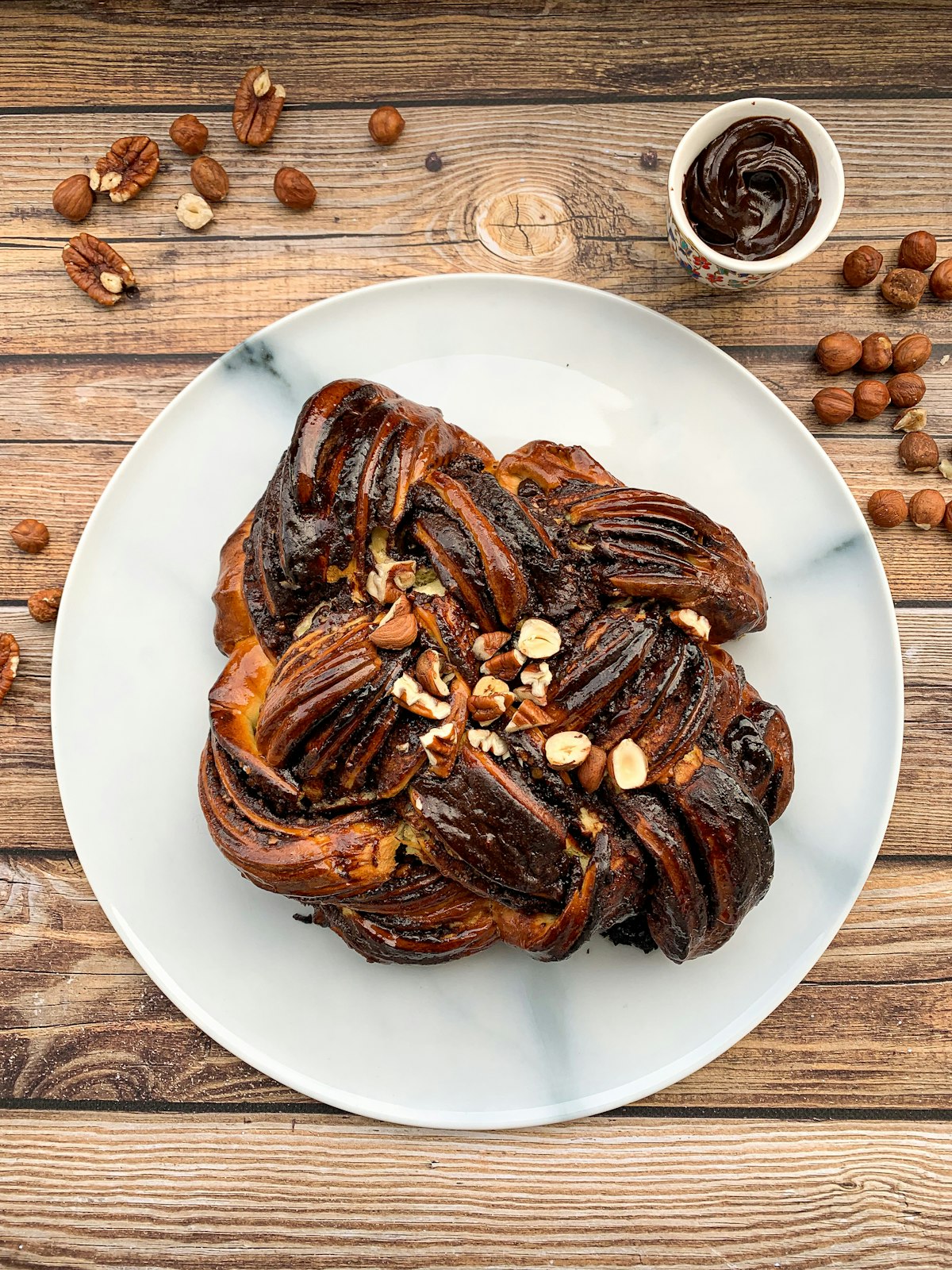
Spread a thin layer of chocolate-hazelnut spread (ensure it is kosher-certified and matches your dairy/pareve choice) over the fat-brushed dough before folding and rolling. The chocolate melts and caramelizes overnight into rich, fudgy pockets. A modern Israeli twist that has become enormously popular.
Cheese Jachnun (Dairy)
Sprinkle grated hard cheese (such as kashkaval or aged gouda) over the fat-brushed dough before folding. The cheese melts into the layers overnight, creating a savory, deeply flavorful version. Serve with tomato only — skip the meat-based accompaniments. Dairy only.
Everything Jachnun
Sprinkle the fat-brushed dough with sesame seeds, nigella seeds, and a pinch of za’atar before folding. The seeds toast during the overnight bake, adding texture and an herbaceous dimension.
Frequently Asked Questions
What is jachnun?
Jachnun is a traditional Yemenite Jewish pastry made from simple unleavened dough (flour, water, sugar, salt) that is rolled paper-thin, brushed with fat, folded into layers, shaped into compact rolls, and baked overnight at very low temperature in a sealed pot. The long, slow bake triggers a deep Maillard reaction that transforms the pale dough into a dark, caramelized, flaky pastry with a toffee-like sweetness — all without any added sweetener beyond a tablespoon of sugar. Jachnun is one of the three iconic Yemenite Shabbat morning breads, alongside kubaneh and malawach.
What is the difference between jachnun and kubaneh?
Both are Yemenite Jewish Shabbat breads baked overnight, but they are fundamentally different. Kubaneh is a yeasted dough — layered with fat, coiled, and baked in a pot overnight. It emerges golden, soft, and pull-apart, with a light, airy crumb similar to brioche. Jachnun is an unleavened dough — rolled paper-thin, laminated with fat, folded, and baked overnight. It emerges dark, dense, and deeply caramelized, with flaky pastry layers more reminiscent of puff pastry than bread. Kubaneh is gentle and pillowy; jachnun is bold and complex. Serve both on the same Shabbat morning for the full Yemenite experience.
Can I make jachnun without overnight baking?
You can bake jachnun at 170°C (340°F) for 45–60 minutes for a same-day version. The result will be a golden, flaky pastry — delicious in its own right, but fundamentally different from the traditional overnight version. The deep caramelization, the toffee-like sweetness, and the distinctive dark color all come from the long, slow bake. For the full jachnun experience, there is no shortcut: plan ahead and trust the night.
Is jachnun the same as malawach?
No. Both are Yemenite Jewish and both are laminated (layered with fat), but they differ in preparation and texture. Jachnun is rolled into compact cylinders and baked overnight in a sealed pot, emerging dark and caramelized. Malawach is shaped into flat, round discs (similar to paratha or roti canai) and pan-fried in a skillet before Shabbat, then reheated. Malawach is crispy and flaky like a flatbread; jachnun is dense and caramelized like a pastry. They are complementary, not interchangeable.
Why is jachnun sweet if there is almost no sugar?
The sweetness in jachnun comes from the Maillard reaction — the same chemical process that makes toast taste sweeter than raw bread, or caramelized onions sweeter than raw ones. When proteins and natural sugars in the flour are exposed to low, sustained heat for many hours, they undergo a cascade of complex reactions that produce hundreds of new flavor compounds, many of which taste sweet, nutty, and toffee-like. The small amount of sugar in the dough (just 15 g) provides a starter for this reaction, but the real sweetness is built entirely by time and heat.
Complete Your Yemenite Shabbat Morning
Jachnun and kubaneh side by side on a Saturday morning — with grated tomato, s’chug, and overnight eggs. Set it up Friday, wake to the aroma on Shabbat. This is how it has been done for centuries.
Save This Recipe
Bake Our Kubaneh Too →
Have questions? Tag us @kosherbreadpro on Instagram or leave a comment below. We answer every one.