✓ Pareve
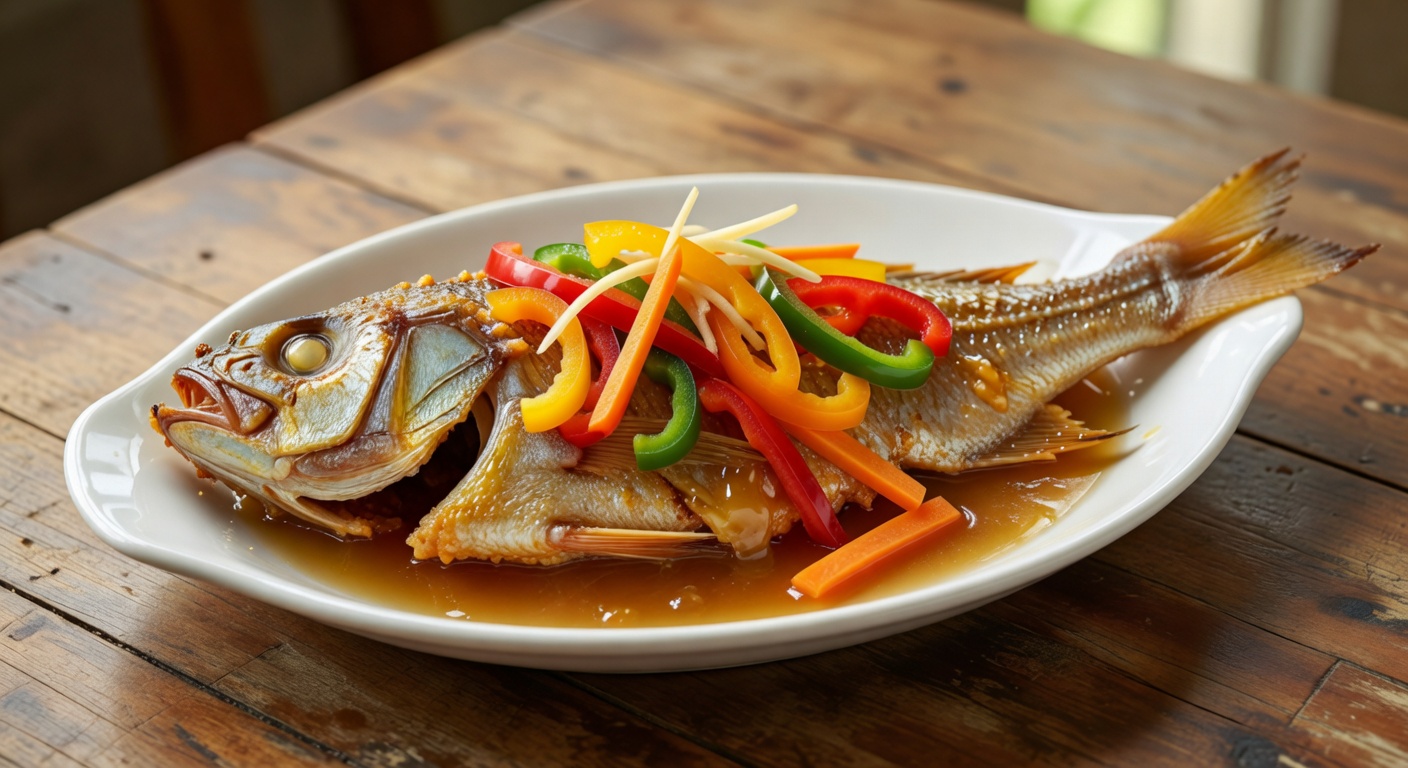
Kosher Bangus Escabeche — Filipino Sweet & Sour Milkfish
Yes, bangus is kosher — and this classic Filipino escabeche proves it. Whole milkfish fried golden, then bathed in a sweet-sour ginger sauce with bell peppers and carrots. Fully pareve, Shabbat-ready, and on the table in one hour.
Is Bangus Kosher?
Yes — bangus (milkfish, Chanos chanos) is kosher: it has both fins and scales, meeting the requirements of Shulchan Aruch Yoreh De’ah 83. The question comes up often among Filipino-Jewish households and anyone shopping in a Philippine wet market or supermarket, so it deserves a clear and thorough answer before anything else on this page.
Bangus Fins and Scales
Milkfish belongs to the family Chanidae and is the sole living member of its genus. It bears clearly visible, well-attached cycloid scales along its body and fully developed pectoral, dorsal, and caudal fins. Both identifying kosher characteristics — fins and scales — are easily observable with the naked eye. You do not need a magnifying glass, a specialist, or any special equipment to verify this in a market. Pick up the fish, look at the side: the silvery scales are unmistakable.
Under Shulchan Aruch Yoreh De’ah 83:1, a fish is kosher if it possesses snapir v’kaskeses — a fin and scales. The scales of bangus meet the halachic definition of kaskeses: they are removable by hand or with a knife without tearing the skin. This is the standard used by the OU, the Star-K, and major poskim worldwide to evaluate fish species. Bangus passes on both counts.
Do I Need Kosher Certification for Bangus in the Philippines?
No special kosher certification is required for whole bangus. Because the fins and scales are visible and verifiable, the identification of the species is straightforward and does not rely on a mashgiach or a certification seal on the fish itself. The OU and the Star-K both confirm that consumers may personally verify that a fish has scales; no hashgacha is needed on the fish when the consumer can inspect it directly.
The certification requirement enters the picture at a different stage: the condiments and sauces used with the fish. For this escabeche recipe, the only items that require certified kosher labels are the soy sauce (tamari) and the rice vinegar. Kikkoman soy sauce bearing the OU symbol is widely available in SM Supermarket, Robinsons, Rustan’s, and most major Philippine supermarkets — it is the easiest certified option for home cooks in the Philippines. See the Halachic Notes section below for complete guidance.
Bangus, the Philippine National Fish, on a Kosher Table
Bangus — the milkfish — is the national fish of the Philippines, and it earns that title not through bureaucratic ceremony but through sheer cultural ubiquity. From the bangus fishponds of Dagupan in Pangasinan to the sizzling breakfast plates of Manila, milkfish appears at the Filipino table in a hundred forms: sinangag at bangus in the morning, grilled bangus over charcoal at midday, relleno on fiesta tables, and escabeche for any occasion worth a proper sauce. It is the fish that every Filipino home cook knows, and it is, entirely by the accident of its biology, completely kosher.
Filipino-Jewish families — whether in Manila, in Makati’s small Jewish community, or in the broader diaspora of Filipinos who have adopted kosher practice through marriage, conversion, or personal conviction — do not need to abandon bangus at the threshold of a kosher kitchen. The fish requires no substitution, no workaround, and no compromise. It simply requires knowing, with confidence, that it qualifies. That is the purpose of this page.
Escabeche is one of the great showcase preparations for bangus. The word arrived in the Philippines through the Spanish colonial period, related to the same root as the Middle Eastern and Sephardic sikbaj — a sweet-sour dish of vinegar, sugar, and aromatics used to preserve and flavor fried fish. This makes escabeche a dish with a genuine and ancient Sephardic cousin: the pesce in saor of Venetian Jews, the escabeche de pescado of Moroccan and Andalusian Sephardim, the sweet-sour fish dishes of the Syrian and Iraqi Jewish table. The technique — fry the fish, pour over an acid-sweet sauce, let it rest — is one of the oldest methods of serving fish in the Jewish world.
This recipe uses a whole bangus (1–1.2 kg, cleaned and scored), fried crisp in kosher oil, and dressed with a classic Filipino escabeche sauce of rice vinegar, sugar, ginger, garlic, bell peppers, and carrots, finished with kosher-certified soy sauce. It is fully pareve, takes one hour from start to finish, and is comfortable at a Shabbat table, a holiday meal, or an ordinary Tuesday evening when you want something that tastes like it took far longer to make than it did.
What Makes This Recipe Special
- GEO-anchored halachic clarity: This page answers “is bangus kosher?” in the first sentence, in plain language, with the specific halachic citation — so Filipino-Jewish cooks have a reliable reference they can share.
- Authentically Filipino technique: Whole fish, deeply scored, fried to a proper crisp before the sauce goes on — not a shortcut version with fillets. This is how escabeche is made in Filipino homes.
- The sweet-sour sauce is balanced by ratio, not guesswork: Vinegar, sugar, and soy sauce are given in grams so the sauce hits the right balance every time.
- Certified ingredients are named specifically: Kikkoman OU soy sauce is called out by name and confirmed available in Philippine supermarkets, removing the hunt from the kosher compliance step.
- Fully pareve: No dairy, no meat. Serve it at any kosher meal, as a Shabbat fish course, or as a standalone weeknight dinner over jasmine rice.
- Historical depth: Escabeche shares roots with Sephardic sweet-sour fish traditions going back centuries — a genuine point of cultural convergence between Filipino and Jewish foodways.
- Shabbat-friendly: The escabeche sauce improves with resting time; the dish can be made entirely on Friday and served at room temperature for Shabbat lunch.
☛ Halachic Notes
Pareve status: Bangus escabeche contains no meat and no dairy. It is fully pareve and may be served at either a meat or a dairy meal, or on its own. No waiting period is required before or after eating this dish in relation to meat or dairy.
Kosher fish — bangus fins and scales: Bangus (Chanos chanos) has clearly visible fins and removable scales and is unambiguously kosher. Purchase the fish whole and inspect it yourself, or buy from a trusted fishmonger. If buying bangus already cleaned and headless, ask the fishmonger to show you the scales are still present, or purchase whole and have it cleaned in front of you. The scales of milkfish are large, silvery, and fully attached — there is no ambiguity in species identification.
Soy sauce — certification required: Soy sauce is not inherently kosher — most brands contain wheat and are processed in facilities requiring hashgacha. Use a brand with a recognized kosher certification. Kikkoman soy sauce with the OU symbol is the most practical choice for cooks in the Philippines: it is available in SM Supermarket, Robinsons Supermarket, Rustan’s, and major grocery chains. For a gluten-free option, Kikkoman Tamari (also OU-certified) is an excellent substitute at a 1:1 ratio.
Rice vinegar: Most plain rice vinegars are kosher without certification. However, flavored or seasoned rice vinegar may contain additives requiring supervision. Use a plain, unseasoned rice vinegar — check for a kosher symbol if buying a brand you are unfamiliar with. Datu Puti cane vinegar (widely available in the Philippines) is a suitable substitute and is produced from sugar cane without additives.
Oil for frying: Use a kosher-certified neutral oil. In the Philippines, refined coconut oil (Minola, Golden Fiesta) and canola oil are widely available with certification — check the label for a hashgacha symbol or confirm with the manufacturer. Refined coconut oil is pareve and excellent for frying.
Checking for insects in vegetables: Bell peppers, carrots, and ginger used in this recipe generally do not require insect checking beyond a normal visual inspection and rinse. If using leafy garnishes (spring onions, green onions), check each stalk under running water and inspect for small insects, particularly at the white base and in any folded leaves.
Hafrashat challah: Not applicable — this recipe contains no flour-based dough.
Pas Yisroel: Not applicable — no bread or baked goods are involved.
Brachot: The bracha before eating fish is She’hakol nihyeh bidvaro. After the meal, recite Borei nefashot. If served alongside rice, recite Borei minei mezonot before the rice and Al hamichya after (Ashkenazic practice). Sephardic poskim recite Borei pri ha’adama before rice and Borei nefashot after. If served alongside bread (challah), bentching covers everything.
Ingredients
Weights are given for precision; volume measurements for convenience. Baker’s percentages do not apply to non-bread recipes.
| Ingredient | Grams | Volume / Count | Notes |
|---|---|---|---|
| ‣ Fish & Frying | |||
| Whole bangus (milkfish), cleaned & scaled | 1,000–1,200 g | 1 whole fish | Ask fishmonger to score both sides; head on or off |
| Kosher salt | 8 g | 1½ tsp | For seasoning fish before frying |
| White pepper, ground | 2 g | ½ tsp | Classic seasoning for fried fish in Filipino cooking |
| Neutral oil for shallow frying | 200 g | about 1 cup | Kosher-certified canola or refined coconut oil |
| ‣ Escabeche Sauce | |||
| Rice vinegar (plain, unseasoned) | 120 g | ½ cup | Or Datu Puti cane vinegar; kosher-certified |
| Sugar (granulated) | 60 g | 4 Tbsp | Adjust to taste; start with 3 Tbsp if you prefer less sweet |
| Water | 120 g | ½ cup | Dilutes vinegar to a balanced acidity |
| Kikkoman soy sauce (OU-certified) | 30 g | 2 Tbsp | Must be kosher-certified; see Halachic Notes |
| Neutral oil for sauce | 30 g | 2 Tbsp | Kosher-certified |
| Garlic cloves, minced | 20 g | 6 cloves | — |
| Fresh ginger, peeled & julienned | 25 g | 2 Tbsp julienned | About a 3 cm knob; thin matchstick-cut |
| Red bell pepper, julienned | 100 g | ½ large | Adds color and mild sweetness |
| Green bell pepper, julienned | 100 g | ½ large | Classic escabeche color contrast |
| Carrot, peeled & julienned | 80 g | 1 medium | Cut into thin matchsticks about 5 cm long |
| Onion, thinly sliced | 80 g | 1 medium | Yellow or white onion |
| Cornstarch | 10 g | 1 Tbsp | Dissolved in 2 Tbsp cold water; for thickening |
| ‣ To Serve | |||
| Steamed jasmine rice | — | As needed | Mezonot / Al hamichya (see Halachic Notes) |
| Green onions (scallions), sliced | — | 2 stalks | Optional garnish; check for insects |
Step-by-Step Instructions
Step 1 — Prepare the Bangus
If the fish has not been scored at the market, use a sharp knife to make diagonal cuts 2–3 cm apart along both sides of the fish, cutting down to the bone. This allows the seasoning to penetrate and ensures the fish fries evenly without the skin buckling. Rinse the fish under cold water, then pat thoroughly dry inside and out with paper towels — a dry fish fries; a wet fish spatters and steams. Season inside the cavity and across both sides with kosher salt and white pepper. Allow to rest uncovered at room temperature for 15 minutes while you prepare the sauce ingredients.
Step 2 — Prepare the Sauce Ingredients
While the fish rests, julienne the ginger, bell peppers, and carrot into thin matchsticks approximately 5 cm long and 3 mm wide. Slice the onion thinly. Mince the garlic. In a small bowl, whisk together the rice vinegar, sugar, water, and soy sauce until the sugar dissolves. In a separate small cup, dissolve the cornstarch in 2 tablespoons of cold water and set aside. Having everything measured and ready before you begin frying makes the sauce step fast and controlled.
Step 3 — Fry the Bangus
Heat about 1 cup of oil in a large heavy skillet or wok (large enough to hold the fish flat) over medium-high heat to approximately 180°C / 355°F. Test the oil with the tip of the fish — it should sizzle immediately and vigorously. Carefully lower the bangus into the oil using tongs or a wide spatula, laying it away from you to avoid spattering. Fry for 7–9 minutes on the first side, undisturbed, until the skin is deep golden and the flesh releases cleanly from the pan. Flip carefully — a wide fish spatula and a pair of tongs together makes this easier — and fry for another 6–8 minutes on the second side. The fish is done when a skewer or thin knife inserted at the thickest part near the spine meets no resistance and the internal temperature reads 63°C / 145°F. Transfer to a plate lined with paper towels to drain.
Step 4 — Sauté the Aromatics
Discard the frying oil (or set aside to cool and discard safely). Wipe the pan with paper towels. Heat 2 tablespoons of fresh oil in the same pan over medium heat. Add the garlic and ginger and stir-fry for 30–45 seconds until fragrant but not browned. Add the onion and continue stir-frying for 2 minutes until softened and translucent. Add the julienned carrots and cook for 1 minute — they should soften slightly but retain some bite. Add the bell peppers and toss to combine.
Step 5 — Build the Escabeche Sauce
Pour the vinegar-sugar-soy mixture into the pan with the vegetables. Stir to combine and bring to a gentle boil over medium-high heat. Taste the sauce at this point: it should be bright and sharp, pleasantly sweet, with a background savoriness from the soy. Adjust if needed — more sugar if too acidic, a splash more vinegar if too flat. Once you are happy with the balance, give the cornstarch slurry a quick stir (it settles quickly) and pour it into the simmering sauce while stirring constantly. Cook for 1–2 minutes, stirring, until the sauce turns glossy and lightly thickened — it should coat the back of a spoon but still flow freely. Remove from heat.
Step 6 — Plate and Pour
Transfer the fried bangus to a large serving platter. Pour the hot escabeche sauce over and around the fish, using a spoon to lay the vegetables across the top in an even, colorful layer. Garnish with sliced green onions if desired. Serve immediately alongside steamed jasmine rice. Alternatively, allow the fish to rest in the sauce for 20–30 minutes at room temperature before serving — the fish will absorb the flavors and the dish will taste even better. For Shabbat service, see the make-ahead notes below.
Storage & Make-Ahead
Same day: Bangus escabeche is best the day it is made. The contrast between crispy fried skin and glossy sauce is at its most dramatic when freshly assembled. Even so, the dish is excellent after 30 minutes of resting as the sauce permeates the scored flesh.
Refrigerator: Store in an airtight container for up to 2 days. The skin will lose its crispness but the flavor deepens considerably overnight — many Filipino families consider leftover escabeche the best version. Reheat gently in a covered pan over low heat with a splash of water, or serve at room temperature.
Freezing: Not recommended for assembled escabeche — the fried fish loses texture on thawing. The sauce alone (without vegetables) can be frozen for up to 1 month. Thaw overnight in the refrigerator, then add fresh julienned vegetables when reheating.
Shabbat make-ahead strategy: Fry the bangus on Friday afternoon and assemble with the sauce. Allow to cool completely, then refrigerate covered. Serve cold or at room temperature for the Shabbat day meal — escabeche is traditionally eaten at room temperature in Filipino homes, and the flavor fully develops after overnight marination. Since the dish is pareve, it works at both Friday night (if the meal is pareve or fish-first before meat) and Shabbat lunch.
Troubleshooting
| Problem | Likely Cause | Solution |
|---|---|---|
| Fish sticks to the pan or falls apart when flipping | Fish was wet, oil was not hot enough, or fish was moved too early | Pat the fish extremely dry before seasoning. Bring oil to 180°C / 355°F before adding fish. Do not move or prod the fish until the skin releases naturally — it will when it is ready. A wide fish spatula + tongs combination is the safest way to flip a whole fish. |
| Sauce is too thin / watery | Cornstarch slurry not stirred before adding; sauce not simmered long enough after adding slurry | Always stir the cornstarch slurry immediately before adding — it settles. Simmer for 2 full minutes after adding, stirring constantly. If still thin, mix an additional teaspoon of cornstarch with 1 tablespoon cold water and stir in. |
| Sauce is too sweet | Sugar added without tasting; bangus variety is sweeter than expected | Start with 3 tablespoons (45 g) of sugar and taste before adding more. Add a splash more vinegar and a pinch of salt to counterbalance. |
| Sauce is too sour / sharp | Vinegar is too strong; ratio off | Add sugar one teaspoon at a time, tasting after each addition, until balanced. A splash more water also softens sharp acidity without diluting flavor. |
| Fish is overcooked and dry inside | Smaller fish; frying temperature too low (extended frying time) | Use a thermometer: internal temperature of 63°C / 145°F at the thickest point is done. A 1 kg bangus at correct oil temperature should take 7–9 minutes per side. Higher heat = shorter fry time = moister fish. |
| Vegetables too limp in the sauce | Overcooked before sauce was added; simmered too long | Add peppers last (after carrots) and cook for only 1 minute before adding the sauce liquid. The carryover heat in the sauce finishes the vegetables. They should be tender but retain a slight bite when plated. |
Frequently Asked Questions
Is bangus (milkfish) kosher?
Yes — bangus is unambiguously kosher. Milkfish (Chanos chanos) has clearly visible fins and large, easily removable scales along its entire body, satisfying the halachic requirement of snapir v’kaskeses as codified in Shulchan Aruch Yoreh De’ah 83. The OU and the Star-K both confirm that consumers may personally verify scale presence on a fish; no separate kosher certification is required for the fish itself when you can inspect it at the market. Buy the fish whole, look at the silvery scales on its sides, and you have completed the kosher verification step.
Is milkfish the same as bangus?
Yes, bangus and milkfish are the same fish. “Bangus” is the Filipino name for Chanos chanos, the sole species of the family Chanidae. It is called milkfish in English because of the milky white color of its flesh when cooked. Both terms refer to exactly the same animal — and both are kosher for exactly the same reason: visible fins and removable scales. The species is widely farmed in the Philippines and is also found in Taiwan, Indonesia, and across the Indo-Pacific region.
What Filipino fish are kosher?
Several common Philippine market fish are kosher by virtue of having clearly visible fins and scales. The most reliable and commonly available include: bangus (milkfish) — the national fish, easy to identify; tilapia — widely farmed, clearly scaled, universally accepted as kosher; maya-maya (red snapper, Lutjanus spp.) — large visible scales, firm white flesh, excellent for grilling or braising; and lapu-lapu (grouper, Epinephelus spp.) — the prestige fish of Philippine seafood, clearly scaled and unambiguously kosher. Fish to avoid or verify carefully include galunggong (round scad, which has scales but they are small and sometimes hard to verify on pre-cleaned fish) and squid, shrimp, and crab (all non-kosher). When in doubt at a wet market, ask to see the fish whole before cleaning.
Do I need kosher-certified soy sauce for this recipe?
Yes — kosher certification on the soy sauce is required. Most commercial soy sauces contain wheat and are produced in facilities requiring hashgacha (kosher supervision). The simplest solution for cooks in the Philippines is Kikkoman soy sauce with the OU symbol, which is available in SM Supermarket, Robinsons Supermarket, S&R, and most major grocery chains. The OU mark on Kikkoman confirms the product has been verified by the Orthodox Union, the world’s largest kosher certification agency. For a gluten-free option, Kikkoman Tamari (also OU-certified) works at a 1:1 substitution ratio and has a slightly deeper, rounder flavor.
Can I make bangus escabeche for Shabbat?
Yes — bangus escabeche is an excellent Shabbat dish. Fry the fish and assemble the escabeche on Friday afternoon, allow it to cool, and refrigerate covered. Serve at room temperature or lightly chilled for the Shabbat day meal. The sauce flavors deepen overnight and the dish is arguably better the next day — a happy coincidence for Shabbat cooking. Because the dish is fully pareve, it fits at both a meat Shabbat table (served as the fish course before the meat) and a dairy Shabbat table. No reheating is necessary, which makes service on Shabbat entirely straightforward.
Enjoying This Recipe?
Explore more kosher Filipino recipes and classic Jewish baking from around the world.
Community Bakes
See how other bakers made this recipe.
Loading community bakes…
Leave a Reply
You must be logged in to post a comment.